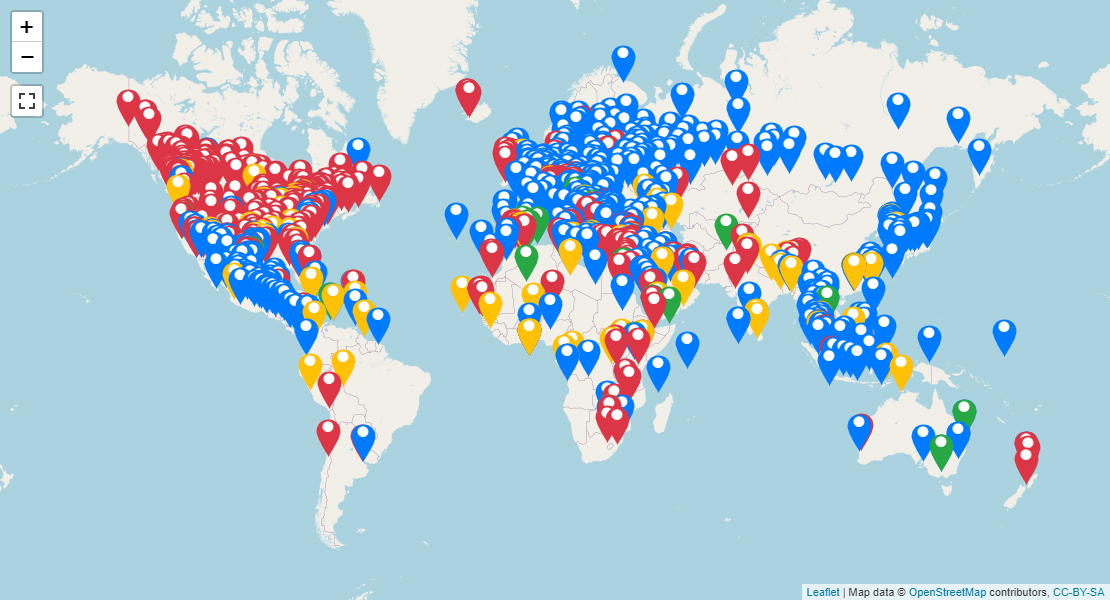
Name: The list provides one or more names for each detention site. Finding the official name of a detention site is often problematic. Different sources translate names differently; officials sometimes use multiple names for the same facility; and nonspecific language is often employed to describe sites. Names given between brackets [ ] are generic titles used by the Global Detention Project when no other name has been provided in the sources of information at our disposal.
Status (Year): "Status" indicates whether the detention site is in operation ("In use") or not ("Closed"); "Year" refers to the last confirmed date of this status. "Year" does not necessarily refer to the year when the site was opened or closed. When the site in question is a "Prison" or an "Ad hoc" site (see "Facility type" below), "Status (Year)" generally refers to the last known reported use of a facility to hold people for migration-related reasons and not to whether the facility was in use for other purposes, like holding criminal detainees.
Location: Provides information about the approximate location of a facility, typically the name of a city with some additional information, like the name of the state or province where the city is located.
Facility type: Types of detention facilities vary greatly from one country to the next, as do the official designations used to describe sites and the particular nature of the sites themselves. In general, however, sites can be divided into two broad categories: "ad hoc" and "official." Within these two categories, there are a wide range of different types. The Global Detention Project uses the following designations:
| AD HOC | |
| - | One of the most prevalent forms of detention for migrants, particularly in developing countries, are ad hoc sites. These can include locked and/or guarded rooms or cells in hospitals, hotels, police stations, or government offices, as well as prisons or camps. These are deemed “Ad hoc” when at least one of the following apply: 1) when detainees at the site are not there under the authorization of the appropriate government agency; 2) when the site is not an officially designated detention site. Ad hoc sites can also include facilities which, although in use for long periods of time to hold non-citizens, are clearly described by authorities as ad hoc in nature, until a replacement facility is made available. |
| OFFICIAL | |
| - | Migrant detention center: An oft-used designation for official detention sites (second only to "Prison"), "Migrant detention center" is a generic category used by the Global Detention Project to designate permanent facilities -- often free-standing structures -- that are used exclusively for confining non-citizens who have been detained because of their status. A "Migrant detention center" will not have any of the attributes associated with other types of detention sites listed below (for example, it will not be a "Prison," it will not located in a "Transit zone," nor will it be used exclusively for housing migrants awaiting removal from the country, which the Project terms a "Deportation center"). |
| - | Deportation center: Detention sites used exclusively for housing migrants -- including rejected asylum seekers and irregular immigrants -- awaiting imminent removal. |
| - | Detention camp: Refers to exposed, fenced in areas typically used to confine people who form part of large refugee or migration flows. Camps are often located near borders of unstable and/or underdeveloped regions. Armed guards are typically present to prevent unauthorized entrance or exit. |
| - | Immigration office: Detention sites located inside regional or local offices of a country's immigration authority or border patrol. Although they sometimes carry discrete names or designations -- for example, "Detention Houses" in Japan -- these sites share in common that they form part of an office or bureau of an immigration agency. The sites typically encompass a delimited space, usually in the form of a few cells or locked rooms located within an immigration or border patrol building, and are often used for short-term confinement, until detainees are expelled, released, or transferred to long-term detention centers or other holding facilities (including prisons). Similar facilities located in immigration offices inside airports or other "international zones" are termed "Transit zones" (see definition below). |
| - | Offshore detention center: Refers to detention sites that a country locates outside its national borders or on territory it has "excised" for immigration purposes. Similar to "Transit zone" detention sites, offshore detention centers have sometimes been used to prevent migrants from making asylum claims as well as from enjoying other legal guarantees. Although offshore sites are located outside the country in question, detainees held at such sites remain in the custody of authorities of that country. Australia's "Pacific Solution," which came to an end in 2008, was a notorious example of this type of detention. |
| - | Prison or Police Station: Many countries use jails, prisons, and/or police lock-ups as short- or long-term detention sites for administrative detainees held on migration-related charges. This designation can also refer to juvenile detention centers. Administrative detainees confined in prisons are often held alongside criminal detainees. In some cases, prison facilities are categorized "Ad hoc." This is done when the facility has not been officially designated for this purpose but has been used to confine migrants. |
| - | Registration center: A facility used specifically for housing asylum seekers until an initial assessment can be made on their cases. These can be secure, semi-secure, or non-secure sites, or sites with a mixed regime, where some people are deprived of their liberty while others are free to come and go. Although there can be exceptions, "Non-secure" facilities are generally not considered detention sites and thus are not included in this list. (For more on distinctions in site "security," see "Security" below.) |
| - | Transit zone: Denotes detention facilities that are located in "international zones" near or inside airports or other ports of entry where people who have been denied immediate entry into a country are confined. These facilities are often comprised of several rooms, offices, and/or cells within an airport. They can also be larger facilities, including free-standing buildings, that are located within a designated international zone. Detention at these sites is often short-term -- until the detainee is released, deported, or transferred to a migrant detention center or other long-term holding facility (including prisons). Persons detained in transit zones are considered by many governments to have not officially entered national territory; they have been used by some states to prevent asylum seekers from being able to claim asylum on their territory. (See also "Offshore detention center.") |
| - | Other: Refers to a broad range of sites that are not typically considered secure detention facilities, including shelters, halfway houses, foster homes, and juvenile housing. Although frequently characterized by their non-secure or semi-secure environment (see “Security” below), these sites are included in the Global Detention Project’s list of detention sites only when a government agency has ordered non-citizens to remain in these facilities, thereby limiting their right to liberty and their freedom of movement. Generally, however, “non-secure” facilities are not considered detention sites and thus are not included in the sites list. Some countries use these types of facilities to house rejected asylum seekers who are not considered a flight risk, migrant families, and/or unaccompanied minors. Important to note, entries for detention sites coded as “foster homes” often do not refer to the exact location of foster care residences, but to the head office of the organization that oversees the placement of unaccompanied minors in foster homes. |
Security: Refers to a combination of factors, including the physical attributes of a detention site (locked cells, armed guards, etc.), its level of surveillance, and/or the degree of liberty allowed detainees. The Global Detention Project uses the following designations to indicate a site's "security": "Secure," "Semi-Secure," "Non-Secure," and "Mixed Regime." Assessing a site's "security" is not scientific and is often based on limited information or unclear descriptions of detention facilities.
| - | Secure: Complete deprivation of liberty. |
| - | Semi-secure: Detainees have limited freedom of movement -- for example, they may be allowed to leave during the day to work or undertake other activities, but must return to the facility by a certain hour. Shelters and residences for juveniles and/or unaccompanied minors, which typically deprive minors of their liberty though in non-prison-like settings, are generally coded “semi-secure” (in contrast, juvenile detention facilities used to confine delinquents as well as unaccompanied minors are generally coded as “secure” prisons). |
| - | Non-secure: Migrants assigned to a "Non-secure" site are allowed, under certain circumstances, to live off premises or can come and go as they wish. Non-Secure sites can include shelters and half-way homes. These sites can be included in the Global Detention Project's list of detention sites in certain cases, for instance when a government agency has ordered a non-citizen to be at a minimum registered at the facility, there is a degree of surveillance over the migrant's activities, and failure to comply with the order to stay in the facility incurs significant penalties (like deportation or loss of status). |
| - | Mixed regime: These are facilities that have both secure and non- or semi-secure sections. |
Authority: Indicates the official body that has ultimate custody over the non-citizens detained at a given site. Thus, for instance, although the U.S. Federal Bureau of Prisons oversees all federal prisons in the United States, immigration detainees confined in those prisons fall under the authority of U.S. Immigration and Customs Enforcement, a branch of the U.S. Department of Homeland Security.
Management: Indicates whether the facility operator is a government agency, private contractor, or international body (for example, the International Organization for Migration). When available, the name of the entity that operates the site is provided.
Capacity: Indicates the number of detainees a given site can hold, as reported by an official agency or credible outside organization or media outlet. The year of the most recent source of information used to verify this information is provided in parenthesis.
Reported population: Indicates the number of detainees a site held on a particular day as reported by a credible source, whether official or non-official. An exact or approximate date is provided in parentheses.
Segregation: This category provides information about whether children and adults ("Age segregation"), women and men ("Gender segregation"), and criminal and administrative detainees ("Legal segregation") are given separate areas of a facility or share the same space. It also denotes when a facility provides space for "Family units." Positive or negative designations are provided only when they are applicable to the site in question. Thus, for instance, it is not necessary to denote "Legal segregation" in a migrant detention facility, which by definition does not hold criminal detainees. If a facility holds only one gender or one age group, that fact is also noted in this category if it is not already clear from the name of the facility and/or its "Facility type" designation. The year of the most recent source of information used to verify this information is provided in parenthesis.
© Global Detention Project