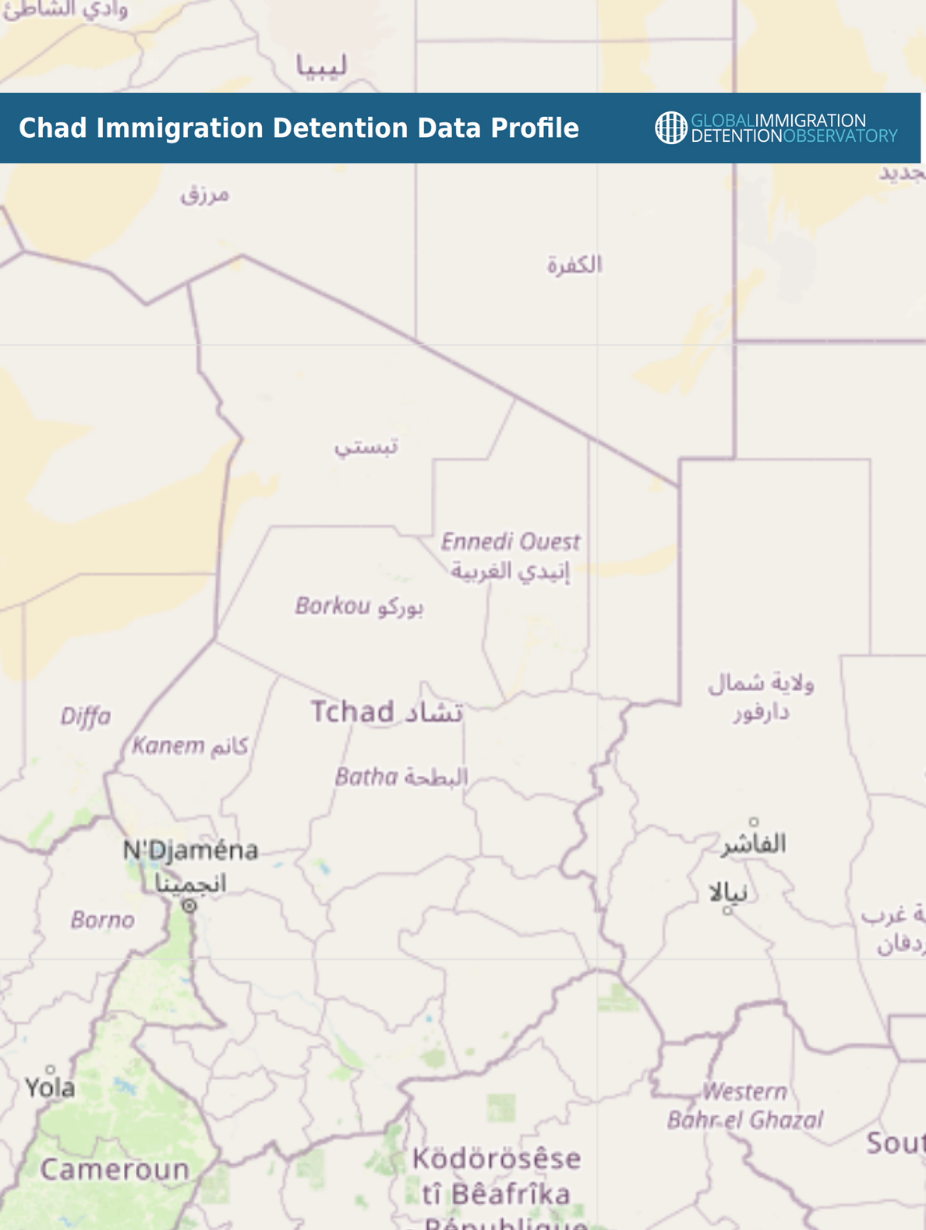
Chad’s geographic location–as Libya’s southern neighbour and located at a crossroads between east and west Africa–has resulted in a “a complex humanitarian crisis,” according to IOM, and one which is further impacted by the country’s severe economic problems. As of mid-2020, there were an estimated 133,000 internally displaced persons and 475,000 refugees and asylum seekers. […]

Last updated:
DETENTION CAPACITY
ALTERNATIVES TO DETENTION
ADDITIONAL ENFORCEMENT DATA
PRISON DATA
POPULATION DATA
LEGAL & REGULATORY FRAMEWORK
Does the Country Have Specific Laws that Provide for Migration-Related Detention?
GROUNDS FOR DETENTION
LENGTH OF DETENTION
DETENTION INSTITUTIONS
PROCEDURAL STANDARDS & SAFEGUARDS
COSTS & OUTSOURCING
COVID-19 DATA
TRANSPARENCY
MONITORING
NATIONAL HUMAN RIGHTS MONITORING BODIES
NATIONAL PREVENTIVE MECHANISMS (OPTIONAL PROTOCOL TO UN CONVENTION AGAINST TORTURE)
NON-GOVERNMENTAL ORGANISATIONS (NGOS)
GOVERNMENTAL MONITORING BODIES
INTERNATIONAL DETENTION MONITORING
INTERNATIONAL TREATIES & TREATY BODIES
International Treaties Ratified
Ratification Year
Observation Date
CAT, Convention against Torture and Other Cruel, Inhuman or Degrading Treatment or Punishment
1995
2017
CTOCTP, Protocol to Prevent, Suppress and Punish Trafficking in Persons, Especially Women and Children
2009
2017
Ratio of relevant international treaties ratified
Ratio: 10/19
Relevant Recommendations or Observations Issued by Treaty Bodies
Treaty Body
Committee against Torture
Recommendation Year
2009
Recommendation Excerpt
§34 [...]
(e) Authorize the verification by United Nations led teams of the presence of children inmilitary camps, training centres and detention centres, as agreed by the State party inMay 2008 during the visit of the Special Representative of the Secretary-General for Children and Armed Conflict;
(f) Ensure that refugee camps and sites for displaced persons are of a civilian and humanitarian nature and increase the security and protection of civilian populations both within and around them, given that such measures help in preventing the recruitment of children and in protecting them
(e) Authorize the verification by United Nations led teams of the presence of children inmilitary camps, training centres and detention centres, as agreed by the State party inMay 2008 during the visit of the Special Representative of the Secretary-General for Children and Armed Conflict;
(f) Ensure that refugee camps and sites for displaced persons are of a civilian and humanitarian nature and increase the security and protection of civilian populations both within and around them, given that such measures help in preventing the recruitment of children and in protecting them
Sources
Committee against Torture, "Consideration of reports submitted by states parties under article 19 of the convention: Concluding observations of the Committee against Torture: Chad," CAT/C/TCD/CO/1, 30 April 2009, https://uhri.ohchr.org/en/document/9134fcfb-bfb9-497b-b633-969cfd097784
> UN Special Procedures
> UN Universal Periodic Review
Relevant Recommendations or Observations from the UN Universal Periodic Review
Recommendation Issued
Yes
Year Issued
2024
UPR Cycle
4th
Recommendation Excerpt
124.85 Conduct independent investigations into allegations of torture and extrajudicial killings by the security forces and law enforcement officers, particularly in detention facilities and camps for refugees and internally displaced persons (Ireland); ......
Sources
Human Rights Council, "Report of the Working Group on the Universal Periodic Review* Chad", 12 July 2024, United Nations General Assembly, (Paragraph..), https://uhri.ohchr.org/en/document/1add8283-ca49-4ee1-a2b1-f60008916227
Recommendation Issued
No
Year Issued
2014
Sources
Report of the Working Group on the Universal Periodic Review* Chad, A/HRC/25/14, 3 January 2014, https://www.upr-info.org/sites/default/files/document/chad/session_17_-_october_2013/a_hrc_25_14_chad_e.pdf
Recommendation Issued
No
Year Issued
2009
Sources
UNIVERSAL PERIODIC REVIEW Report of the Working Group on the Universal Periodic Review Chad, https://www.upr-info.org/sites/default/files/document/chad/session_5_-_may_2009/ahrc125chade.pdf
HEALTH CARE PROVISION
HEALTH IMPACTS
COVID-19
Country Updates
Chad’s geographic location--as Libya’s southern neighbour and located at a crossroads between east and west Africa--has resulted in a “a complex humanitarian crisis,” according to IOM, and one which is further impacted by the country’s severe economic problems. As of mid-2020, there were an estimated 133,000 internally displaced persons and 475,000 refugees and asylum seekers. Compounding pressures on the country, according to UNHCR, as of July 2020, 108,809 Chadiens had been returned to the country. Despite these challenges, Chad has had a reputation as traditionally having “a positive and welcoming attitude towards refugees.” It has also been a supporter of the Global Compact for Migration.
To date, the GDP has been unable to establish the extent to which detention measures are used in Chad as part of immigration enforcement policies. Likewise, the GDP has found no details about whether any Covid-19-related measures have been taken in the country to safeguard people who are in custody for immigraiton reasons, including as part of deportation proceedings. UNHCR reported in July 2020 that no one of concern to their mandate, including refugees and returned Chadiens, had reported an infection. However, 47 persons of concerns had been placed in quarantine.
On 24 March, visits to prisons were suspended and all public hearings of courts of justice were postponed. Between March and April, three collective escapes took place at the prisons of Amsinéné and Bongor following the suspension of visits. The Ministry of Justice announced on 9 April the release of more than 3,200 prisoners, as an “exceptional measure taken to respect the preventive measures instituted by the highest authorities of the country against the coronavirus pandemic.” This measure concerned vulnerable prisoners such as the elderly, minors, sick individuals, and pregnant women.
Government Agencies
Ministry of Foreign Affairs - https://diplomatie.gouv.td/
Ministry of Interior - https://www.africa2trust.com/B2BAfrica/chad/government/government-ministries-departments/minist-re-de-l-int-rieur-interior-chad/Profile/AboutUs/1/42/40126/6
International Organisations
UNHCR Office - https://www.unhcr.org/where-we-work/countries/chad
IOM Office - https://chad.iom.int/
OHCHR Office - https://www.ohchr.org/fr/countries/chad
NGO & Research Institutions
Ombudsman - https://www.wavn.org/chads-ombudsman-seeks-presidential-pardon-for-35-convicted-armed-group-members/
Human Rights Watch - https://www.hrw.org/world-report/2025/country-chapters/chad
Amnesty Interantional - https://www.amnesty.org/en/location/africa/west-and-central-africa/chad/
Sudan Voluntaire Organisation - https://svo-ngo.org/