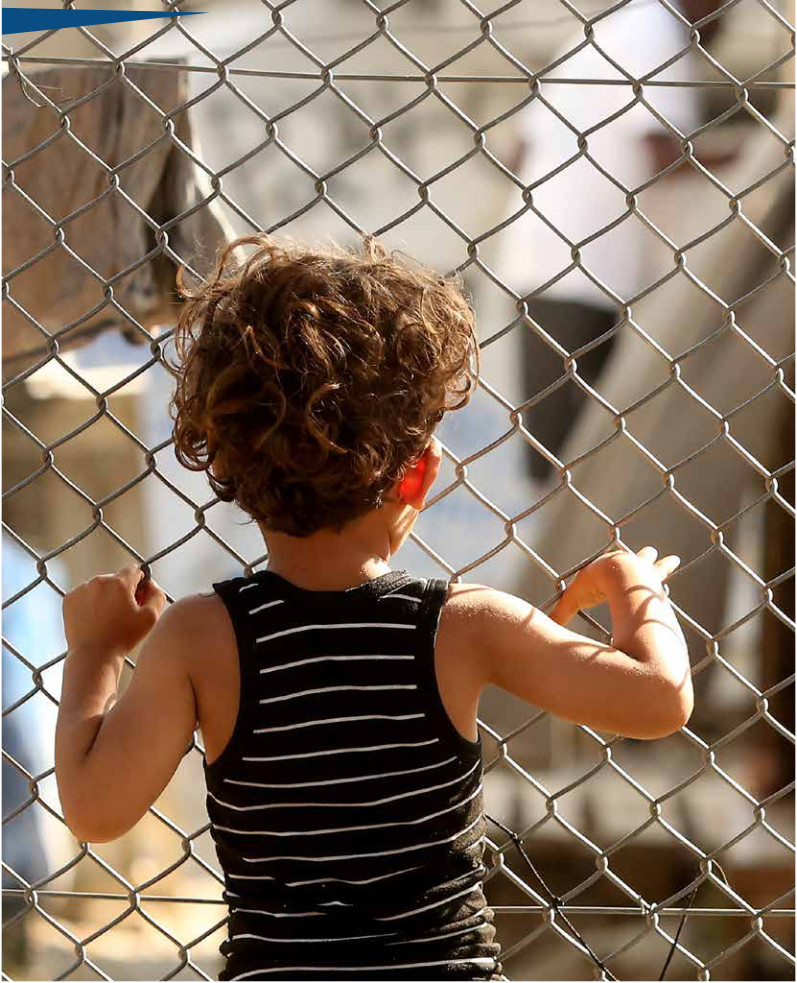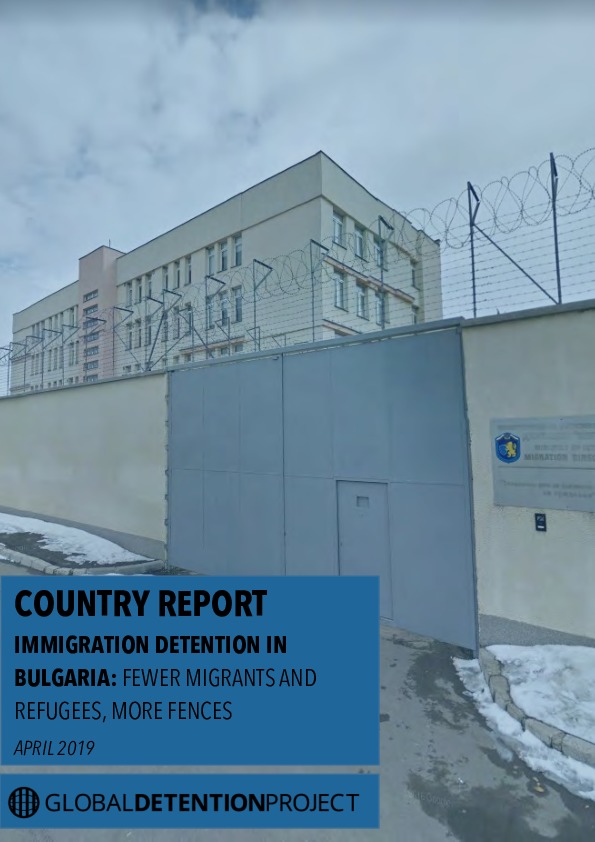
Bulgaria’s extremely long immigration detention of a Saudi law student and human rights activist reveals the degrading conditions in which migrants and asylum seekers are detained in the country. It also reflects a broader trend in Europe and globally: the de facto use of immigration detention for purposes that may have nothing to do with […]
Bulgaria: Covid-19 and Detention
In early November, Bulgarian authorities sent 350 additional military personnel to its border with Turkey because of concerns over increasing migration and refugee pressures. The Bulgarian Interior Ministry reported that during January-September 2021, more than 6,500 people were detained after entering the country irregularly. This was a threefold increase compared to the same period in […]

Bulgaria: Covid-19 and Detention
In a follow-up response to its 5 June GDP Covid-19 survey, the Interior Ministry provided additional information regarding removal procedures during the Covid-19 crisis. According to the ministry, removals were halted as there were practical difficulties in carrying out returns due to measures to protect the health of migrants and escort staff, as well as […]

Bulgaria: Covid-19 and Detention
Responding to the Global Detention Project’s Covid-19 survey, the Bulgarian Ministry of Interior reported that the country has not established a moratorium on new detention orders and that the measure is not being contemplated. The Ministry also explained that no immigration detainees have been released from “special homes for temporary accommodation of foreigners (closed detention […]

Bulgaria: Covid-19 and Detention
Responding to the Global Detention Project’s Covid-19 survey, a non-governmental actor in Bulgaria reported that while the country has not declared a moratorium on new detention orders officials have worked to limit detainee populations in its detention centres. The source, who asked to remain anonymous but whose identity was verified by the GDP, said that […]

Border Police establishments & Immigration detention facilities from report of the European Committee for the Prevention of Torture 2014 visit to Bulgaria)
A. Border Police establishments; (Read full CPT report)7. Under the Law on Aliens in the Republic of Bulgaria (LARB), foreign nationals may be detained by the Border Police, on their own authority, for up to 24 hours. If it is needed to prolong the period of detention beyond the 24 hours, the foreign national must […]

Last updated: April 2019
Bulgaria Immigration Detention Profile
- Key Findings
- Introduction
- Laws, Policies, Practices
- Detention Infrastructure
- Download PDF Version
KEY FINDINGS
· Despite a 91 percent drop in irregular arrivals since 2015, detention remains a key feature in the country’s response to migration flows.
· Conditions in detention are generally substandard and marred by allegations of abuse and poor access to procedural standards.
· Asylum seekers are sometimes held in “pre-removal” detention while their claims are processed.
· Depending on their nationality, asylum seekers can face severe discrimination, which observers argue is intended to serve as a method of deterrence.
· While migration law prohibits the detention of unaccompanied children, it is permitted under asylum law.
1. INTRODUCTION
Bulgaria is often viewed as a transit country into the European Union. While it received an important number of arrivals during the refugee “crisis,” the number of irregular non-citizens apprehended in the country has decreased dramatically, including a 90 percent drop between 2015 and 2017.[1] Despite this decrease, immigration detention has remained a key tool in Bulgaria’s response to migration and asylum flows, in addition to other measures such as the construction of a border fence.
A 2019 report on the treatment of asylum seekers in four frontline European Union (EU) countries, which was produced by several European NGOs—including the Global Detention Project (GDP), the Bulgarian Foundation for Access to Rights (FAR), and the Hungarian Helsinki Society (HHC)—found that “Exceptional measures of a temporary character” like mass detention have become “normalised” in Bulgarian public discourse. The report noted the contradictory rationales used to characterise these measures, which are presented as a “humanitarian” response even as officials describe the actions as protecting the public from national security threats.”[2]
In 2018, Bulgaria was one of several central and eastern EU countries that refused to endorse the Global Compact for Safe, Orderly and Regular Migration (GCM).[3] Although the country held the EU presidency for the first time while the GCM was being drafted, the government argued that the non-binding document, which was signed by more than 150 countries, would weaken its ability to control migration.[4]
Bulgaria, which has the lowest gross domestic product per capita in the European Union, has experienced a steady emigration haemorrhage since 1990.[5] Nevertheless, it has spent some 85 million EUR on a razor-wire fence along its south-eastern border to prevent irregular crossings. Construction began in 2014, at the height of the “refugee crisis” when the country was experiencing an influx of Syrian refugees, and was completed in October 2017. Described as a “temporary fence facility” by the government, it stretches for over 236 km along the country’s border with Turkey.[6]
Many migrants, asylum seekers, and refugees have experienced pushbacks back into Turkey, a practice that numerous NGOs have denounced. According to Save the Children, “the largest number of violent pushbacks (involving children in 2018) was reported at the borders between Bulgaria and Turkey (154).”[7] UNHCR has also raised the issue of pushbacks with Bulgarian authorities.[8]
The massive costs associated with building the border fence have also been a source of controversy. In 2017, the Supreme Cassation Court “ordered the State Agency for National Security and the State Financial Inspection Agency to investigate allegations of corruption amongst senior state officials” in relation to the project.[9]
Bulgarian border control has been bolstered by the deployment of the European Border and Coast Guard (formerly Frontex) along its land borders with Turkey and Serbia. In 2017, this was comprised of “126 officers (including crew members of the deployed assets) supported by 6 thermo-vision vehicles, 38 patrol cars, 1 CO2 detector, 39 smartdeck cameras and 3 mobile offices.”[10]
According to reports, certain nationalities of asylum applicants face discrimination in the treatment of their claims in Bulgaria, which observers say is used as a deterrence measure.[11] This would likely amount to a violation of both domestic and international laws. Often held in detention for more than three months while their applications are assessed, asylum seekers from countries like Pakistan, Ukraine, Algeria, and Turkey have reportedly had their claims systematically rejected, resulting in a zero percent recognition rate for those nationalities. The recognition rate for Afghan asylum seekers was just 1.5 percent in 2017,[12] compared to the 46 percent overall EU average.[13]
2. LAWS, POLICIES, PRACTICES
2.1 Key norms. The Constitution of the Republic of Bulgaria sets out safeguards against arbitrary detention (Article 30). Two laws regulate entry, residence, detention, and removal of migrants and asylum seekers: The 1998 Law on Foreigners in the Republic of Bulgaria[14] (LFRB) (Закон За Чужденците В Република България), as amended as of April 2019,[15] and the Law on Asylum and Refugees[16] (LARB) (Закон за убежището и бежанците), as amended as of April 2019.
Bulgarian law employs euphemistic language in characterising the administrative detention of migrants and asylum seekers, referring to “compulsory accommodation” in “special homes for temporary accommodation of foreigners” (LFRB Article 44(6)). Regulations for the Application of the Law on the Foreigners in the Republic of Bulgaria (2011), which were last amended in June 2018, clarify the implementation of the LFRB.[17]
2.2 Grounds for detention. Article 44(6) of the LFRB includes the following grounds for administrative immigration-related detention: 1) to effect removal; 2) to prevent absconding; 3) when non-citizens obstruct the execution of their removal; and 4) when non-citizens do not fulfil conditions for non-custodial measures. In addition, Article 45(b) of the LARB includes grounds for detention during the asylum process (see: 2.3 Asylum seekers).
In 2016, Bulgaria introduced new provisions concerning establishing or verifying a person’s identity. The provision allows relevant authorities[18] to issue short-term “accommodation” (detention) orders for up to 30 days to establish identity and to assess the subsequent measures that should be taken. This type of detention is to take place in “special units” within the Migration Directorate’s detention centres.[19] The introduction of short-term detention, according to observers, legalised the existing practice of detaining non-citizens at the border in the Elhovo “distribution centre,” which previously had occurred in the absence of specific detention orders.[20]
2.3 Asylum seekers. Article 45b(1-4) of the LARB provides grounds for asylum seekers to be “accommodated in a closed centre” (i.e. placed in detention) temporarily and for the shortest possible period of time. Detention is allowed in order to 1) establish and verify the non-citizen’s identity or nationality; 2) establish the facts and circumstances on which the application for international protection is based where this cannot be done in any other way and there is a risk that the non-citizen may abscond; 3) where it is necessary to protect national security or public order; 4) to establish the state responsible for examining the asylum application and to transfer the foreigner to the competent state and where there is also a risk of absconding. However, according to Article 54b(2), foreigners cannot be placed in detention solely because they have applied for asylum, while Article 45c(2) provides that the decision to detain an asylum seeker should take into consideration whether they belong to a vulnerable group.
Asylum seekers are, however, most commonly placed in immigration detention under LFRB Article 44(13).[21] (See: 2.2 Grounds for detention.)
In 2017, 3,700 persons applied for asylum in Bulgaria,[22] a sharp decrease compared to the 19,336 applications received in 2016 and 11,081 in 2014, the year that work started on the fence at the Bulgarian-Turkish border. Prior to the 2014-2016 surge, applications were substantially lower: 1,387 applications were lodged in 2012 and 893 in 2011.[23] According to the Ministry of Interior, the main countries of origin for asylum seekers in 2017 were Afghanistan, Iraq, Syria, Pakistan, and Iran.[24] During that year, 1,459 persons applying for asylum did so from an immigration detention centre.[25]
The detention of asylum seekers, however, appears to contravene Article 31 of the Convention Relating to the Status of Refugees.[26] In 2017, the UN Committee on the Elimination of Racial Discrimination (CERD) urged Bulgaria to end the practice of mandatory detention for undocumented asylum seekers.[27] During the UN Universal Periodic Review (UPR) of Bulgaria in 2015, Brazil recommended that Bulgaria reform its legislation authorising the detention of asylum seekers on the basis of illegal entry,[28] echoing a 2011 recommendation by the Committee against Torture (CAT).[29] More recently, in November 2018, the Human Rights Committee (CCPR) recommended that Bulgaria “avoid placing asylum seekers in detention except as a last resort and for the shortest period possible, establish a mechanism for the identification of vulnerable applicants, (and) provide effective alternatives to detention.”[30]
In 2018, the European Committee for the Prevention of Torture (CPT) also recalled its position that asylum seekers should only be deprived of liberty as an exceptional measure, and that they should be held separately from foreign nationals who have not lodged an application for international protection.[31] The CPT’s general stance is that asylum seekers should enjoy broader safeguards than “irregular migrants.”[32]
As quoted by the Foundation for Access to Rights (FAR), the Bulgarian Supreme Administrative Court ruled in January 2018 that “the submission of an application for international protection is a statutory fact that puts an end to immigration detention. … The reasoning of the court has been that the return procedure is suspended and therefore removal detention of asylum seekers does not serve a lawful purpose.”[33]
There is a history of discriminatory treatment against certain nationalities of asylum seekers in Bulgaria. In 2017, single young Afghan adults, as well as applicants from Turkey, Algeria, Indonesia, and China, were screened while in detention as a method of deterrence.[34] According to the Bulgarian Helsinki Committee, these nationalities spent an average of 3.8 months in detention—significantly longer than the 19-day average detention period for other immigration detainees in 2017. According to NGO reports, short-term detention to determine identity was mostly applied to Syrians in Lyubimets Detention Centre in the first six months of 2018 and to Iraqis in the Sofia Busmantsi Detention Centre. Advocates have observed that the introduction of short-term detention legalised the existing practice of detaining non-citizens at the border in the Elhovo “distribution centre,” which used to take place without a detention order.[35]
2.4 Children. According to Article 44(9) of the LFRB, accompanied minors can be “forcibly accommodated” (i.e. detained) for up to three months. In its response to the CPT’s 2017 report following its visit to the Lyubimets centre, the Bulgarian government stated: “The placement of migrant minors accompanied by a parent or other adult is regulated by the Law ... as an exceptional option. … Forced accommodation does not apply to minors. … The measure applies if necessary due to the principle of family reunification and the lack of a developed system of resident social services for families of illegally staying migrants.”[36]
In practice, 736 children were detained in 2017, a marked decrease from 2016 (6,068) and 2015 (7,647).[37] Children are particularly at risk as they may share dormitories with unrelated men (see: 3.3 Conditions in detention).
LFRB Article 44(9) provides that “forced accommodation” does not apply to unaccompanied minors. However, Article 45e(2) appears to allow the detention of “minor aliens seeking international protection.” This paradoxical situation is the result of the transposition of the recast Reception Conditions Directive 2013/33/EU that introduced the detention of asylum seekers for the first time in January 2016.[38]
According to the Bulgarian Helsinki Committee, “in practice, both asylum-seeking and other migrant unaccompanied children continue to be detained in pre-removal detention centres. Unaccompanied children arrested by the Border Police upon entry or, if arrested during their attempt to exit Bulgaria irregularly, are assigned (“attached”) to any of the adults present in the group with which the children travelled, which has been a steady practice ongoing for last couple of years.”[39]
According to the Annual Border Monitoring Report under the Tripartite Memorandum of Understanding (MoU) (see: 2.11 Domestic monitoring) there were 198 cases of unaccompanied children being “attached” to unrelated adults by police authorities in 2016, and 141 in 2017.[40] In November 2018, the Human Rights Committee highlighted the practice when it stated “While noting that national law prohibits detention of unaccompanied children, the Committee is concerned that this rule is reportedly circumvented in practice by “attaching” unaccompanied children to unrelated adults or registering such children as adults (art. 9 and 24).”[41] The issue was similarly raised in 2015 during the UPR of Bulgaria by the UN Human Rights Council (HRC), when Sweden and Belgium recommended that children should not be detained with unrelated adults.[42]
The detention of children in general has also been a subject of focus for human rights monitoring bodies. In 2018, the CPT recommended that the detention of minors and their parents “should only occur as a last resort, and if, in exceptional circumstances, such placement cannot be avoided, its duration should be as short as possible.” The CPT found no unaccompanied children in detention in Lyubimets centre during its visit in October 2017. However, it did find 43 accompanied children (including infants) and observed that there were “no adapted food and clothes, no toys, and it was difficult to obtain nappies for infants and sanitary materials for women.” [43] Previously, in 2016, the Committee on the Rights of the Child (CRC) recommended that Bulgaria avoid detaining asylum seekers under 18 as well as families with children,[44] and during the 2015 UPR, Brazil recommended that “detention of asylum seekers, particularly children, be applied only in exceptional circumstances after due diligence.”[45]
In December 2017, the European Court of Human Rights (ECtHR) ruled that Bulgaria had violated Article 3 of the European Convention on Human Rights (ECHR) (prohibition of inhuman or degrading treatment) in its detention of an Iraqi family in a border police-operated short-term detention facility in Vidin.[46] Intercepted at the Bulgarian/Serbian border, three Iraqi minors, accompanied by their parents, were detained for 32 to 41 hours in conditions that the ECtHR stated were the worst that had been presented to the court. The cell that they were held in was dirty, with litter and damp cardboard on the floor, detainees had no option but to urinate on the floor of the cell, and authorities did not give them food or drink for more than 24 hours. Moreover, “the mother had only been given access to the baby bottle and the milk of the youngest applicant, who was one-and-a-half years old, about nineteen hours after they had been taken into custody.”[47] As the ECtHR concluded, “The combination of the above-mentioned factors must have considerably affected the applicants, both physically and psychologically, and must have had particularly nefarious effects on the youngest applicant in view of his very young age.”[48]
2.5 Other vulnerable groups. Article 17 (new - SG 80/2005, in force from 16.10.2015) of the LARB includes a definition of vulnerable persons: Persons from a vulnerable group “shall be minors, unaccompanied minors, persons with disabilities, elderly people, pregnant women, single parents with juveniles, victims of trafficking in human beings, people with severe health problems, people with mental disorders and those who have suffered torture, rape or other serious forms of mental, physical or sexual violence.”
Although the number of persons placed in immigration detention drastically decreased between 2015 and 2017 (due to a 91 percent drop in irregular arrivals to Bulgaria), the proportion of women placed in immigration detention doubled from 10.7 percent in 2015 to 22 percent in 2017.[49]
LFRB Article 14(2), which regulates places of immigration detention, provides that non-citizens of different genders, families, and minors should be accommodated in “separate parts of the bed sector.”[50] Furthermore, LARB Article 45e(4) provides that female asylum seekers should be separated from males, unless they are relatives and the women have given their consent.
In practice, the CPT reported that in October 2017, accommodation at Lyubimets Detention Centre was “particularly dangerous for women and minors (including infants), who had to share the same dormitories with often unrelated adult men (the latter accommodated together with their respective families), locked at night in total darkness (electricity being switched off between 11 p.m. and 7 a.m.).” In July 2018, NGOs also reported detainees' complaints that dormitories in Busmantsi and Lyubimets were locked at night, meaning that they could not go to the toilet.[51]
The CPT thus recommended that women and minors should not share dormitories with unrelated adult male detainees.[52] In its response to the CPT in October 2018, the Government of Bulgaria announced that a new regime would be introduced, and that dormitories housing families and children would no longer be locked at night.[53]
2.6 Length of detention. According to LFRB Articles 44(6) and (8), non-citizens can be “imposed a compulsory administrative measure” (i.e. detained) for up to six months, with monthly reviews of their detention. This initial period can exceptionally be extended for an additional 12 months, and the subsequent 18-month immigration detention limit reflects provisions in the EU Returns Directive.[54] According to the Bulgarian Helsinki Committee, some nationalities spend longer in detention than others: specifically, in 2017 non-citizens from Afghanistan, Turkey, Algeria, Indonesia, and China spent an average of 3.8 months in detention, which was considerably longer than the 19-day average detention period for other nationalities (see section 2.3 Asylum seekers).
In practice, the average detention time in Busmantsi and Lyubimets rose from 25 and 24 days to 59 and 52 days between 2015 and 2017.[55] After their first visit to the Lyubimets centre in 2017, the CPT noted “the average detention period was 2 to 3 months, but the delegation spoke with several foreign nationals (mostly single adult males) who claimed having been at the establishment for much longer periods (more than a year).”[56] In November 2018, the Human Rights Committee recommended that Bulgaria “reduce the length and practice of detaining migrants.”[57]
2.7 Procedural guarantees. According to NGO research, an amendment to the LFRB in 2017 significantly reduced the legal avenues available to non-citizens wishing to challenge the prolongation of detention. LFRB Article 46a provides that detention can be challenged within 14 days after detention, but such an appeal is not suspensive. The court must make a decision within one month and the first instance decision may be appealed before the Supreme Administrative Court which has two months to deliver a decision. The legality of short-term placement in detention under LFRB Article 44(13) may be appealed under the Administrative Appeal Procedure Code.[58] The appeal is not suspensive and the court must rule on the appeal immediately.
In December 2017, the automatic review of detention every six months (and up to the 18 months limit) was repealed.[59] As a result, the only possibility to challenge a 12-month prolongation of detention after the initial six months is through an individual appeal no later than 14 days after the detention order is served.[60]
In November 2018, the Human Rights Committee recommended that Bulgaria “should ensure that any detention is justified as reasonable, necessary and proportionate in the light of the individual’s circumstances, that it is subject to periodic judicial review, and that asylum seekers and migrants have access to qualified legal aid when the interests of justice so require.”[61] In 2017, the Committee on the Elimination of Racial Discrimination (CERD) also recommended that Bulgaria ensure due process and fair trial guarantees for detainees.[62] Meanwhile, in 2011 the CAT recommended that police officers should be instructed to ensure that all detainees are granted access to a lawyer from the outset of their detention, as is legally required.[63]
In 2017 the ECtHR found a violation of Article 5§4 of the ECHR (right to a speedy decision on the lawfulness of detention) in the case of a stateless man of Palestinian origin.[64]
Article 45c(3) of the LFRB provides that detention orders must be issued in writing and must indicate the detention ground and the time limit for appeal, as well as the possibility for receiving free legal assistance. Article 45e guarantees visits by persons providing legal assistance and legal counsel, as well as representatives from NGOs and international organisations.
According to NGOs however, these guidelines tend not be adhered to in practice. Instead, asylum seekers and other persons in detention are “informed orally by the detention staff of the reasons of their detention and the possibility to challenge it in court, but not about the possibility and the methods of applying for legal aid.” Moreover, as a principle, detainees are not informed in a language that they can understand.[65]
2.8 Detaining authorities and institutions. As per LFRB Article 44, “compulsory administrative measures” (i.e. detention) can be imposed by bodies under the Ministry of Interior including the Chairman of the State Agency for National Security, the Migration Directorate, the Directors of the Chief Directorates of the National Police, the border police and police fighting against organised crime, and regional directorates (as well as officials authorised by them).
2.9 Non-custodial measures. Article 44(5)(1-3) of the LFRB provides for non-custodial measures including weekly reporting to a local Ministry of Interior office; release on bail or provision of a guarantor; and deposit of a valid passport or travel documents. According to GDP sources, release on bail is not used in practice, and the deposit of documents and weekly reporting are used infrequently. In July 2018, a regulation was adopted concerning concrete procedures for release measures by means of a money bond of 500 to 5,000 BGN (approximately 255 to 2,555 EUR) or by handing over a travel document (passport).[66] Article 45(a) of the LARB also provides for the non-citizen’s “mandatory appearance” every two weeks during proceedings.
The CERD (2017) and the Human Rights Committee (2018) recommended that Bulgaria develop alternatives to detention, and the CRC has also emphasised the need for “unconditional release.”[67]
2.10 Regulation of detention conditions. Conditions are regulated through Ordinance № Iз-1201 of 1 June 2010 on the Provision of Temporary Accommodation of Foreigners in the Special Houses for the Temporary Accommodation of Foreigners and their Staff and for their Organisation and their Activity (amended, as of 30 June 2017), issued by the Minister of the Interior.[68]
2.11 Domestic monitoring. Article 45e of the LARB guarantees visits by persons providing legal assistance and legal counsel, as well as NGO and IGO representatives. Various Bulgarian NGOs have access to detainees in places of detention, including lawyers from the Bulgarian Helsinki Committee (BHC), the Foundation for Access to Rights (FAR), the Center for Legal Aid - Voice in Bulgaria (CLA), and Bulgarian Lawyers for Human Rights (BLHR).
A Tripartite MoU on Modalities of Mutual Cooperation and Coordination to Support the Access of Persons Seeking Protection to the Territory and the Procedure for Granting Protection was signed on 14 April 2010 by UNHCR, the BHC, and the General Directorate of Border Police (GDBP) with the Ministry of Interior.[69] The MoU “grants access to any national border and/or 24-hour detention facility at the land or air border, including transit halls at international airports, without limitation to the number of monitoring visits.” Access is granted without prior permission or the imposition of specific conditions.
2.12 International monitoring. In recent years, detention policies and practices in Bulgaria have received regular and in-depth scrutiny from regional and international human rights mechanisms and bodies.
Following its visit to Bulgaria in October-November 2017, the CPT issued an extensive list of detailed recommendations in 2018, such as that asylum seekers should only be deprived of liberty as an exceptional measure.[70] (For more of the CPT’s recommendations, see: 2.3 Asylum seekers, 2.4 Children, 2.5 Other vulnerable groups, and 3.3 Conditions in detention.)
The Council of Europe's Commissioner for Human Rights visited Bulgaria in February 2015, and similarly challenged the detention of asylum seekers in urging Bulgaria not to adopt legislation providing for their systematic detention. The Commissioner also called on the country to immediately cease the detention of persons pending registration as asylum seekers, and to use detention for the purpose of removal only as a last resort, for the shortest possible period of time, and on the basis of individual assessment. He also reiterated that migrant children, both accompanied and non-accompanied, should never be detained as detention is not in their best interest.[71]
Following visits in 2016, OHCHR highlighted that “virtually all people entering Bulgaria in an irregular manner are detained as a matter of course.” Responding to the visits, the High Commissioner stated that criminalising migrants for entering and exiting Bulgaria irregularly raised concerns about the country's compliance with international law and warned against recent legislation allowing for the detention of asylum seekers. The monitoring team also found that “conditions in some migrant detention facilities were degrading, with the extremely dilapidated and insanitary Elhovo transit centre in eastern Bulgaria of particular concern.”[72]
In 2017 the CERD adopted a series of recommendations (see: 2.3 Asylum seekers, 2.7 Procedural guarantees, 2.9 Non-custodial measures, 2.12 Criminalisation, and 3.3 Conditions in detention).[73] Similarly, the CRC issued recommendations in 2016 (see: 2.4 Children, and 2.9 Non-custodial measures),[74] as did the Human Rights Committee in 2018 (see: 2.3 Asylum seekers, 2.4 Children, 2.6 Length of detention, 2.7 Procedural guarantees, and 2.9 Non-custodial measures). During the UPR of Bulgaria in 2015, UN members states such as Brazil and Sweden also made a number of recommendations (see: 2.4 Children, 2.3 Asylum seekers, and 3.3 Conditions in detention).[75]
2.13 Criminalisation. Under Article 279(1) and (2) of the Criminal Code of Bulgaria, failure to enter Bulgaria—or cross the Bulgarian border—without a permit is an offence punishable with imprisonment for up to five years (and six years for re-entry), as well as a fine of up to 300 BGN (approximately 153 EUR).[76] Article 31 of the Convention Relating to the Status of Refugees, which prevents state authorities from imposing penalties upon asylum seekers on grounds of irregular entry or presence, has been transposed in Article 279(5) of the Criminal Code. However, in practice the non-penalisation clause has largely been respected since 2014: in 2015, there were no convictions, in 2016 there were 17, and in 2017 there were 15. However, there are reports that 3.5 percent of asylum seekers arriving at the border “were prevented to apply for asylum at the border, allegedly, in order to be convicted beforehand.”[77]
In 2017, the CERD recommended that Bulgaria investigate excessive use of force by law officials at the border and within detention facilities, refrain from engaging in pushbacks and refoulement, and decriminalise irregular border crossing.
2.14 Privatisation. The GDP does not have information regarding the extent to which private actors are involved in providing services in Bulgarian detention centres.
2.15 Cost of detention. The GDP does not have information concerning the cost of specific immigration detention-related activities in Bulgaria.
2.16 Externalisation, readmission, and third-country agreements. Bulgaria is bound by 14 EU multilateral readmission agreements, including with: Albania, Bosnia-Herzegovina, Cape Verde, Georgia, Hong Kong, Macao, Macedonia, Moldova, Montenegro, Pakistan, the Russian Federation, Serbia, Sri Lanka, and Ukraine. In May 2016, Bulgaria signed the first bilateral protocol between Turkey and an EU state implementing the readmission agreement linked to the March 2016 EU-Turkey agreement.[78]
Bulgaria has also concluded bilateral readmission agreements with Armenia, Macedonia (FYROM), Kosovo, Lebanon, Serbia, Switzerland, and Uzbekistan.[79] In its 2014 report to the European Migration Network, the Bulgarian National Contact Point (EMN-NCP) wrote: “As Bulgaria applies readmissions mainly with neighbouring countries there is no ground to assess added value of the bilateral readmission agreements signed.”[80] In 2017, Bulgaria removed 405 non-citizens to other countries under readmission agreements, including 105 to Turkey (all Turkish citizens).
In 2017, Bulgaria received 446 persons returned from other EU states under the EU Dublin Regulation. According to joint monitoring reports under the Tripartite MoU (see: 2.11 Domestic monitoring), all transferees, except those served with a final rejection from the State Agency for Refugees, were released by the Border Police upon arrival due to a change in national regulations.[81]
2.17 Transparency and access to information. Immigration and asylum laws detail provisions and conditions for immigration detention. National civil society organisations are permitted access to places of immigration detention and are also provided with responses to freedom of information requests.[82] (See: 2.11 Domestic monitoring and 2.12 International monitoring.)
2.18 Trends and statistics. The numbers of irregular non-citizens apprehended in Bulgaria decreased from 34,056 in 2015 to 2,989 in 2017. However, during this same period the percentage of persons placed in immigration detention in relation to the number of apprehensions increased from 81 percent in 2015 (27,724 persons) to 111 percent in 2017 (3,332 persons).
Between 2015 and 2017, the average detention time in the Busmantsi and Lyubimets detention centres rose from 25 and 24 days to 59 and 52 days, respectively.[83] According to reports under the joint Tripartite MoU in 2017, 743 persons were apprehended that year upon irregular entry, and 2,413 upon irregular exit (445 of whom were deemed “new arrivals”). It marked the third year in a row that persons apprehended upon exit surpassed those apprehended upon entry, reflecting Bulgaria’s role as a country of transit for those en route to central and western Europe.[84]
2.19 External sources of funding or assistance. Acccording to EU documents published in the early 2000s, Bulgaria’s immigration detention estate was established with support from the EU and a European Commission (EC) PHARE twinning project supported by Sweden and Germany.[85]
While EU “neighbourhood” states such as Libya and Turkey have received multi-million EU grants for migration management and border control, the European Economic and Social Committee reported that “The EU has refused to finance any part of the fence's construction at the South Eastern border of Bulgaria.”[86] In 2016, however, the EC did respond to the Bulgarian authorities’ requests for assistance, announcing up to 108 million EUR in emergency funding to support border and migration management.[87]
According to the Bulgarian government, the staff at both Lyubimets and Busmantsi detention centres participated in five training sessions organised by the International Organisation for Migration (IOM). Held at both detention centres in September 2017, these sessions took place within the framework of the IOM’s project “Working with Vulnerable Migrants and Persons Seeking Protection and Protection of Human Rights.”[88]
3. DETENTION INFRASTRUCTURE
3.1 Summary. Bulgaria employs a range of facilities for the purposes of depriving migrants and asylum seekers of their liberty. These facilities are characterised in law using euphemistic language: non-citizens can be “accommodated in closed-type centres,” as per Article 45b of the Law on Asylum and Refugees (LARB); or they can be “issued an order for compulsory accommodation in a special home for temporary accommodation of foreigners,” as per Article 44(6)(7) of the Law on Foreigners in the Republic of Bulgaria (LFRB).
3.2 Detention facilities. As of early 2019, there were two dedicated immigration detention centres in Bulgaria: in Busmantsi (close to the capital Sofia), and in Lyubimets (within the southern-central province of Haskovo, close to the Greek and Turkish borders). A third centre was opened in Elhovo in 2013, close to the Turkish border, which authorities dubbed a “distribution” or “allocation” centre for short-term detention. With no legal provisions for short-term detention facilities, Elhovo was established through an order by the Ministry of Interior.[89] In 2015, NGOs reported that persons applying for asylum at the border were sent to the centre without detention orders,[90] and in January 2017 the facility was closed for “reorganization and repair activities”—although authorities later indicated that it would be closed indefinitely, unless the country faced a surge in arrivals.[91]
According to reports by NGOs and the Bulgarian Ombudsman, in 2017 the State Agency for Refugees announced plans to transform Pastrogor Transit Centre (in the same area as the Lyubimets centre) and one block in Harmanly Registration and Admission Centre into closed-type centres for asylum seekers.[92] However, the GDP has found no information about the implementation of those plans. The ombudsman reported in 2017 that “Amendments to the Rules of Procedure of the State Agency for Refugees (SAR) with the Council of Ministers (promulgated SG no. 70 of 9 September 2016) regulate the powers of the SAR chairperson to designate specific closed-type centres with SAR Local branches.”
Reports indicate that immigration detention facilities in Bulgaria have prison-like settings. Busmantsi centre, which was opened in 2006 in a small town 13 kilometres from Sofia, was established in a former juvenile prison and is surrounded by a high spiked fence. The 400-bed facility was used to detain 1,102 people in 2017.[93] That year it was also reported that one derelict block was unused while three other blocks were “infrastructurally sound but hauntingly brutal: clothes hang from barred windows, and immigration police are stationed at every corner … it is a lifeless soul-sapping place.”[94]
Following a visit to the centre in 2017, the Bulgarian Ombudsman, acting as a National Preventive Mechanism under the Optional Protocol to the Convention against Torture (OPCAT) reported the death of an asylum seeker.[95] The ombudsman team called for the creation of a medical office inside the centre and found the centre’s arrangement for a doctor to come twice a week to be insufficient.
The Lyubimets centre, which has a capacity of 300, was opened in 2011. 853 persons were detained in the centre in 2017.[96]
3.3 Conditions in detention. Conditions in so-called “special homes for accommodation of foreigners” are well below standards and have been denounced by national civil society and regional international human rights mechanisms. Premises are not only badly maintained but lack any form of recreation—either indoors or outdoors—and TVs and radios do not function. Following a visit to Lyubimets in 2017, the European Committee for the Prevention of Torture (CPT) stated that “the only positive features were an open-door policy during the day and the daily access (between 9 a.m. and noon and between 2 p.m. and 4 p.m.) to a spacious (but bare) asphalted outdoor area.”[97]
In general, the chief Council of Europe anti-torture watchdog found conditions in Lyubimets to be “very poor, with large-capacity dormitories being dilapidated, filthy and crammed with bunk beds.” It detailed the need to reduce occupancy levels in dormitories; replace or repair broken furniture; clean sanitary facilities and ensure they are properly maintained; initiate de-infestation measures to eliminate the problem of bed bugs; provide lockable personal lockers; ensure detainees have access to a toilet at all times; and provide personal hygiene items (sanitary material for women, nappies for infants), clothing and shoes, and appropriate food arrangements (including baby food and suitable nutrition for those with specific dietary habits). In addition, the CPT requested that detainees are provided with information in a language they can understand so that they may request items from the centre's administration.
Concerned by the insufficient provision of healthcare at the centre, the CPT made further recommendations to strengthen support for detainees. These included ensuring that detainees have access to external specialists such as a dentist, gynaecologist, obstetrician, paediatrician, and psychiatrist; providing non-citizens with interpretation when necessary; and improving the quality of medical screening upon arrival. Noting that some custodial staff were equipped with truncheons, even within the accommodation area, the CPT also recommended that authorities cease this “intimidating and unjustified practice.” [98]
In 2017, the CERD recommended that Bulgaria “continue improving the capacity and material conditions of reception centres, and ensure that all asylum seekers have access to basic services, including health care, psychological assistance and education.”[99] The CERD also called for investigations into the excessive use of force at borders and in places of detention.[100]
During the UPR of Bulgaria by the UN Human Rights Council (HRC) in 2015, Sweden recommended that detainees should be treated in a humane and dignified manner and that children should not be detained with unrelated adults.[101] In 2016, a Bulgarian court decided that provisions allowing for placement in isolation cells and body searches introduced in the Regulation for Detention Centres (Regulation on the Temporary Placement of Foreigners and the Organization and Activity of the Special Homes for the Temporary Placement of Foreigners) were unlawful as they were not included in the LFRB.[102] This lawsuit was initiated by the Bulgarian Lawyers for Human Rights (BLHR).
[1] V. Ilareva, “Advocacy Report on the “Red Line” Detention of Asylum Seekers upon Entry in Bulgaria,” Foundation for Access to Rights (FAR) / European Programme for Integration and Migration (EPIM), July 2018, https://bit.ly/2PJlfZM; see also: Hungarian Helsinki Committee et al, “Crossing a Red Line: How EU Countries Undermine the Right to Liberty by Expanding the Use of Detention of Asylum Seekers Upon Entry,” February 2019, https://www.globaldetentionproject.org/crossing-red-line
[2] Hungarian Helsinki Committee et al, “Crossing a Red Line: How EU Countries Undermine the Right to Liberty by Expanding the Use of Detention of Asylum Seekers Upon Entry,” February 2019, https://www.globaldetentionproject.org/crossing-red-line
[3] Austria, Italy, Latvia, and Romania also abstained. The Czech Republic, Hungary, and Poland voted against the compact. Slovakia did not participate in the vote.
[4] UN News, “General Assembly Endorses First-Ever Global Compact on Migration, Urging Cooperation among Member States in Protecting Migrants,” 19 December 2018, https://www.un.org/press/en/2018/ga12113.doc.htm
[5] According to a consensus of local experts, Bulgaria’s population shrunk by 2 million to 7.1 million in the years following 1990 – See: K. Hope, “Bulgaria Battles to Stop its Brain Drain,” Financial Times, 11 January 2018, https://on.ft.com/2NrgToQ
[6] European Migration Network, “Annual Report on Migration and Asylum 2017 – National report Part 2 – Bulgaria,” 2017, https://bit.ly/2xwA31M
[7] Save the Children, “Hundreds of Children Report Police Violence at EU Borders,” 24 December 2018, https://bit.ly/2T8wCrb
[8] UNHCR, “Desperate Journeys - Refugees and Migrants Arriving in Europe and at Europe’s Borders: January-August 2018,” 2018, http://www.unhcr.org/desperatejourneys/
[9] C. Leviev-Sawyer, “Bulgarian Prosecution Orders Probe into Alleged Corruption in Turkish Border Fence Project,” IBNA, 8 June 2017, https://bit.ly/2MP9ryP; Bulgaria was ranked lowest among EU countries at 71/180 in the 2017 Corruption Perceptions Index – see: Transparency International, “Corruption Perceptions Index - 2017,” https://www.transparency.org/country/BGR
[10] European Commission, “Fifth Report from the Commission to the European Parliament, the European Council and the Council on the Operationalisation of the European Border and Coast Guard,” 2 September 2017, https://bit.ly/2xwfm63
[11] I. Savova (Bulgarian Helsinki Committee), “Country Report: Bulgaria – 2017 Update,” Asylum Information Database, February 2018, http://www.asylumineurope.org/reports/country/bulgaria
[12] “Report of the Fact-Finding Mission by Ambassador Tomás Bocek, Special Representative of the Secretary General on Migration and Refugees to Bulgaria, 13-17 November 2017, SG/Inf(2018)18,” Council of Europe, 19 April 2018, https://rm.coe.int/report-of-the-fact-finding-mission-by-ambassador-tomas-bocek-special-r/16807be041; I. Savova (Bulgarian Helsinki Committee), “Country Report: Bulgaria - 2017 Update,” Asylum Information Database, February 2018, http://www.asylumineurope.org/reports/country/bulgaria
[13] Eurostat, “EU Member States Granted Protection to More than Half a Million Asylum Seekers in 2017,” 19 April 2018, https://bit.ly/2z8lNR4
[14] Закон За Чужденците В Република България
[15] Law on Foreigners in the Republic of Bulgaria, amended up to 2016 (in English), http://www.bulgarian-citizenship.com/wp-content/uploads/2017/12/FOREIGNERS-IN-THE-REPUBLIC-OF-BULGARIA-ACT.pdf as amended as of April 2019, (in Bulgarian), https://lex.bg/bg/laws/ldoc/2134455296
[16] Закон за убежището и бежанците
[17] The Sofia Globe, “Bulgarian Government Approves Changes to Foreigners Act Regulations,” 20 June 2018, https://bit.ly/2Kw8bnf
[18] As per LFRB Article 44.1: “the Chairman of the State Agency “National Security,” the Directors of the Chief Directorates “National Police,” “Border Police” and “Fighting Organised Crime,” the Directors of the Capital and Regional Directorates, the Director of the Migration Directorate, the Directors of the regional directorates “Border Police” at the Ministry of Interior and of officials authorized by them.”
[19] V. Ilareva, “Advocacy Report on the “Red Line” Detention of Asylum Seekers upon Entry in Bulgaria,” Foundation for Access to Rights (FAR) / European Programme for Integration and Migration (EPIM), July 2018, https://bit.ly/2PJlfZM; see also: Hungarian Helsinki Committee et al, “Crossing a Red Line: How EU Countries Undermine the Right to Liberty by Expanding the Use of Detention of Asylum Seekers Upon Entry,” February 2019, https://www.globaldetentionproject.org/crossing-red-line
[20] V. Ilareva, “Advocacy Report on the “Red Line” Detention of Asylum Seekers upon Entry in Bulgaria,” Foundation for Access to Rights (FAR) / European Programme for Integration and Migration (EPIM), July 2018, https://bit.ly/2PJlfZM; see also: Hungarian Helsinki Committee et al, “Crossing a Red Line: How EU Countries Undermine the Right to Liberty by Expanding the Use of Detention of Asylum Seekers Upon Entry,” February 2019, https://www.globaldetentionproject.org/crossing-red-line
[21] V. Ilareva, “Advocacy Report on the “Red Line” Detention of Asylum Seekers upon Entry in Bulgaria,” Foundation for Access to Rights (FAR) / European Programme for Integration and Migration (EPIM), July 2018, https://bit.ly/2PJlfZM; see also: Hungarian Helsinki Committee et al, “Crossing a Red Line: How EU Countries Undermine the Right to Liberty by Expanding the Use of Detention of Asylum Seekers Upon Entry,” February 2019, https://www.globaldetentionproject.org/crossing-red-line
[22] State Agency for Refugees, “Actual Information and Reports,” https://www.aref.government.bg/index.php/bg/aktualna-informacia-i-spravki
[23] UNHCR, “Statistical Yearbook 2016”; “Statistical Yearbook 2014”; “Statistical Yearbook 2012,” and “Statistical Yearbook 2011,” https://www.unhcr.org/statistical-yearbooks.html
[24] UNHCR, Bulgarian Helsinki Committee, and General Directorate of Border Police, “Bulgaria, 2017 Annual Border Monitoring Report – Access to Territory and International Protection,” 25 June 2018, https://bit.ly/2H2tlso
[25] UNHCR, Bulgarian Helsinki Committee, and General Directorate of Border Police, “Bulgaria, 2017 Annual Border Monitoring Report – Access to Territory and International Protection,” 25 June 2018, https://bit.ly/2H2tlso
[26] Article 31 (1): “1. The Contracting States shall not impose penalties, on account of their illegal entry or presence, on refugees who, coming directly from a territory where their life or freedom was threatened in the sense of article 1, enter or are present in their territory without authorization, provided they present themselves without delay to the authorities and show good cause for their illegal entry or presence.” https://bit.ly/2RV8Q1H
[27] UN Committee on the Elimination of Racial Discrimination (CERD), “Concluding Observations on the Combined Twentieth to Twenty-Second Periodic Reports of Bulgaria, CERD/C/BGR/CO/20-22,” 31 May 2017, https://bit.ly/2IqepQk
[28] UN Human Rights Council, “Report of the Working Group on the Universal Periodic Review, Bulgaria, A/HRC/30/10,” 8 July 2015, https://bit.ly/2MtlPoa
[29] UN Committee against Torture (CAT), “Consideration of Reports Submitted by States Parties under Article 19 of the Convention Concluding Observations of the Committee against Torture, CAT/C/BGR/CO/4-5,” 14 December 2011, https://bit.ly/2tIgP7s
[30] UN Human Rights Committee (CCPR), “Concluding Observations on the Fourth Periodic Report of Bulgaria, CCPR/C/BGR/C/4,” 15 November 2018, https://bit.ly/2N1M8Tt
[31] European Committee for the Prevention of Torture, “Report to the Bulgarian Government on the Visit to Bulgaria Carried Out by the European Committee for the Prevention of Torture and Inhuman or Degrading Treatment or Punishment (CPT) from 25 September to 6 October 2017,” 4 May 2018, https://rm.coe.int/16807c4b74
[32] See: ““Detained irregular migrants” is the term used to denote persons who have been deprived of their liberty under aliens legislation either because they have entered a country illegally (or attempted to do so) or because they have overstayed their legal permission to be in the country in question. It should be noted that asylum seekers are not irregular migrants, although the persons concerned may become so should their asylum application be rejected and their leave to stay in a country rescinded. Whenever asylum seekers are deprived of their liberty pending the outcome of their application, they should be afforded a wide range of safeguards in line with their status, going beyond those applicable to irregular migrants.” In European Committee for the Prevention of Torture (CPT), “Extract from the 19th General Report of the CPT - Safeguards for Irregular Migrants Deprived of their Liberty,” October 2009, https://bit.ly/2A4ZQjB
[33] V. Ilareva, “Advocacy Report on the “Red Line” Detention of Asylum Seekers upon Entry in Bulgaria,” Foundation for Access to Rights (FAR) / European Programme for Integration and Migration (EPIM), July 2018, https://bit.ly/2PJlfZM; see also: Hungarian Helsinki Committee et al, “Crossing a Red Line: How EU Countries Undermine the Right to Liberty by Expanding the Use of Detention of Asylum Seekers Upon Entry,” February 2019, https://www.globaldetentionproject.org/crossing-red-line
[34] I. Savova, “Country Report: Bulgaria - 2017 Update,” Asylum Information Database, February 2018, http://www.asylumineurope.org/reports/country/bulgaria
[35] V. Ilareva, “Advocacy Report on the “Red Line” Detention of Asylum Seekers upon Entry in Bulgaria,” Foundation for Access to Rights (FAR) / European Programme for Integration and Migration (EPIM), July 2018, https://bit.ly/2PJlfZM; see also: Hungarian Helsinki Committee et al, “Crossing a Red Line: How EU Countries Undermine the Right to Liberty by Expanding the Use of Detention of Asylum Seekers Upon Entry,” February 2019, https://www.globaldetentionproject.org/crossing-red-line
[36] European Committee for the Prevention of Torture and Inhuman or Degrading Treatment or Punishment (CPT), “Response of the Bulgarian Government to the Report of the European Committee for the Prevention of Torture and Inhuman or Degrading Treatment or Punishment (CPT) on its Visit to Bulgaria from 25 September to 6 October 2017, CPT/Inf (2018) 46,” 23 October 2018, https://rm.coe.int/16808e839e
[37] Ministry of the Interior, Decision to grant access to public information No.812104-158 of 29.06.2018, in V. Ilareva, “Advocacy Report on the “Red Line” Detention of Asylum Seekers upon Entry in Bulgaria,” Foundation for Access to Rights (FAR) / European Programme for Integration and Migration (EPIM), July 2018, https://bit.ly/2PJlfZM
[38] V. Ilareva, “Detention of Asylum Seekers: Interaction Between the Return and Reception Conditions Directives in Bulgaria,” eumigrationlawblog, 25 November 2015, https://bit.ly/2zZ0XBx
[39] I. Savova, “Country Report: Bulgaria - 2017 Update,” Asylum Information Database, February 2018, http://www.asylumineurope.org/reports/country/bulgaria
[40] UNHCR, Bulgarian Helsinki Committee, and General Directorate of Border Police, “Bulgaria, 2017 Annual Border Monitoring Report – Access to Territory and International Protection,” 25 June 2018, https://bit.ly/2H2tlso
[41] UN Human Rights Committee (CCPR), “Concluding Observations on the Fourth Periodic Report of Bulgaria, CCPR/C/BGR/C/4,” 15 November 2018, https://bit.ly/2N1M8Tt
[42] Human Rights Council (HRC), “Report of the Working Group on the Universal Periodic Review, Bulgaria, A/HRC/30/10,” 8 July 2015, https://bit.ly/2MtlPoa
[43] European Committee for the Prevention of Torture and Inhuman or Degrading Treatment or Punishment (CPT), “Report to the Bulgarian Government on the Visit to Bulgaria Carried Out by the European Committee for the Prevention of Torture and Inhuman or Degrading Treatment or Punishment (CPT) from 25 September to 6 October 2017,” 4 May 2018, https://rm.coe.int/16807c4b74
[44] UN Committee on the Rights of the Child (CRC), “Concluding Observations on the Combined Third to Fifth Periodic Reports of Bulgaria,CRC/C/BGR/CO/3-5,” 21 November 2016, https://bit.ly/2N1M8Tt
[45] UN Human Rights Council (HRC), “Report of the Working Group on the Universal Periodic Review, Bulgaria, A/HRC/30/10,” 8 July 2015, https://bit.ly/2MtlPoa
[46] “S.F. and others v. Bulgaria (application no. 8138/16) [Article 3 ECHR],” 7 December 2017, https://hudoc.echr.coe.int/eng#{“itemid”:[“002-11765”]}
[47] European Court of Human Rights, “Information Note on the Court’s Case-Law 213, S.F. and Others v. Bulgaria - 8138/16,” December 2017, https://bit.ly/2lP0FWg
[48] European Court of Human Rights, “Information Note on the Court’s Case-Law 213, S.F. and Others v. Bulgaria - 8138/16,” December 2017, https://bit.ly/2lP0FWg
[49] V. Ilareva, “Advocacy Report on the “Red Line” Detention of Asylum Seekers upon Entry in Bulgaria,” Foundation for Access to Rights (FAR) / European Programme for Integration and Migration (EPIM), July 2018, https://bit.ly/2PJlfZM; see also: Hungarian Helsinki Committee et al, “Crossing a Red Line: How EU Countries Undermine the Right to Liberty by Expanding the Use of Detention of Asylum Seekers Upon Entry,” February 2019, https://www.globaldetentionproject.org/crossing-red-line
[50] Ordinance No. Із-1201 of 1 June 2010 on the Procedure for the Temporary Accommodation of Foreigners in the Special Homes for the Temporary Accommodation of Foreigners and Their Units and for the Organization of Their Activity (in Bulgarian:) Наредба № Із-1201 От 1 Юни 2010 Г. За Реда За Временно Настаняване На Чужденци В Специалните Домове За Временно Настаняване На Чужденци И В Техните Звена И За Организацията И Дейността Им (Загл. Изм. - Дв, Бр. 52 От 2017 Г., В Сила От 30.06.2017 Г.), https://lex.bg/bg/laws/ldoc/2135684112
[51] V. Ilareva, “Advocacy Report on the “Red Line” Detention of Asylum Seekers upon Entry in Bulgaria,” Foundation for Access to Rights (FAR) / European Programme for Integration and Migration (EPIM), July 2018, https://bit.ly/2PJlfZM; see also: Hungarian Helsinki Committee et al, “Crossing a Red Line: How EU Countries Undermine the Right to Liberty by Expanding the Use of Detention of Asylum Seekers Upon Entry,” February 2019, https://www.globaldetentionproject.org/crossing-red-line
[52] European Committee for the Prevention of Torture and Inhuman or Degrading Treatment or Punishment (CPT), “Report to the Bulgarian Government on the Visit to Bulgaria Carried Out by the European Committee for the Prevention of Torture and Inhuman or Degrading Treatment or Punishment (CPT) from 25 September to 6 October 2017,” 4 May 2018, https://rm.coe.int/16807c4b74
[53] Council of Europe, “Response of the Bulgarian Government to the Report of the European Committee for the Prevention of Torture and Inhuman or Degrading Treatment or Punishment (CPT) on its Visit to Bulgaria from 25 September to 6 October 2017, CPT/Inf (2018) 46,” 23 October 2018, https://rm.coe.int/16808e839e
[54] Directive 2008/115/EC of the European Parliament and of the Council of 16 December 2008 on common standards and procedures in Member States for returning illegally staying third-country nationals, https://bit.ly/2RxG9Yx
[55] V. Ilareva, “Advocacy Report on the “Red Line” Detention of Asylum Seekers upon Entry in Bulgaria,” Foundation for Access to Rights (FAR) / European Programme for Integration and Migration (EPIM), July 2018, https://bit.ly/2PJlfZM; see also: Hungarian Helsinki Committee et al, “Crossing a Red Line: How EU Countries Undermine the Right to Liberty by Expanding the Use of Detention of Asylum Seekers Upon Entry,” February 2019, https://www.globaldetentionproject.org/crossing-red-line
[56] European Committee for the Prevention of Torture and Inhuman or Degrading Treatment or Punishment (CPT), “Report to the Bulgarian Government on the Visit to Bulgaria Carried Out by the European Committee for the Prevention of Torture and Inhuman or Degrading Treatment or Punishment (CPT) from 25 September to 6 October 2017,” 4 May 2018, https://rm.coe.int/16807c4b74
[57] UN Human Rights Committee (HRC), “Concluding Observations on the Fourth Periodic Report of Bulgaria, CCPR/C/BGR/C/4,” 15 November 2018, https://bit.ly/2N1M8Tt
[58] Administrative Procedure Code (Административнопроцесуален Кодекс), https://www.lex.bg/bg/laws/ldoc/2135521015
[59] Article 46a(3)-(4) LARB, repealed by Law amending the LARB, State Gazette No 97, 5 December 2017, see: I. Savova, “Bulgarian Helsinki Committee, Country Report: Bulgaria - 2017 Update,” Asylum Information Database, February 2018, http://www.asylumineurope.org/reports/country/bulgaria
[60] V. Ilareva, “Advocacy Report on the “Red Line” Detention of Asylum Seekers upon Entry in Bulgaria,” Foundation for Access to Rights (FAR) / European Programme for Integration and Migration (EPIM), July 2018, https://bit.ly/2PJlfZM; Voice in Bulgaria, “Know your Rights: Changes in Bulgaria’s Immigration Detention Rules,” 23 July 2018, https://bit.ly/2AE61eN
[61] UN Human Rights Committee, “Concluding Observations on the Fourth Periodic Report of Bulgaria, CCPR/C/BGR/C/4,” 15 November 2018, https://bit.ly/2N1M8Tt
[62] UN Committee on the Elimination of Racial Discrimination (CERD), “Concluding Observations on the Combined Twentieth to Twenty-Second Periodic Reports of Bulgaria, CERD/C/BGR/CO/20-22,” 31 May 2017, https://bit.ly/2IqepQk
[63] UN Committee against Torture (CAT),” Consideration of Reports Submitted by States Parties Under Article 19 of the Convention Concluding Observations of the Committee against Torture, CAT/C/BGR/CO/4-5,” 14 December 2011, https://bit.ly/2tIgP7s
[64] European Court of Human Rights (ECtHR), “8M.M. v. Bulgaria, (no. 75832/13),” June 2017, https://hudoc.echr.coe.int/eng#{%22itemid%22:[%22001-174116%22]}
[65] I. Savova, “Country Report: Bulgaria - 2017 Update,” Asylum Information Database, February 2018, http://www.asylumineurope.org/reports/country/bulgaria
[66] Voice in Bulgaria, “Know Your Rights: Changes in Bulgaria’s Immigration Detention Rules,” 23 July 2018, https://bit.ly/2AE61eN
[67] UN Committee on the Elimination of Racial Discrimination (CERD), “Concluding Observations on the Combined Twentieth to Twenty-Second Periodic Reports of Bulgaria, CERD/C/BGR/CO/20-22,” 31 May 2017, https://bit.ly/2IqepQk; UN Human Rights Committee, “Concluding Observations on the Fourth Periodic Report of Bulgaria, CCPR/C/BGR/C/4,” 15 November 2018, https://bit.ly/2N1M8Tt; UN Committee on the Rights of the Child (CRC), “Concluding Observations on the Combined Third to Fifth Periodic Reports of Bulgaria, CRC/C/BGR/CO/3-5,” 21 November 2016, https://bit.ly/2N1M8Tt
[68] Ordinance No. Із-1201 of 1 June 2010 on the Procedure for the Temporary Accommodation of Foreigners in the Special Homes for the Temporary Accommodation of Foreigners and Their Units and for the Organization of Their Activity (in Bulgarian:) Наредба № Із-1201 От 1 Юни 2010 Г. За Реда За Временно Настаняване На Чужденци В Специалните Домове За Временно Настаняване На Чужденци И В Техните Звена И За Организацията И Дейността Им (Загл. Изм. - Дв, Бр. 52 От 2017 Г., В Сила От 30.06.2017 Г.), https://lex.bg/bg/laws/ldoc/2135684112
[69] UNHCR, Bulgarian Helsinki Committee, and General Directorate of Border Police, “Bulgaria, 2017 Annual Border Monitoring Report – Access to Territory and International Protection,” 25 June 2018, https://bit.ly/2H2tlso
[70] European Committee for the Prevention of Torture and Inhuman or Degrading Treatment or Punishment (CPT), “Report to the Bulgarian Government on the Visit to Bulgaria Carried Out by the European Committee for the Prevention of Torture and Inhuman or Degrading Treatment or Punishment (CPT) from 25 September to 6 October 2017,” 4 May 2018, https://rm.coe.int/16807c4b74
[71] Commissioner for Human Rights, “Report by Nils Muizniek Following his Visit to Bulgaria from 9 to 11 February 2015,” Council of Europe, https://rm.coe.int/ref/CommDH(2015)12
[72] Office of the High Commissioner for Human Rights, “Jailing Migrants is not the Solution to Bulgaria’s Migration Challenges – Zeid,” United Nations, 11 August 2016, https://bit.ly/2POR3Yn
[73] UN Committee on the Elimination of Racial Discrimination (CERD), “Concluding Observations on the Combined Twentieth to Twenty-Second Periodic Reports of Bulgaria, CERD/C/BGR/CO/20-22,” 31 May 2017, https://bit.ly/2IqepQk
[74] UN Committee on the Rights of the Child (CRC), “Concluding Observations on the Combined Third to Fifth Periodic Reports of Bulgaria, CRC/C/BGR/CO/3-5,” 21 November 2016, https://bit.ly/2N1M8Tt
[75] Universal Periodic Review (UPR), “Report of the Working Group on the Universal Periodic Review, A/HRC/30/10,” Human Rights Council, 8 July 2015, https://bit.ly/2Sc4dR3
[76] Criminal Code of the Republic of Bulgaria (1968, amended 2017) (English version), https://bit.ly/2Fieck7
[77] UNHCR, Bulgarian Helsinki Committee, and General Directorate of Border Police, “Bulgaria, 2017 Annual Border Monitoring Report – Access to Territory and International Protection,” 25 June 2018, http://www.bghelsinki.org/media/uploads/special/2017_annual_report_access_to_territory_and_asylum_procedure_en.pdf
[78] TRT World, “Turkey, Bulgaria Sign Readmission Deal to Take Back Refugees,” 5 May 2016, https://bit.ly/2BuNyRH
[79] J.P. Cassarino, “Inventory of the Bilateral Agreements Linked to Readmission,” http://www.jeanpierrecassarino.com/datasets/ra/; Migration and Home Affairs, “Return & Readmission,” European Commission, 20 December 2018, https://bit.ly/2thDUfe; European Migration Network, “Good Practices in the Return and Reintegration of Irregular Migrants: Member States’ Entry Bans Policy & Use of Readmission Agreements between Member States and Third Countries,” 5 March 2014, https://bit.ly/2rLyAlE
[80] European Migration Network, “Good Practices in the Return and Reintegration of Irregular Migrants: Member States’ Entry Bans Policy & Use of Readmission Agreements Between Member States and Third Countries,” 5 March 2014, https://bit.ly/2rLyAlE
[81] UNHCR, Bulgarian Helsinki Committee, and General Directorate of Border Police, “Bulgaria, 2017 Annual Border Monitoring Report – Access to Territory and International Protection,” 25 June 2018, https://bit.ly/2H2tlso
[82] Ministry of the Interior, Decision to grant access to information No.812104-158 of 29.06.2018, in V. Ilareva, “Advocacy Report on the “Red Line” Detention of Asylum Seekers upon Entry in Bulgaria,” Foundation for Access to Rights (FAR) / European Programme for Integration and Migration (EPIM), July 2018, https://bit.ly/2PJlfZM
[83] V. Ilareva, “Advocacy Report on the “Red Line” Detention of Asylum Seekers upon Entry in Bulgaria,” Foundation for Access to Rights (FAR) / European Programme for Integration and Migration (EPIM), July 2018, https://bit.ly/2PJlfZM; see also: Hungarian Helsinki Committee et al, “Crossing a Red Line: How EU Countries Undermine the Right to Liberty by Expanding the Use of Detention of Asylum Seekers Upon Entry,” February 2019, https://www.globaldetentionproject.org/crossing-red-line
[84] UNHCR, Bulgarian Helsinki Committee, and General Directorate of Border Police, “Bulgaria, 2017 Annual Border Monitoring Report – Access to Territory and International Protection,” 25 June 2018, https://bit.ly/2Fg9PWQ
[85] European Neighbourhood Policy and Enlargement Negotiations, “Standard Summary Project Fiche, CRIS Number: BG2003/004-937.08.05,” https://bit.ly/2TGs8sl; and Global Detention Project, “Bulgaria Immigration Detention Profile,” August 2011, https://www.globaldetentionproject.org/countries/europe/bulgaria
[86] European Economic and Social Committee, “EESC Fact-Finding Missions on the Situation of Refugees, as Seen by Civil Society Organisations – Mission Report – Bulgaria, 25 and 26 January 2016,” https://www.eesc.europa.eu/en/documents/mission-report-bulgaria
[87] European Commission (EC), “European Commission Announces up to €108 Million in Emergency Funding to Bulgaria to Improve Border and Migration Management,” 16 September 2016, http://europa.eu/rapid/press-release_IP-16-3088_en.htm
[88] Council of Europe, “Response of the Bulgarian Government to the Report of the European Committee for the Prevention of Torture and Inhuman or Degrading Treatment or Punishment (CPT) on its Visit to Bulgaria from 25 September to 6 October 2017, CPT/Inf (2018) 46,” 23 October 2018, https://rm.coe.int/16808e839e
[89] Ministry of Interior, REF. No 1887/07.10.2014, in UNHCR, Bulgarian Helsinki Committee, and General Directorate of Border Police, “Bulgaria, 2014 Annual Border Monitoring Report – Access to Territory and International Protection,” 25 May 2015, https://bit.ly/2RoT1EA
[90] Bulgarian Helsinki Committee, “AIDA Report on Bulgaria, Fourth Update,” October 2015, http://www.asylumineurope.org/reports/country/bulgaria; Foundation for Access to Rights (FAR), “An Alarming “Legalization” of the “Distribution Center” in Elhovo is Being Prepared,” April 2016, http://www.farbg.eu/bg/elhovo/ quoted in V. Ilareva, “Advocacy Report on the “Red Line” Detention of Asylum Seekers upon Entry in Bulgaria,” Foundation for Access to Rights (FAR) / European Programme for Integration and Migration (EPIM), July 2018, https://bit.ly/2PJlfZM
[91] Ministry of the Interior, Decision to grant access to information No.812104-158 of 29.06.2018, in V. Ilareva, “Advocacy Report on the “Red Line” Detention of Asylum Seekers upon Entry in Bulgaria,” Foundation for Access to Rights (FAR) / European Programme for Integration and Migration (EPIM), July 2018, https://bit.ly/2PJlfZM; I. Savova, “Country Report: Bulgaria - 2017 Update,” Asylum Information Database, February 2018, http://www.asylumineurope.org/reports/country/bulgaria
[92] I. Savova, “Country Report: Bulgaria - 2017 Update,” Asylum Information Database, February 2018, http://www.asylumineurope.org/reports/country/bulgaria; Bulgarian Ombudsman, “2017 Annual Report of the Ombudsman Acting as National Preventive Mechanism,” https://bit.ly/2LZqFuy
[93] Ministry of Interior, Bulgaria, “Decision No 812104 – 158 of 29 June 2018 to Provide Access to Public Information,” 29 June 2018.
[94] I. Steel, “Observations from a Bulgarian Refugee Camp,” International Development Journal, 12 May 2017, https://idjournal.co.uk/2017/05/12/refugee-camps-in-bulgaria/
[95] Bulgarian Ombudsman, “2017 Annual Report of the Ombudsman Acting as National Preventive Mechanism,” https://bit.ly/2LZqFuy
[96] Ministry of Interior, Bulgaria, “Decision No 812104 – 158 of 29 June 2018 to provide access to public information,” 29 June 2018.
[97] European Committee for the Prevention of Torture and Inhuman or Degrading Treatment or Punishment (CPT), “European Committee for the Prevention of Torture, Report to the Bulgarian Government on the Visit to Bulgaria Carried Out by the European Committee for the Prevention of Torture and Inhuman or Degrading Treatment or Punishment (CPT) from 25 September to 6 October 2017,” 4 May 2018, https://rm.coe.int/16807c4b74
[98] European Committee for the Prevention of Torture and Inhuman or Degrading Treatment or Punishment (CPT), “European Committee for the Prevention of Torture, Report to the Bulgarian Government on the Visit to Bulgaria Carried Out by the European Committee for the Prevention of Torture and Inhuman or Degrading Treatment or Punishment (CPT) from 25 September to 6 October 2017,” 4 May 2018, https://rm.coe.int/16807c4b74
[99] UN Committee on the Elimination of Racial Discrimination (CERD), “Concluding Observations on the Combined Twentieth to Twenty-Second Periodic Reports of Bulgaria, CERD/C/BGR/CO/20-22,” 31 May 2017, https://bit.ly/2IqepQk
[100] UN Committee on the Elimination of Racial Discrimination (CERD), “Concluding Observations on the Combined Twentieth to Twenty-Second Periodic Reports of Bulgaria, CERD/C/BGR/CO/20-22,” 31 May 2017, https://bit.ly/2IqepQk
[101] UN Human Rights Council, “Report of the Working Group on the Universal Periodic Review, Bulgaria, A/HRC/30/10,” 8 July 2015, https://bit.ly/2MtlPoa
[102] R. Pavlov, “A Legal Victory: Detained Migrants in Bulgaria Can No Longer Be Subjected to Body Searches or Solitary Confinement,” DETAINED, 16 March 2016, https://bit.ly/2IwGUvH
DETENTION STATISTICS
Administrative Detainee Entries as Percentage of Total Migrant Population (Year)
8.71%
2017
9.33%
2015
6.5%
2013
1.28%
2010
DETAINEE DATA
DETENTION CAPACITY
ADDITIONAL ENFORCEMENT DATA
PRISON DATA
POPULATION DATA
SOCIO-ECONOMIC DATA & POLLS
LEGAL & REGULATORY FRAMEWORK
Does the Country Have Specific Laws that Provide for Migration-Related Detention?
Detention-Related Legislation
Name
Year Adopted
Last Amended
Foreigners in the Republic of Bulgaria (LFRB) Act. No. 153/23.12.1998. Last Amendment, SG No. 53/27.06.2014
1998
2014
Law on Foreign Nationals in the Republic of Bulgaria, Last Amendment SG. No. 56 of 6 July 2018
1998
2018
Regulations, Standards, Guidelines
Name
Year Published
Regulation for the Application of the Law on the Foreigners in the Republic of Bulgaria [2011] State Gazette 51 of 05.07.2011, last amended State Gazette 57 of 28.07.2015
2011
Ordinance No. Із-1201 of 1 June 2010 on the Procedure for the Temporary Accommodation of Foreigners in the Special Homes for the Temporary Accommodation of Foreigners and Their Units and for the Organization of Their Activity
2010
Bilateral/Multilateral Readmission Agreements
Name
Year in force
GROUNDS FOR DETENTION
Immigration-Status-Related Grounds
Non-Immigration-Status-Related Grounds in Immigration Legislation
Criminal Penalties for Immigration-Related Violations
Grounds for Criminal Immigration-Related Incarceration / Maximum Length of Incarceration
Has the Country Decriminalised Immigration-Related Violations?
Children & Other Vulnerable Groups
Group
In Law
In Practice
Year
LENGTH OF DETENTION
DETENTION INSTITUTIONS
Custodial Authorities
Agency
Ministry
Typology
Year
National Service Border Police
Ministry of Interior
2011
National Service Border Police
Ministry of Interior
Interior or Home Affairs
2011
PROCEDURAL STANDARDS & SAFEGUARDS
Procedural Standards
Name
In Law
In Practice
Year
Types of Non-Custodial Measures (ATDs) Provided in Law
Name
In Law
In Practice
Year
COSTS & OUTSOURCING
Detention Contractors and Other Non-State Entities
Yunis OOD (Юнис ООД)
For profit
Yes
2017
Description of Foreign Assistance
In 2017, 54 039 006, 67 BGN were assigned to the Ministry of Interior by the EU to cope with “the increased migratory pressure”. Currently the Migration Directorate implements the project "Implementation of Coercive Administrative Measures on Third-Country Nationals and Provision of Translation" under the National Program of Bulgaria under the AMIF. The deadline for the contract is October 14, 2018. Funding from the European Union amounts to € 750,000.
COVID-19 DATA
TRANSPARENCY
MONITORING
Types of Authorised Detention Monitoring Institutions
Institution
Type
Year
Commission for Protection against Discrimination
National Human Rights Institution (or Ombudsperson) (NHRI)
NATIONAL HUMAN RIGHTS MONITORING BODIES
NATIONAL PREVENTIVE MECHANISMS (OPTIONAL PROTOCOL TO UN CONVENTION AGAINST TORTURE)
NON-GOVERNMENTAL ORGANISATIONS (NGOS)
GOVERNMENTAL MONITORING BODIES
INTERNATIONAL TREATIES & TREATY BODIES
International Treaties Ratified
Ratification Year
Observation Date
OPCAT, Optional Protocol to the Convention against Torture and Other Cruel, Inhuman or Degrading Treatment or Punishment
2011
2011
CTOCTP, Protocol to Prevent, Suppress and Punish Trafficking in Persons, Especially Women and Children
2001
2001
CTOCSP, Protocol against the Smuggling of Migrants by Land, Sea and Air, supplementing the United Nations Convention against Transnational Organized Crime
2001
2001
CAT, Convention against Torture and Other Cruel, Inhuman or Degrading Treatment or Punishment
1986
1986
Ratio of relevant international treaties ratified
Ratio: 15/19
Individual Complaints Procedures
Relevant Recommendations or Observations Issued by Treaty Bodies
Treaty Body
Committee on the Rights of the Child
Recommendation Year
2024
Recommendation Excerpt
40. The Committee notes with appreciation the legislative measures taken to ensure the rights of asylum-seeking and refugee children, and the establishment of a coordination mechanism for supporting unaccompanied children. It also commends the State party for hosting a large number of refugees from Ukraine. However, the Committee is deeply concerned about:
(a) Reports of violent pushbacks by border officials;
(b) Lengthy stays by asylum-seeking and refugee children in closed reception
centres, with living conditions that are not in line with international standards;
(c) Insufficient resources for ensuring the access of children to qualified legal aid and integration measures;
(d) Detention of refugee and unaccompanied children, despite legislation guaranteeing their exemption.
41. Recalling joint general comments No. 22 and No. 23 of the Committee on the Rights of the Child/No. 3 and No. 4 of the Committee on the Protection of the Rights of All Migrant Workers and Members of Their Families (2017) on the human rights of children in the context of international migration, the Committee recommends the State party:
...
(f) Continue to ensure that asylum-seeking and refugee children, including unaccompanied children, are exempt from detention, and that they are not deported and/or separated from their parents on the basis of their or their parents’ migration status;
(a) Reports of violent pushbacks by border officials;
(b) Lengthy stays by asylum-seeking and refugee children in closed reception
centres, with living conditions that are not in line with international standards;
(c) Insufficient resources for ensuring the access of children to qualified legal aid and integration measures;
(d) Detention of refugee and unaccompanied children, despite legislation guaranteeing their exemption.
41. Recalling joint general comments No. 22 and No. 23 of the Committee on the Rights of the Child/No. 3 and No. 4 of the Committee on the Protection of the Rights of All Migrant Workers and Members of Their Families (2017) on the human rights of children in the context of international migration, the Committee recommends the State party:
...
(f) Continue to ensure that asylum-seeking and refugee children, including unaccompanied children, are exempt from detention, and that they are not deported and/or separated from their parents on the basis of their or their parents’ migration status;
Sources
Committee on the Rights of the Child, "Concluding observations on the combined sixth and seventh
periodic reports of Bulgaria," United Nations, 2 February 2024, https://tbinternet.ohchr.org/_layouts/15/treatybodyexternal/Download.aspx?symbolno=CRC%2FC%2FBGR%2FCO%2F6-7&Lang=en
Treaty Body
Committee on the Elimination of Racial Discrimination
Recommendation Year
2023
Recommendation Excerpt
29. The Committee recommends that the State party take the necessary measures :
(a) To establish a functional local integration mechanism for migrants, refugees, asylum-seekers and stateless persons in areas such as education, employment, housing, social assistance and health-care services, and adopt and implement in that regard a national strategy and action plan, which should include benchmarks, indicators of progress and a time frame for monitoring implementation;
(b) To prevent and address all forms of discrimination and xenophobia against migrants, refugees, stateless persons and asylum-seekers, ensure that law enforcement officials act in accordance with the Convention and international standards when forcibly removing foreigners, including by monitoring their activities and investigating, prosecuting and punishing the perpetrators of human rights abuses with appropriate penalties, and ensure access to effective remedies and reparations for victims;
(c) To ensure that the principle of non-refoulement is strictly respected in practice, that all asylum-seekers and migrants are protected against pushbacks at the border, that they have access to information on asylum procedures and to legal aid and that they have the right to apply for asylum and be assessed on an individual basis, without discrimination;
(d) To enhance training for the border police and immigration personnel to ensure full respect for the principle of non-refoulement and the rights of asylum ‑ seekers, refugees and migrants under the Convention and other international standards;
(e) To put in place procedures to permit the rapid and appropriate identification of persons in vulnerable situations, improve the procedure for the identification and registration of unaccompanied children and ensure that staff are trained to conduct identification and referral procedures in a sensitive manner;
(f) To ensure that immigration detention is applied only as a measure of last resort and for the shortest possible period, after an assessment of its legality, necessity and proportionality on a case-by-case basis, and that those detained in reception centres are provided with legal safeguards and have access to legal counsel, as well as interpretation services, particularly in police detention facilities;
(g) To strengthen its efforts to ensure, in cooperation with its regional and international partners, decent living conditions in all reception and detention centres for migrants and asylum-seekers, by providing adequate health-care services, water and sanitary conditions, as well as by providing sufficient human, technical and financial resources to increase the capacity and improve the conditions of government ‑ run reception centres to accommodate migrant and asylum-seeking children, including unaccompanied children, and ensure that the services provided by the reception centres are child-friendly and age-appropriate;
(h) To strengthen the procedures for the early identification of victims of trafficking among migrants, refugees and asylum-seekers and their referral to appropriate services for their assistance and rehabilitation.
(a) To establish a functional local integration mechanism for migrants, refugees, asylum-seekers and stateless persons in areas such as education, employment, housing, social assistance and health-care services, and adopt and implement in that regard a national strategy and action plan, which should include benchmarks, indicators of progress and a time frame for monitoring implementation;
(b) To prevent and address all forms of discrimination and xenophobia against migrants, refugees, stateless persons and asylum-seekers, ensure that law enforcement officials act in accordance with the Convention and international standards when forcibly removing foreigners, including by monitoring their activities and investigating, prosecuting and punishing the perpetrators of human rights abuses with appropriate penalties, and ensure access to effective remedies and reparations for victims;
(c) To ensure that the principle of non-refoulement is strictly respected in practice, that all asylum-seekers and migrants are protected against pushbacks at the border, that they have access to information on asylum procedures and to legal aid and that they have the right to apply for asylum and be assessed on an individual basis, without discrimination;
(d) To enhance training for the border police and immigration personnel to ensure full respect for the principle of non-refoulement and the rights of asylum ‑ seekers, refugees and migrants under the Convention and other international standards;
(e) To put in place procedures to permit the rapid and appropriate identification of persons in vulnerable situations, improve the procedure for the identification and registration of unaccompanied children and ensure that staff are trained to conduct identification and referral procedures in a sensitive manner;
(f) To ensure that immigration detention is applied only as a measure of last resort and for the shortest possible period, after an assessment of its legality, necessity and proportionality on a case-by-case basis, and that those detained in reception centres are provided with legal safeguards and have access to legal counsel, as well as interpretation services, particularly in police detention facilities;
(g) To strengthen its efforts to ensure, in cooperation with its regional and international partners, decent living conditions in all reception and detention centres for migrants and asylum-seekers, by providing adequate health-care services, water and sanitary conditions, as well as by providing sufficient human, technical and financial resources to increase the capacity and improve the conditions of government ‑ run reception centres to accommodate migrant and asylum-seeking children, including unaccompanied children, and ensure that the services provided by the reception centres are child-friendly and age-appropriate;
(h) To strengthen the procedures for the early identification of victims of trafficking among migrants, refugees and asylum-seekers and their referral to appropriate services for their assistance and rehabilitation.
Sources
International Convention on the Elimination of A ll Forms of Racial Discrimination, "Concluding observations on the combined twenty-third to twenty-fifth periodic reports of Bulgaria", 27 December 2023, United Nation, (paragraph 29),https://uhri.ohchr.org/Document/File/3c9beb77-0706-4176-8f03-ee529a718a42/C0C182FE-5797-4150-B452-E788A39B15ED
Treaty Body
Committee on the Elimination of Discrimination Against Women
Recommendation Year
2020
Recommendation Excerpt
§ 38. The State party: (a) Enhance efforts to ensure that rural women have adequate access to social, health and other basic services, transportation and infrastructure, and develop income-generating activities aimed specifically at women in rural areas, in line with the Committee’s general recommendation No. 34 (2016) on the rights of rural women; (b) Provide migrant women and asylum-seeking women with better access to social, health and other basic services, transportation and infrastructure; (c) Implement a gender-sensitive approach at State-run reception centres, recognizing the specific needs of migrant women and asylum-seeking women, in particular pregnant women, women with disabilities, single women and older women.
Sources
Committee on the Elimination of Discrimination against Women," Concluding observations on the eighth periodic report
of Bulgaria,"CEDAW/C/BGR/CO/8, 10 March 2020, https://uhri.ohchr.org/Document/File/e92e6cba-5faa-4d03-9a75-2fdb1c0dae75/6AA6F2E6-C94F-44D7-B44C-D86EFB51FAEB
Treaty Body
Human Rights Committee
Recommendation Year
2018
Recommendation Excerpt
30. The State party should:
(a) Fully respect the principle of non- refoulement by ensuring that all persons seeking international protection have the right to apply for asylum , receive accessible information regarding their rights and have access to a prompt and fair status determination procedure based on an individualized assessment , and that no person is expelled or deported to a country in which there are substantial grounds for believing that there is a real risk of irreparable harm , such as that mentioned in articles 6 and 7 of the Covenant;
(b) Ensure that force is not applied against migrants and asylum seekers except under strict conditions of necessity and proportionality , that all allegations of the use of force against migrants and asylum seekers are promptly investigated , and that perpetrators are prosecuted and , if found guilty , punished with appropriate sanctions , with reparation to victims;
(c) Enhance training for the border police and immigration personnel to ensure full respect for the principle of non- refoulement and the rights of asylum seekers , refugees and migrants under the Covenant and other international standards;
(d) Avoid placing asylum seekers in detention except as a last resort and for the shortest period possible , establish a mechanism for the identification of vulnerable applicants , provide effective alternatives to detention and reduce the length and practice of detaining migrants. The State party should ensure that any detention is justified as reasonable , necessary and proportionate in the light of the individual ’ s circumstances , that it is subject to periodic judicial review , and that asylum seekers and migrants have access to qualified legal aid when the interests of justice so require;
(e) Further improve conditions for persons seeking international protection by ensuring that reception centres provide basic services , protecting asylum seekers and migrants from attacks and abuse , and by ensuring adequate access to social , psychological , rehabilitation and health-care services and benefits in practice.
(a) Fully respect the principle of non- refoulement by ensuring that all persons seeking international protection have the right to apply for asylum , receive accessible information regarding their rights and have access to a prompt and fair status determination procedure based on an individualized assessment , and that no person is expelled or deported to a country in which there are substantial grounds for believing that there is a real risk of irreparable harm , such as that mentioned in articles 6 and 7 of the Covenant;
(b) Ensure that force is not applied against migrants and asylum seekers except under strict conditions of necessity and proportionality , that all allegations of the use of force against migrants and asylum seekers are promptly investigated , and that perpetrators are prosecuted and , if found guilty , punished with appropriate sanctions , with reparation to victims;
(c) Enhance training for the border police and immigration personnel to ensure full respect for the principle of non- refoulement and the rights of asylum seekers , refugees and migrants under the Covenant and other international standards;
(d) Avoid placing asylum seekers in detention except as a last resort and for the shortest period possible , establish a mechanism for the identification of vulnerable applicants , provide effective alternatives to detention and reduce the length and practice of detaining migrants. The State party should ensure that any detention is justified as reasonable , necessary and proportionate in the light of the individual ’ s circumstances , that it is subject to periodic judicial review , and that asylum seekers and migrants have access to qualified legal aid when the interests of justice so require;
(e) Further improve conditions for persons seeking international protection by ensuring that reception centres provide basic services , protecting asylum seekers and migrants from attacks and abuse , and by ensuring adequate access to social , psychological , rehabilitation and health-care services and benefits in practice.
Sources
Human Rights Committee, "Concluding observations on the fourth periodic report of Bulgaria," CCPR/C/BGR/CO/4, 17 October 2018, https://uhri.ohchr.org/en/document/0f805209-6d8b-4da5-aaca-58d2128cac00
Treaty Body
Committee against Torture
Recommendation Year
2017
Recommendation Excerpt
§24 The State party should:
(a) Ensure that persons in need of international protection are not subjected to arbitrary detention, provide for judicial review of detention, envisage alternatives to detention and prohibit the detention of children;
(b) Avoid registering unaccompanied children apprehended upon irregular entry as being “accompanied” by adults they are not related to, and establish a single body for coordinating the child protection policy;
(c) Prevent the ill-treatment of asylum seekers by law enforcement officers, including border police, by providing appropriate training on how to deal with migrants and other vulnerable persons; and promptly investigate all cases of excessive use of force;
(d) Implement adequate identification procedures, including by providing interpreters; conduct individual assessments; and ensure the availability of adequate procedural safeguards regarding protection and refugee status determination procedures;
(e) Ensure the rapid and appropriate identification of persons in a vulnerable situation, including survivors of torture and ill-treatment, and provide adequate access to health care and psychological services;
(f) Refrain from engaging in pushbacks and refoulement, and set up accessible and protection-sensitive entry systems at border crossing points;
(g) Prevent the stigmatization of and attacks against migrants, including robbery of migrants by law enforcement officers and/or non-State actors such as vigilante groups; and prevent private individuals from carrying out apprehensions of migrants;
(h) Reinstate the monthly financial allowance for asylum seekers, and improve material conditions in reception centres to ensure an adequate standard of living;
(i) Reduce the level of overcrowding in migrant detention facilities, in particular in Busmantsi and Lyubimets.
(a) Ensure that persons in need of international protection are not subjected to arbitrary detention, provide for judicial review of detention, envisage alternatives to detention and prohibit the detention of children;
(b) Avoid registering unaccompanied children apprehended upon irregular entry as being “accompanied” by adults they are not related to, and establish a single body for coordinating the child protection policy;
(c) Prevent the ill-treatment of asylum seekers by law enforcement officers, including border police, by providing appropriate training on how to deal with migrants and other vulnerable persons; and promptly investigate all cases of excessive use of force;
(d) Implement adequate identification procedures, including by providing interpreters; conduct individual assessments; and ensure the availability of adequate procedural safeguards regarding protection and refugee status determination procedures;
(e) Ensure the rapid and appropriate identification of persons in a vulnerable situation, including survivors of torture and ill-treatment, and provide adequate access to health care and psychological services;
(f) Refrain from engaging in pushbacks and refoulement, and set up accessible and protection-sensitive entry systems at border crossing points;
(g) Prevent the stigmatization of and attacks against migrants, including robbery of migrants by law enforcement officers and/or non-State actors such as vigilante groups; and prevent private individuals from carrying out apprehensions of migrants;
(h) Reinstate the monthly financial allowance for asylum seekers, and improve material conditions in reception centres to ensure an adequate standard of living;
(i) Reduce the level of overcrowding in migrant detention facilities, in particular in Busmantsi and Lyubimets.
Sources
Committee Against Torture (CAT), Concluding observations on the sixth periodic report of Bulgaria, 27 November 2017, CAT/C/BGR/CO/6, available at: http://www.refworld.org/docid/5a291a654.html [accessed 22 August 2018]
Treaty Body
Committee on the Elimination of Racial Discrimination
Recommendation Year
2017
Recommendation Excerpt
§22 The Committee recommends that the State party take a human-rights based approach and integrate a non-discrimination perspective into its migration governance. Recalling its general recommendations No. 22 (1996) on refugees and displaced persons in the context of article 5 of the Convention and No. 30 (2004) on discrimination against non-citizens, the Committee urges the State party to:
(a) Refrain from engaging in pushbacks and refoulement, conduct individual assessments, ensure the availability of adequate procedural safeguards, investigate effectively any excessive use of force by law enforcement officials in the context of migration at the border or in detention facilities and bring perpetrators to justice by sanctioning them adequately;
(b) Decriminalize irregular border crossing and develop policies and avenues for regularizing the status of migrants, in particular those in a situation of vulnerability;
(c) Increase allocations to the State Agency for Refugees to enable it to discharge its functions effectively and reinstate an adequate monthly payment for all asylum seekers residing in reception centres;
(d) Put in place procedures to permit the rapid and appropriate identification of persons in vulnerable situations, ensure that staff are trained to conduct identification and referral procedures in a sensitive manner, guarantee the availability of individual and qualified legal guardians to all unaccompanied children and, to that end, strengthen the human and financial capacity of municipalities;
(e) Stop the practice of placing undocumented asylum seekers in mandatory detention, consider developing alternatives to detention while ensuring that detainees enjoy due process and fair trial guarantees, continue improving the capacity and material conditions of reception centres, and ensure that all asylum seekers have access to basic services, including health care, psychological assistance and education;
(f) Step up integration efforts for beneficiaries of international protection, including by facilitating access to social housing and language training, with a view to ensuring their ability to enjoy their socioeconomic rights and, to that end, effectively implement the National Strategy on Migration, Asylum and Integration.
(a) Refrain from engaging in pushbacks and refoulement, conduct individual assessments, ensure the availability of adequate procedural safeguards, investigate effectively any excessive use of force by law enforcement officials in the context of migration at the border or in detention facilities and bring perpetrators to justice by sanctioning them adequately;
(b) Decriminalize irregular border crossing and develop policies and avenues for regularizing the status of migrants, in particular those in a situation of vulnerability;
(c) Increase allocations to the State Agency for Refugees to enable it to discharge its functions effectively and reinstate an adequate monthly payment for all asylum seekers residing in reception centres;
(d) Put in place procedures to permit the rapid and appropriate identification of persons in vulnerable situations, ensure that staff are trained to conduct identification and referral procedures in a sensitive manner, guarantee the availability of individual and qualified legal guardians to all unaccompanied children and, to that end, strengthen the human and financial capacity of municipalities;
(e) Stop the practice of placing undocumented asylum seekers in mandatory detention, consider developing alternatives to detention while ensuring that detainees enjoy due process and fair trial guarantees, continue improving the capacity and material conditions of reception centres, and ensure that all asylum seekers have access to basic services, including health care, psychological assistance and education;
(f) Step up integration efforts for beneficiaries of international protection, including by facilitating access to social housing and language training, with a view to ensuring their ability to enjoy their socioeconomic rights and, to that end, effectively implement the National Strategy on Migration, Asylum and Integration.
Sources
Committee on the Elimination of Racial Discrimination, "Concluding observations on the combined twentieth to twenty-second periodic reports of Bulgaria," CERD/C/BGR/CO/20-22, 5 May 2017, https://uhri.ohchr.org/en/document/74f920bb-d5f5-4a6c-a20f-232f9c0285ed
Treaty Body
Committee on the Rights of the Child
Recommendation Year
2016
Recommendation Excerpt
51. In the light of general comment No. 6 (2005) on treatment of unaccompanied and separated children outside their country of origin, the Committee recommends that the State party:
(a) Ensure that sufficient provisions are made to prevent unaccompanied asylum-seeking children from being placed in rooms with unrelated adults;
(b) Take all necessary legal and practical steps to ensure the timely appointment of guardians for unaccompanied and separated children;
(c)Avoid any form of detention of asylum seekers under the age of 18 years and families with children, and consider all possible alternatives, including unconditional release, prior to detention. To that end, the Committee draws the State party’s attention to UNHCR’s Revised Guidelines on Applicable Criteria and Standards relating to the Detention of Asylum-Seekers of 26 February 1999;
(d) Ensure that all asylum-seeking children are systematically provided with information on their rights and obligations, asylum procedures and available services. In this regard, consider amending relevant national legislation, including the Asylum and Refugees Act;
(e) Expand the scope of free legal assistance to all asylum-seeking and refugee children at all stages of the application for international protection by amending relevant legislation and providing financial support to non-governmental organizations that provide legal assistance to asylum-seeking and refugee children;
(f) Ensure full respect of the principle of non-refoulement and facilitate access to the asylum system for children in need of international protection, in line with articles 6, 22 and 37 of the Convention and the Committee’s general comment No. 6 on treatment of unaccompanied and separated children outside their country of origin;
(g) Take all necessary measures to safeguard the principle of the family unity for refugees and their children, including by making administrative requirements for family unification more flexible and affordable;
(h) Develop campaigns to counter hate speech against asylum seekers and refugees;
(i) Effectively implement the National Integration Strategy for Individuals Granted International Protection in Bulgaria (2014-2020) with particular focus on the needs of children.
(a) Ensure that sufficient provisions are made to prevent unaccompanied asylum-seeking children from being placed in rooms with unrelated adults;
(b) Take all necessary legal and practical steps to ensure the timely appointment of guardians for unaccompanied and separated children;
(c)Avoid any form of detention of asylum seekers under the age of 18 years and families with children, and consider all possible alternatives, including unconditional release, prior to detention. To that end, the Committee draws the State party’s attention to UNHCR’s Revised Guidelines on Applicable Criteria and Standards relating to the Detention of Asylum-Seekers of 26 February 1999;
(d) Ensure that all asylum-seeking children are systematically provided with information on their rights and obligations, asylum procedures and available services. In this regard, consider amending relevant national legislation, including the Asylum and Refugees Act;
(e) Expand the scope of free legal assistance to all asylum-seeking and refugee children at all stages of the application for international protection by amending relevant legislation and providing financial support to non-governmental organizations that provide legal assistance to asylum-seeking and refugee children;
(f) Ensure full respect of the principle of non-refoulement and facilitate access to the asylum system for children in need of international protection, in line with articles 6, 22 and 37 of the Convention and the Committee’s general comment No. 6 on treatment of unaccompanied and separated children outside their country of origin;
(g) Take all necessary measures to safeguard the principle of the family unity for refugees and their children, including by making administrative requirements for family unification more flexible and affordable;
(h) Develop campaigns to counter hate speech against asylum seekers and refugees;
(i) Effectively implement the National Integration Strategy for Individuals Granted International Protection in Bulgaria (2014-2020) with particular focus on the needs of children.
Sources
Committee on the Rights of the Child, "Concluding Observations on the Combined Third to Fifth Periodic Reports of Bulgaria," CRC/C/BGR/CO/3-5, 21 November 2016, https://tbinternet.ohchr.org/_layouts/15/treatybodyexternal/Download.aspx?symbolno=CRC%2fC%2fBGR%2fCO%2f3-5&Lang=en
Treaty Body
Committee against Torture
Recommendation Year
2011
Recommendation Excerpt
§9 The Committee recommends that the Bulgarian authorities re-instruct all police officers on the legal obligation to grant access to a lawyer to all detainees from the very outset of their detention. Further, the Committee recommends that the State party take appropriate measures to remove all obstacles to the right of equal access to justice; and that the State party ensure that the National Bureau of Legal Aid be provided with adequate financial and staffing resources in order to fulfil its role with regard to all categories of detainees.
§14 The Committee recommends that the State party:
(a) Amend article 16 of the Ordinance for the Responsibilities and Coordination between the State Agency for Refugees, the Directorate of Migration and the Border Police – in order to formally remove the rule that allows for the detention of asylum-seekers on the basis of illegal entry and ensure that asylum-seekers enjoy accommodation, documentation, access to health care, social assistance , education and language training, as provided in articles 29 and 30 (a) of the Law on Asylum and Refugees;
(b) Ensure that the detention of asylum-seekers is only used as a last resort, when necessary , for as short a period as possible and that safeguards against refoulement are fully implemented;
(c) Accelerate the long-awaited opening of the Pastrogor transit centre in order to correct the current practice of transferring asylum-seekers to detention centres because of inadequate reception facilities;
( d ) Ensure interpretation and translation services at all border crossings and centres dealing with asylum-seekers;
( e ) Ensure that the State Agency for Refugees reinstate its legal assistance programme and make sure that reports, descriptions of evidence presented by asylum-seekers, minutes and interviews are established in a professional manner.
§14 The Committee recommends that the State party:
(a) Amend article 16 of the Ordinance for the Responsibilities and Coordination between the State Agency for Refugees, the Directorate of Migration and the Border Police – in order to formally remove the rule that allows for the detention of asylum-seekers on the basis of illegal entry and ensure that asylum-seekers enjoy accommodation, documentation, access to health care, social assistance , education and language training, as provided in articles 29 and 30 (a) of the Law on Asylum and Refugees;
(b) Ensure that the detention of asylum-seekers is only used as a last resort, when necessary , for as short a period as possible and that safeguards against refoulement are fully implemented;
(c) Accelerate the long-awaited opening of the Pastrogor transit centre in order to correct the current practice of transferring asylum-seekers to detention centres because of inadequate reception facilities;
( d ) Ensure interpretation and translation services at all border crossings and centres dealing with asylum-seekers;
( e ) Ensure that the State Agency for Refugees reinstate its legal assistance programme and make sure that reports, descriptions of evidence presented by asylum-seekers, minutes and interviews are established in a professional manner.
Sources
Committee against Torture, "Consideration of reports submitted by States parties under
article 19 of the ConventionConcluding observations of the Committee against Torture
Bulgaria," United Nations, CAT/C/BGR/CO/4-5, 14 December 2011. http://uhri.ohchr.org/document/index/4f96facb-6fc0-4a82-a6e2-9bde488180da
Global Detention Project and Partner Submissions to Treaty Bodies
Treaty Body
Committee against Torture (CAT)
Session Date
29 December 2020
Submission Partners
Global Detention Project
Session Information
(70th Session: 9 November – 4 December 2020)
Submission Type
List of Issues Prior to Reporting
Recommendation Impact
No
Discussion of Impact
The Committee’s list of issues prior to reporting failed to raise several of our submission recommendations. The Committee did not urge Bulgaria to provide information on steps to improve material conditions in the Busmantsi and Lyubimets detention facilities, nor did it inquire why detainees, particularly vulnerable individuals, were not released from immigration detention after the onset of the pandemic, as other European countries had done. The Committee also did not request up-to-date statistics on the number of children in detention, details of efforts to reduce the penal nature of immigration detention by ensuring custodial staff cease carrying weapons in accommodation areas, or information on “re-organizational and repair” activities at the Elhovo facility, and whether Bulgarian authorities plan to re-open the centre.
Sources
Global Detention Project, "Submission to the UN Committee against Torture: Bulgaria," 23 June 2020, https://www.globaldetentionproject.org/submission-to-the-un-committee-against-torture-bulgaria
Committee against Torture, "List of issues prior to submission of the seventh periodic report of Bulgaria", 29 December 2020, https://tbinternet.ohchr.org/_layouts/15/treatybodyexternal/Download.aspx?symbolno=CAT%2FC%2FBGR%2FQPR%2F7&Lang=en
> UN Special Procedures
> UN Universal Periodic Review
Relevant Recommendations or Observations from the UN Universal Periodic Review
Recommendation Issued
Yes
Year Issued
2025
UPR Cycle
4th
Recommendation Excerpt
68. The same Committee and the Office of the United Nations High Commissioner for Refugees (UNHCR) recommended that Bulgaria ensure that detention of migrants, refugees and asylum-seekers was used only as a last resort......71. The Subcommittee on Prevention of Torture expressed concern that detaining undocumented migrants might weaken their protection against ill-treatment. It recalled that the detention of migrant children was prohibited under any circumstances. It recommended that Bulgaria provide an adequate standard of living to all migrants, ensure that they were held in sanitary conditions, establish alternatives to deprivation of liberty, take measures to combat problematic living conditions, investigate allegations of ill-treatment, and ensure adequate human resources for health services..... 73. The Committee on the Rights of the Child expressed concern about violent pushbacks; lengthy stays in reception centres; insufficient access to legal aid and integration measures; and detention, despite legislation guaranteeing exemptions for children. 74. The same Committee recommended that Bulgaria: prohibit the pushback of asylum-seeking and refugee children; ensure that their best interests were given primary consideration and that they had access to child-friendly justice mechanisms.......53. AI reported that Bulgaria continued to carry out systematic pushbacks of migrants and asylum seekers at its borders, with over 1,100 estimated pushbacks recorded in 2021,
affecting at least 13,000 people. Despite the introduction of a pilot programme with the aim of fast-tracking the asylum process and bolstering border security and surveillance systems, reception conditions for asylum seekers reportedly remained substandard......69 NNK expressed its concern regarding reported violence against people on the move in Bulgaria, including the use of pushbacks, pullbacks, and migration detention, and inhumane conditions in detention
and reception centres, as well as physical and psychological abuse, lack of due process and abuse of power, coercion into voluntary returns, deaths and disappearances......56. JS5 reported on alleged human rights violations of refugees from the Syrian Arab Republic, including arbitrary detention, torture and ill-treatment such as severe beating with sticks and electric shocks, strip searches, verbal abuse, the stealing of items such as money and phones, refoulement, and degrading detention conditions. They were also reportedly subjected to unlawful detention, including in clandestine centres where such refugees and migrants were deprived of their right to seek asylum or to object to removal.
affecting at least 13,000 people. Despite the introduction of a pilot programme with the aim of fast-tracking the asylum process and bolstering border security and surveillance systems, reception conditions for asylum seekers reportedly remained substandard......69 NNK expressed its concern regarding reported violence against people on the move in Bulgaria, including the use of pushbacks, pullbacks, and migration detention, and inhumane conditions in detention
and reception centres, as well as physical and psychological abuse, lack of due process and abuse of power, coercion into voluntary returns, deaths and disappearances......56. JS5 reported on alleged human rights violations of refugees from the Syrian Arab Republic, including arbitrary detention, torture and ill-treatment such as severe beating with sticks and electric shocks, strip searches, verbal abuse, the stealing of items such as money and phones, refoulement, and degrading detention conditions. They were also reportedly subjected to unlawful detention, including in clandestine centres where such refugees and migrants were deprived of their right to seek asylum or to object to removal.
Sources
Human Rights Council, "Working Group on the Universal Periodic Review Bulgaria," 14 November 2025, Fiftieth session, 4th Cycle United Nation General Assembly, https://docs.un.org/en/A/HRC/WG.6/50/BGR/2
Human Rights Council, "Summary of stakeholders’ submissions on Bulgaria" 14 November 2025,
Fiftieth session, 4th Cycle, https://docs.un.org/en/A/HRC/WG.6/50/BGR/3
Recommendation Issued
Yes
Year Issued
2025
UPR Cycle
4th
Recommendation Excerpt
128.247 Further improve living conditions for migrants and establish alternatives to deprivation of liberty (Japan );
128.256 Undertake measures to ensure the humanitarian treatment of asylum - seekers and refugees, regardless of their origin, including through proper reception conditions, access to information and independent monitoring of border procedures (Brazil).
128.256 Undertake measures to ensure the humanitarian treatment of asylum - seekers and refugees, regardless of their origin, including through proper reception conditions, access to information and independent monitoring of border procedures (Brazil).
Sources
Universal Periodic Review, "Report of the Working Group on the Universal Periodic Review: Bulgaria," Human Rights Council, 14 November 2025, https://docs.un.org/en/A/HRC/61/11
Recommendation Issued
Yes
Year Issued
2020
UPR Cycle
3rd
Recommendation Excerpt
134.222 Ensure that detention of asylum seekers is only used as a measure of last resort and that provisions for alternative care are established for the entire family (Mexico); 134.231 Ensure access to the territory and the procedure for granting international protection, as well as full respect for the fundamental principle of non-refoulement, while promoting and facilitating alternatives to detention, and in this regard, devote special attention to children, making sure that no child is placed in detention (Holy See);
Sources
Working Group on the Universal Periodic Review, "Report of the Working Group on the Universal Periodic Review Bulgaria, 3rd, Session 36," United Nations, 10 November 2020, https://uhri.ohchr.org/en/document/e5e9bd6e-8dd1-4c7a-857a-998ce47eb58b
Recommendation Issued
No
Year Issued
2011
Sources
Report of the Working Group on the Universal Periodic Review Bulgaria, A/HRC/16/9, 4 January 2011, https://www.upr-info.org/sites/default/files/document/bulgaria/session_9_-_november_2010/ahrc169bulgariae.pdf
Recommendation Issued
Yes
Year Issued
2015
Sources
Draft report of the Working Group on the Universal Periodic Review Bulgaria, A/HRC/WG.6/22/L.8, 20 May 2015, p.20, 25, 123.89, 123.174, https://www.upr-info.org/sites/default/files/document/bulgarie/session_22_-_mai_2015/a_hrc_wg.6_22_l.8.pdf
Recommendation Issued
No
Year Issued
2020
Sources
Human Rights Council," Report of the Working Group on the Universal Periodic Review: Bulgaria,"
A/HRC/46/13, 21 December 2020, https://uhri.ohchr.org/Document/File/e5e9bd6e-8dd1-4c7a-857a-998ce47eb58b/E028DA65-7BB8-4469-A800-192D44B22D0E
Global Detention Project and Partner Submissions to Universal Periodic Review
Date of Submission
2019
Link to Submission Text
Submission Partners
Global Detention Project and Foundation for Access to Rights
UPR Cycle
3rd
Were Recommendations Reflected in UPR Recommendations
Pending
Discussion of Impact
REGIONAL HUMAN RIGHTS MECHANISMS
Regional Legal Instruments
Year of Ratification (Treaty) / Transposed (Directive) / Adoption (Regulation)
Observation Date
ECHR, Convention for the Protection of Human Rights and Fundamental Freedoms (commonly known as the European Convention on Human Rights1992
1992
2019
ECHRP1, Protocol 1 to the European Convention on Human Rights (amended by protocol 11)1992
1992
2019
ECHRP7, Protocol 7 to the European Convention on Human Rights (amended by protocol 11)2001
2001
2019
ECPT, European Convention for the Prevention of Torture and Inhuman or Degrading Treatment of Punishment1994
1994
2019
CPCSE, Convention on the Protection of Children against Sexual Exploitation and Sexual Abuse2011
2011
2019
ECHRP1, Protocol 1 to the European Convention on Human Rights (amended by protocol 11)1992
1992
2019
Regional Judicial Decisions on Individual Complaints
Observation Date
European Court of Human Rights (ECtHR)Djalti v. Bulgaria (application no. 31206/05), 12 March 2013
2019
European Court of Human Rights (ECtHR)S.F. and Others v. Bulgaria, Application No. 8138/16, violation of Article 3 of the ECHR with respect of the children Y.F, S.F2 and A.F., 7 December 2017
2019
European Court of Human Rights (ECtHR)Al- Nashif v Bulgaria, Applciation no. 50963/99, violation of Article 5(4), Article 8 and Article 13 of the Convention, 20 June 2002
2019
European Court of Human Rights (ECtHR)Auad v. Bulgaria, Application No. 46390/10, violation of Article 5.1 and Article 13 of the Convention, 11 January 2012
2019
European Court of Human Rights (ECtHR)Amie and Others v. Bulgaria, Application No. 58149/08, Violation of Articles 5 § 1, 5 § 4 and 8, 12 February 2013
2019
European Court of Human Rights (ECtHR)M. and Others v. Bulgaria, Application No. 41416/08, Violations of Article 5(1) and (4), Article 8, and Article 13, 26 July 2011
2019
Court of Justice of European Union (CJEU)C-146/14 PPU - Mahdi, Directive 2008/115/EC — Return of illegally staying third-country nationals — Article 15 — Detention — Extension of detention — Obligations of the administrative or judicial authority — Review by a judicial authority — Third-country national without identity documents — Obstacles to implementation of a removal decision — Refusal of the embassy of the third country concerned to issue an identity document enabling the third-country national to be returned — Risk of absconding — Reasonable prospect of removal — Lack of cooperation — Whether the Member State concerned is under an obligation to issue a temporary document relating to the status of the person concerned, 5 June 2014
2019
Relevant Recommendations or Observations of Regional Human Rights Mechanisms
Regional Mechanism
European Committee for the Prevention of Torture and Inhuman or Degrading Treatment or Punishment (CPT)
Recommendation Year
2024
Recommendation Excerpt
17.......The CPT would welcome the Bulgarian authorities observations on these allegations. More generally, the Committee recommends that steps be taken to ensire that unaccompanied minors are not held in SHTAFs (as is indeed foreseen by the national legislation) and that accompanied minors are only held in SHTAF s when absolutely necessary and for the shortest time possible. 18...... The CPT reiterates its recommendation that it be recalled to staff at the SHAFT in Busmantsi that any forms of ill-treatment of detained foreign nationals (including of a verbal nature) are illegal and unacceptable and will be punished accordingly. 19....... More generally, the CPT reiterates its recommendation that the management and staff of the immigration detention facilities in Busmantsi and lyubimets remain vigilant and make use of all the means at their disposal to prevent inter-detainee violence and intimidation. 22....... The Committee calls upon the Bulgarian authorities to take urgent steps to remedy the above-mentioned deficiencies. In particular, all the accommodation areas in Busmantsi and Lyubimets must be refurbished, adequatedly equipped (including with new beds, mattresses, pillows bedsheets and blankets) and maintaianed in a clean condition (free from vermin including bedbugs). Occupany levels must be reduced in all dormitories and in living conainers, to provide the minimum of 4m of living space per person. All detained foriegn nationals must be given ready acces to toilet, including at night, and the communal toilets and showers must be refurbished in manner ensuring privacy, especially for female detainees in Busmatsi. Further, efforts are required to ensure adequate supply of free -of-charge personal hygiene items (including sanitary pads for women and nappies for infants), cleaning materials and products, and suitable clothing and shoes for detained foreign nationals (including minors). As for the foreign nationals detained at the Sar Closed Unit, they must be allowed access to the corridor during the day, granted ready access to toilet (including and night) and provided with a possibility to use washing machines to wash their clothes....... 41.The CPT also recommends that the Bulgarian authorities take the necessary measures to prevent any practices of the kind described in paragraph 38, that is, forcibly returning irregular migrants arriving at the border or present in the territory of Bulgaria, without any prior individualised screening with a view to identifying persons in need of protection.
Sources
European Committee for the Prevention of Torture, "Report to the Austrian Government on the periodic visit to Bulgaria carried out by the European Committee for the Prevention of Torture and Inhuman or Degrading Treatment or Punishment (CPT) 23 September 2024, https://rm.coe.int/1680b6e029
Government Response, "Response
of the Bulgarian Government
to the report of the European Committee
for the Prevention of Torture and Inhuman
or Degrading Treatment or Punishment (CPT)
on its visit to Bulgaria ", 23 September 2024, https://rm.coe.int/1680b6e028
Regional Mechanism
European Committee for the Prevention of Torture and Inhuman or Degrading Treatment or Punishment (CPT)
Recommendation Year
2012
Recommendation Excerpt
<p>§35 [...] The CPT must stress once again that deprivation of asylum seekers of their liberty should be resorted to only exceptionally, after a careful examination of each individual case, and should be applied for the shortest possible time; further, the lawfulness of such a measure should be open to challenge before a judicial authority<a name="_ftnref11"></a><a href="http://www.cpt.coe.int/documents/bgr/2012-09-inf-eng.htm#_ftn11" title="">[11]</a>. When asylum seekers are deprived of their liberty as an exceptional measure, they should be kept separately from foreign nationals who have not lodged an application for international protection. <strong>The Committee calls upon the Bulgarian authorities to act in accordance with these precepts. In those instances where there are exceptional reasons for depriving an asylum seeker of his/her liberty while awaiting the outcome of his/her application, such reasons should be fully documented.</strong></p>
<p>In this connection, the delegation learned that a new establishment for the temporary placement of foreign nationals was expected to open in 2011 in Lyubimets, near the border with Turkey, and that persons who had applied for asylum might be detained there. <strong>The CPT would like to receive detailed information on</strong> <strong>the new facility (e.g. capacity, structure, categories of persons held, etc.).</strong></p>
<p>39. <strong>The CPT recommends that the management of the Special Home for Temporary Placement of Foreign Nationals in Busmantsi continue to deliver a clear message to all staff members that the ill-treatment of detained persons (whether of a physical or verbal nature) is not acceptable and will be the subject of sanctions. Further, the Committee recommends that the management and staff exercise increased vigilance and make use of all the means at their disposal to prevent inter-detainee violence and intimidation. </strong></p>
<p>43. <strong>The CPT reiterates the recommendations made in the report on the 2008 visit that</strong> <strong>steps be taken at the Busmantsi Home to:- ensure occupancy levels in the dormitories which guarantee a minimum of 4 m² per detained person; </strong><strong>- restore the broken furniture and sanitary facilities to a good state of repair and provide sufficient funding for running repairs; </strong><strong>- ensure that detained persons have ready access to a toilet at all times, including at night; </strong><strong>- review the provision of personal hygiene products and appropriate clothing and footwear to detainees. Further, the Committee invites the Bulgarian authorities to review the food arrangements in the Busmantsi Home in order to ensure that the dietary habits and needs of detained persons are being adequately catered for.</strong> <strong>It would be useful to involve detainees in the setting up of food menus, to reflect better the range of different dietary habits.</strong></p>
<p><strong>§47 </strong> <strong>The CPT recommends that steps be taken to strengthen the provision of health care to foreign nationals detained at the Busmantsi Home, and in particular to:</strong> <strong>reinforce the health-care team by appointing at least one more nurse;</strong> <strong>ensure that detained persons have unrestricted and reasonably rapid access to the doctor and outside specialists, including to dental care;</strong> <strong>provide interpretation in cases when medical staff cannot communicate with detained foreign nationals; ensure that detained foreign nationals are fully informed of their treatment.</strong></p>
<p>§48 [...] <strong>The Committee recommends that the Bulgarian authorities reinforce the provision of psychological care to foreign nationals detained at the Busmantsi Home.</strong></p>
<p><strong>§ 51 [...] The CPT recommends the Bulgarian authorities seek ways to improve channels of communication between SAR and the Busmantsi Home with a view to better informing detainees of their situation. </strong></p>
<p><strong>§53 [...] The CPT reiterates its recommendation that the Bulgarian authorities take steps to ensure that foreign nationals detained at the Busmantsi Home receive, when necessary, the assistance of qualified interpreters. The use of fellow detainees as interpreters should, in principle, be avoided.</strong></p>
<p><strong>§54 [...] The CPT recommends that the Bulgarian authorities take effective steps to ensure that foreign nationals subject to coercive administrative measures (including those facing expulsion on grounds of national security) benefit from an effective legal remedy enabling them to have the lawfulness of their detention decided speedily before a judicial body. This judicial review should entail an oral hearing with legal assistance, if necessary provided free of charge to the person concerned, and interpretation. Moreover, detained foreign nationals should be expressly informed of this legal remedy. </strong></p>
<p> </p>
<p> </p>
<p> </p>
<p> </p>
<p> </p>
<p> </p>
<p>In this connection, the delegation learned that a new establishment for the temporary placement of foreign nationals was expected to open in 2011 in Lyubimets, near the border with Turkey, and that persons who had applied for asylum might be detained there. <strong>The CPT would like to receive detailed information on</strong> <strong>the new facility (e.g. capacity, structure, categories of persons held, etc.).</strong></p>
<p>39. <strong>The CPT recommends that the management of the Special Home for Temporary Placement of Foreign Nationals in Busmantsi continue to deliver a clear message to all staff members that the ill-treatment of detained persons (whether of a physical or verbal nature) is not acceptable and will be the subject of sanctions. Further, the Committee recommends that the management and staff exercise increased vigilance and make use of all the means at their disposal to prevent inter-detainee violence and intimidation. </strong></p>
<p>43. <strong>The CPT reiterates the recommendations made in the report on the 2008 visit that</strong> <strong>steps be taken at the Busmantsi Home to:- ensure occupancy levels in the dormitories which guarantee a minimum of 4 m² per detained person; </strong><strong>- restore the broken furniture and sanitary facilities to a good state of repair and provide sufficient funding for running repairs; </strong><strong>- ensure that detained persons have ready access to a toilet at all times, including at night; </strong><strong>- review the provision of personal hygiene products and appropriate clothing and footwear to detainees. Further, the Committee invites the Bulgarian authorities to review the food arrangements in the Busmantsi Home in order to ensure that the dietary habits and needs of detained persons are being adequately catered for.</strong> <strong>It would be useful to involve detainees in the setting up of food menus, to reflect better the range of different dietary habits.</strong></p>
<p><strong>§47 </strong> <strong>The CPT recommends that steps be taken to strengthen the provision of health care to foreign nationals detained at the Busmantsi Home, and in particular to:</strong> <strong>reinforce the health-care team by appointing at least one more nurse;</strong> <strong>ensure that detained persons have unrestricted and reasonably rapid access to the doctor and outside specialists, including to dental care;</strong> <strong>provide interpretation in cases when medical staff cannot communicate with detained foreign nationals; ensure that detained foreign nationals are fully informed of their treatment.</strong></p>
<p>§48 [...] <strong>The Committee recommends that the Bulgarian authorities reinforce the provision of psychological care to foreign nationals detained at the Busmantsi Home.</strong></p>
<p><strong>§ 51 [...] The CPT recommends the Bulgarian authorities seek ways to improve channels of communication between SAR and the Busmantsi Home with a view to better informing detainees of their situation. </strong></p>
<p><strong>§53 [...] The CPT reiterates its recommendation that the Bulgarian authorities take steps to ensure that foreign nationals detained at the Busmantsi Home receive, when necessary, the assistance of qualified interpreters. The use of fellow detainees as interpreters should, in principle, be avoided.</strong></p>
<p><strong>§54 [...] The CPT recommends that the Bulgarian authorities take effective steps to ensure that foreign nationals subject to coercive administrative measures (including those facing expulsion on grounds of national security) benefit from an effective legal remedy enabling them to have the lawfulness of their detention decided speedily before a judicial body. This judicial review should entail an oral hearing with legal assistance, if necessary provided free of charge to the person concerned, and interpretation. Moreover, detained foreign nationals should be expressly informed of this legal remedy. </strong></p>
<p> </p>
<p> </p>
<p> </p>
<p> </p>
<p> </p>
<p> </p>
Sources
European Committee for the Prevention of Torture, Report to the Bulgarian Government on the visit to Bulgaria carried out by the European Committee for the Prevention of Torture and Inhuman or Degrading Treatment or Punishment (CPT) from 18 to 29 October 2010, Council of Europe, CPT/Inf (2012) 9, 15 March 2012. http://www.cpt.coe.int/documents/bgr/2012-09-inf-eng.htm
Regional Mechanism
European Committee for the Prevention of Torture and Inhuman or Degrading Treatment or Punishment (CPT)
Recommendation Year
2017
Recommendation Excerpt
“The CPT
recommends that
the management of
the Special Home
for Accommodation
of Foreigners in
Lyubimets deliver a
clear message to all
staff members that
the ill-treatment
of detained foreign
nationals (whether
of a physical or
verbal nature) is not
acceptable and
will be the subject of
severe sanctions.
The Committee also
recommends that
steps be taken to
increase ongoing
staff presence
inside the
accommodation
areas, and that
serious efforts be
made to improve
staff’s training
in languages and
inter-cultural
communication.”
“the CPT
recommends that
the management
and staff of the
Special Home for
Accommodation of
Foreigners in
Lyubimets exercise
increased vigilance and make use of all
the means at their
disposal to prevent
inter-detainee
violence and
intimidation, paying
particular attention
to ensuring the
safety of women
and minors who
should not share
dormitories with
unrelated male adult
detainees. The
Committee would
also like to receive
information on the
outcome of the
investigation into the
incident referred to
above. “
“the CPT
recommends that
following steps be
taken in respect of
the Special Home
for Accommodation
of Foreigners in
Lyubimets:
- reduce occupancy
levels in the
dormitories and
remove spare beds;
- refurbish the
detainee
accommodation
areas, replace or
repair the broken
furniture (and
provide lockable
space for personal
belongings) and
sanitary
facilities (toilets,
washrooms and
showers) and make
sure all these
premises and
installations are properly maintained
and kept clean;
carry out thorough
and repeated
disinfestation
measures and
replace all
mattresses with
new, insulated and
washable ones, so
as to eliminate the
problem of
infestation with bed
bugs;
- ensure that
detained foreign
nationals have
ready access to a
toilet at all times,
including at night;
- ensure the
provision of
personal hygiene
items, sanitary
materials for
women,
nappies for infants,
appropriate clothing
and shoes;
- provide detained
foreign nationals
with clear
information, in
languages they
understand, about
the procedures to be
followed to obtain
the
above-mentioned
items from the
Home’s
administration.
53
Further, the
Committee invites
the Bulgarian
authorities to review
the food
arrangements
(including as regards baby food)
in the Home in order
to ensure that the
dietary habits and
needs of detained
foreign nationals are
being adequately
catered for. Close
attention should also
be paid to the prices
of items sold in the
establishment’s
shop.”
“The CPT calls upon
the Bulgarian
authorities to offer a
range of
constructive
activities to foreign
nationals detained
at the Special Home
for Accommodation
of Foreigners in
Lyubimets, taking
into consideration
the fact that persons
may – and often do
– spend lengthy
periods of time at
the establishment.
As a first step, TV
sets must be
repaired (and
foreign nationals
enabled to watch
foreign TV
channels), and radio
sets, books,
magazines,
newspapers (in an
appropriate range of
languages)
provided. Further,
detained foreign
nationals must be
offered the
possibility to engage
in sports and play
board games, andminors should have
a playground (with
toys) at their
disposal. As regards
the large outdoor
area, it should be
equipped with a
suitable number of
shelters against
inclement weather.”
“The Committee
recommends that
steps be taken to
strengthen the
provision of health
care to foreign
nationals detained
at the Special Home
for Accommodation
of Foreigners in
Lyubimets, and in
particular to: -
ensure that detained
foreign nationals
have reasonably
rapid and
free-of-charge
access to the doctor
and outside
specialists, including
to dental care and to
a gynaecologist, an
obstetrician, a
paediatrician and a
psychiatrist; efforts
should also be
made to offer to
female detainees
the possibility to see
a female doctor; -
ensure appropriate
supplies of
free-of-charge
medication; -
provide qualified
interpretation in
cases when
detained foreigners
and medical staff
cannot communicate with
each other; -
improve the quality
of medical screening
upon arrival (include
the screening for
TB, other
transmissible
diseases and mental
disorders including
signs of PTSD), and
the quality of the
recording of injuries;
in this respect,
reference is made to
the
recommendations in
paragraph 27 above
which apply mutatis
mutandis.|
“The Committee
recommends that
the Bulgarian
authorities strive to
improve
the level of
psychological
assistance to foreign
nationals detained
at the Special Home
for
Accommodation of
Foreigners in
Lyubimets, including
the provision of
interpretation.”
“The CPT
recommends that
steps be taken to
ensure that all
detained foreign
nationals
at the Special Home
for Accommodation
of Foreigners in
Lyubimets are
provided with
adequate written information in
languages they
understand.
Further, it would be
desirable for foreign
nationals to receive
a written translation
in a
language they
understand of
decisions regarding
their
detention/removal,
as well as written
and oral information
on the modalities
and deadlines for
appealing against
such decisions.”
“the Committee
reiterates its
recommendation
that the Bulgarian
authorities take
steps to extend the
system of legal aid
to
detained foreign
nationals, in all
phases of the
procedure. For
indigent foreign
nationals, these
services should be
provided free of
charge.”
“The CPT
recommends that
steps be taken to
ensure
that foreign
nationals detained
at the Special Home
for Accommodation
of Foreigners in
Lyubimets receive,
when necessary, the
assistance of qualified
interpreters. The
use of fellow
detainees as
interpreters should,
in principle, be
avoided.”
“The Committee
recommends that
the Bulgarian
authorities allow
foreign nationals
detained at the
Special Home for
Accommodation of
Foreigners in
Lyubimets to use
the VoIP
technologies on a
free-of-charge basis
to communicate with
the outside world.”
recommends that
the management of
the Special Home
for Accommodation
of Foreigners in
Lyubimets deliver a
clear message to all
staff members that
the ill-treatment
of detained foreign
nationals (whether
of a physical or
verbal nature) is not
acceptable and
will be the subject of
severe sanctions.
The Committee also
recommends that
steps be taken to
increase ongoing
staff presence
inside the
accommodation
areas, and that
serious efforts be
made to improve
staff’s training
in languages and
inter-cultural
communication.”
“the CPT
recommends that
the management
and staff of the
Special Home for
Accommodation of
Foreigners in
Lyubimets exercise
increased vigilance and make use of all
the means at their
disposal to prevent
inter-detainee
violence and
intimidation, paying
particular attention
to ensuring the
safety of women
and minors who
should not share
dormitories with
unrelated male adult
detainees. The
Committee would
also like to receive
information on the
outcome of the
investigation into the
incident referred to
above. “
“the CPT
recommends that
following steps be
taken in respect of
the Special Home
for Accommodation
of Foreigners in
Lyubimets:
- reduce occupancy
levels in the
dormitories and
remove spare beds;
- refurbish the
detainee
accommodation
areas, replace or
repair the broken
furniture (and
provide lockable
space for personal
belongings) and
sanitary
facilities (toilets,
washrooms and
showers) and make
sure all these
premises and
installations are properly maintained
and kept clean;
carry out thorough
and repeated
disinfestation
measures and
replace all
mattresses with
new, insulated and
washable ones, so
as to eliminate the
problem of
infestation with bed
bugs;
- ensure that
detained foreign
nationals have
ready access to a
toilet at all times,
including at night;
- ensure the
provision of
personal hygiene
items, sanitary
materials for
women,
nappies for infants,
appropriate clothing
and shoes;
- provide detained
foreign nationals
with clear
information, in
languages they
understand, about
the procedures to be
followed to obtain
the
above-mentioned
items from the
Home’s
administration.
53
Further, the
Committee invites
the Bulgarian
authorities to review
the food
arrangements
(including as regards baby food)
in the Home in order
to ensure that the
dietary habits and
needs of detained
foreign nationals are
being adequately
catered for. Close
attention should also
be paid to the prices
of items sold in the
establishment’s
shop.”
“The CPT calls upon
the Bulgarian
authorities to offer a
range of
constructive
activities to foreign
nationals detained
at the Special Home
for Accommodation
of Foreigners in
Lyubimets, taking
into consideration
the fact that persons
may – and often do
– spend lengthy
periods of time at
the establishment.
As a first step, TV
sets must be
repaired (and
foreign nationals
enabled to watch
foreign TV
channels), and radio
sets, books,
magazines,
newspapers (in an
appropriate range of
languages)
provided. Further,
detained foreign
nationals must be
offered the
possibility to engage
in sports and play
board games, andminors should have
a playground (with
toys) at their
disposal. As regards
the large outdoor
area, it should be
equipped with a
suitable number of
shelters against
inclement weather.”
“The Committee
recommends that
steps be taken to
strengthen the
provision of health
care to foreign
nationals detained
at the Special Home
for Accommodation
of Foreigners in
Lyubimets, and in
particular to: -
ensure that detained
foreign nationals
have reasonably
rapid and
free-of-charge
access to the doctor
and outside
specialists, including
to dental care and to
a gynaecologist, an
obstetrician, a
paediatrician and a
psychiatrist; efforts
should also be
made to offer to
female detainees
the possibility to see
a female doctor; -
ensure appropriate
supplies of
free-of-charge
medication; -
provide qualified
interpretation in
cases when
detained foreigners
and medical staff
cannot communicate with
each other; -
improve the quality
of medical screening
upon arrival (include
the screening for
TB, other
transmissible
diseases and mental
disorders including
signs of PTSD), and
the quality of the
recording of injuries;
in this respect,
reference is made to
the
recommendations in
paragraph 27 above
which apply mutatis
mutandis.|
“The Committee
recommends that
the Bulgarian
authorities strive to
improve
the level of
psychological
assistance to foreign
nationals detained
at the Special Home
for
Accommodation of
Foreigners in
Lyubimets, including
the provision of
interpretation.”
“The CPT
recommends that
steps be taken to
ensure that all
detained foreign
nationals
at the Special Home
for Accommodation
of Foreigners in
Lyubimets are
provided with
adequate written information in
languages they
understand.
Further, it would be
desirable for foreign
nationals to receive
a written translation
in a
language they
understand of
decisions regarding
their
detention/removal,
as well as written
and oral information
on the modalities
and deadlines for
appealing against
such decisions.”
“the Committee
reiterates its
recommendation
that the Bulgarian
authorities take
steps to extend the
system of legal aid
to
detained foreign
nationals, in all
phases of the
procedure. For
indigent foreign
nationals, these
services should be
provided free of
charge.”
“The CPT
recommends that
steps be taken to
ensure
that foreign
nationals detained
at the Special Home
for Accommodation
of Foreigners in
Lyubimets receive,
when necessary, the
assistance of qualified
interpreters. The
use of fellow
detainees as
interpreters should,
in principle, be
avoided.”
“The Committee
recommends that
the Bulgarian
authorities allow
foreign nationals
detained at the
Special Home for
Accommodation of
Foreigners in
Lyubimets to use
the VoIP
technologies on a
free-of-charge basis
to communicate with
the outside world.”
Sources
Report to the Bulgarian Government on the visit to Bulgaria carried out by the European Committee for the Prevention of Torture and Inhuman or Degrading Treatment or Punishment (CPT) from 25 September to 6 October 2017, Strasbourg, 4 May 2018, https://rm.coe.int/16807c4b74
Regional Mechanism
Council of Europe Commissioner for Human Rights
Recommendation Year
2015
Recommendation Excerpt
“138. Any excessive
use of force by law
enforcement officials
in the context of
migration at the
border or in
detention facilities
must be fully and
effectively
investigated and
those found
responsible must be
adequately
sanctioned.
139. Concerning
detention, the
Commissioner calls
on the Bulgarian
authorities to give
up plans to adopt a
law providing for the
systematic detention
of asylum seekers.
Practices such as
22 June 2015 REPORT
BY NILS
MUIŽNIEKS
COMMISSIONER
FOR HUMAN
RIGHTS OF THE
COUNCIL OF
EUROPE,
FOLLOWING HIS
VISIT TO
BULGARIA FROM 9
TO 11 FEBRUARY
2015,
https://rm.coe.int/ref/
CommDH(2015)12
the detention of
persons
pending the
registration of their
asylum claims with
the SAR should
cease immediately.
In addition, the
Commissioner
stresses that asylum
seekers in
particularly
vulnerable situations
should not be kept
in
immigration
detention. The
Commissioner
draws the
authorities’ attention
to the recently
adopted
UNHCR Global
Strategy on
Detention75
.
140. As to detention
for the purpose of
removal, the
Commissioner calls
on the Bulgarian
authorities to
ensure that
detention is only
used as a last
resort, for the
shortest possible
period of time and
on the
basis of individual
assessments.
Alternatives to
detention should be
considered first.
141. The
Commissioner
reiterates that
migrant children,
including those
accompanied by
their parents,
should not be
detained under any
circumstances as
detention is not in
their best interests.
142. The
Commissioner calls
on the Bulgarian
authorities to
decriminalise
irregular crossing of
the Bulgarian
border by repealing
Article 279 of the
Criminal Code.
Punishing those
who are seeking
safety in Europe
is not acceptable:
the Commissioner
recalls that these
persons are not
criminals and should
not be
treated as such”
use of force by law
enforcement officials
in the context of
migration at the
border or in
detention facilities
must be fully and
effectively
investigated and
those found
responsible must be
adequately
sanctioned.
139. Concerning
detention, the
Commissioner calls
on the Bulgarian
authorities to give
up plans to adopt a
law providing for the
systematic detention
of asylum seekers.
Practices such as
22 June 2015 REPORT
BY NILS
MUIŽNIEKS
COMMISSIONER
FOR HUMAN
RIGHTS OF THE
COUNCIL OF
EUROPE,
FOLLOWING HIS
VISIT TO
BULGARIA FROM 9
TO 11 FEBRUARY
2015,
https://rm.coe.int/ref/
CommDH(2015)12
the detention of
persons
pending the
registration of their
asylum claims with
the SAR should
cease immediately.
In addition, the
Commissioner
stresses that asylum
seekers in
particularly
vulnerable situations
should not be kept
in
immigration
detention. The
Commissioner
draws the
authorities’ attention
to the recently
adopted
UNHCR Global
Strategy on
Detention75
.
140. As to detention
for the purpose of
removal, the
Commissioner calls
on the Bulgarian
authorities to
ensure that
detention is only
used as a last
resort, for the
shortest possible
period of time and
on the
basis of individual
assessments.
Alternatives to
detention should be
considered first.
141. The
Commissioner
reiterates that
migrant children,
including those
accompanied by
their parents,
should not be
detained under any
circumstances as
detention is not in
their best interests.
142. The
Commissioner calls
on the Bulgarian
authorities to
decriminalise
irregular crossing of
the Bulgarian
border by repealing
Article 279 of the
Criminal Code.
Punishing those
who are seeking
safety in Europe
is not acceptable:
the Commissioner
recalls that these
persons are not
criminals and should
not be
treated as such”
Sources
REPORT
BY NILS
MUIŽNIEKS
COMMISSIONER
FOR HUMAN
RIGHTS OF THE
COUNCIL OF
EUROPE,
FOLLOWING HIS
VISIT TO
BULGARIA FROM 9
TO 11 FEBRUARY
2015,
https://rm.coe.int/ref/
CommDH(2015)12
Regional Mechanism
European Committee for the Prevention of Torture and Inhuman or Degrading Treatment or Punishment (CPT)
Recommendation Year
2018
Recommendation Excerpt
16. The Committee recommends that steps be taken to ensure that Section 58 (4) of the
LAR is always duly applied and that, more generally, no foreign national is detained at a
Home for a total/cumulative period exceeding the maximum time-limit of 18 months.
23. The Committee recommends that urgent steps be taken to remedy the above-
mentioned deficiencies at Busmantsi and Lyubimets Homes. In particular, all the remaining
accommodation areas (as well as toilets and washing facilities) should be refurbished,
adequately equipped (including with new beds, mattresses, pillows, bed sheets, blankets and
call-bells) and heated, and maintained in a clean condition (free from vermin including
bedbugs); occupancy levels should be reduced in all dormitories (to provide the minimum of
4 m² of living space per person) and spare beds removed. More efforts are also required to
ensure adequate supply of free-of-charge personal hygiene items, cleaning materials and
products, and suitable clothing and shoes for detained foreign nationals.
Further, the CPT invites the Bulgarian authorities to review the food arrangements at
both Homes in order to ensure that the dietary habits and needs of detained foreign nationals
are being adequately catered for. The possibilities of involving detainees in the setting up of
food menus and allowing them to cook their own meals should be seriously considered.
24.The Committee would like to receive more detailed information on these plans and the timeline for their implementation. More generally, the CPT recommends that any further refurbishment/reconstruction of both Homes include the transformation of large-capacity dormitories into smaller living units, offering more privacy.
26.The Committee recommends that steps be taken to ensure that the cells at the SAR
Closed Unit never accommodate more than three detained foreign nationals each. The unused
spare beds should be removed.
29. The Committee calls upon the Bulgarian authorities to make further efforts to offer a
range of constructive activities to foreign nationals detained at Busmantsi and Lyubimets
Homes, as well as the SAR Closed Unit. As a first step, all detainees (including women and
families in Busmantsi) should be enabled to watch foreign TV channels, and more radio sets,
books, magazines and newspapers (in an appropriate range of languages) should be made
available. Further, detained foreign nationals must be offered the genuine possibility to
engage in sports and play board games on a daily basis, and minors should have adequate
access to the playgrounds (i.e. much more than it is currently the case). As regards the
outdoor areas, to which access should be granted for at least 2 hours per day (and possibly
more), they should be equipped with a suitable number of shelters against inclement weather. The CPT would also like to be informed about the outcome of the tender procedures
referred to in paragraph 27 above, and to receive confirmation that the new indoor gym is
now operational in Lyubimets and that detained foreign nationals in both Homes have access
to PCs.
33. The Committee calls upon the Bulgarian authorities to take urgent steps to address the
aforementioned serious deficiencies of health-care services at Busmantsi and Lyubimets
Homes. In particular:
- the infirmary (both the in-patient premises and the staff offices) at Busmantsi
Home must be refurbished and kept clean;
- both Homes must be provided with adequate equipment (including life-saving
equipment such as defibrillators, oxygen and nebulisers) in working order;
- appropriate supplies of free-of-charge medication must be ensured, and all the
expired medicines destroyed;
- detained foreign nationals at both Homes must be given reasonably rapid and
free-of-charge access to outside specialists, including to dental care and to a
gynaecologist and a psychiatrist;
- qualified interpretation must be provided in cases when detained foreigners and
health-care staff cannot communicate with each other;
- confidentiality of medical consultations and documentation must be ensured;
- the quality of medical documentation must be improved at both Homes; in
particular, a single and comprehensive individual medical record must be
created for every detained foreign national;
- the quality of medical screening upon arrival must be improved (including the
screening for tuberculosis, other transmissible diseases and mental disorders
including signs of PTSD);
- as for the recording and reporting of injuries, the rules applicable should be
aligned mutatis mutandis with those described in paragraph 27 of the report on
the 2017 visit;65
- regarding the reporting obligation, health-care staff must advise detained
foreign nationals of its existence, explaining that the writing of such a report
falls within the framework of a system for preventing ill-treatment and that the
forwarding of the report to the competent prosecutor is not a substitute for the
lodging of a complaint in a proper form.
34. The Committee calls upon the Bulgarian authorities to take urgent steps to [...] ensure that the
relevant Ministry of Justice instructions are duly implemented [...]. More generally, the CPT reiterates all its general recommendations concerning the procedure for recording and reporting injuries on persons brought to IDFs and prisons, set out in paragraph 23 of the report on the 2014 visit.”
39. The CPT recommends that further steps be taken to improve access to information to
foreign nationals detained at Busmantsi and Lyubimets Homes (and the SAR Closed Unit). In
particular, detainees should receive a written translation in a language they understand of
decisions regarding their detention/removal, and of the information on modalities and
deadlines for appealing against such decisions.
40. The Committee reiterates its recommendation that steps be taken to ensure that
foreign nationals detained at Busmantsi and Lyubimets Homes (and the SAR Closed Unit)
receive, whenever necessary, the assistance of qualified interpreters. The use of fellow
detainees as interpreters should be avoided.
41.the CPT reiterates its recommendation that the system of legal aid (run by the National Legal
Aid Bureau) be extended to detained foreign nationals, in all phases of the procedure. For
indigent foreign nationals, these services should be provided free of charge.
42. The Committee recommends that the Bulgarian authorities provide the possibility of
unsupervised visits for detainees at Busmantsi and Lyubimets Homes (and at the SAR Closed
Unit).
48. The CPT recommends that the Bulgarian authorities review the operation of the
complaints procedures at Busmantsi and Lyubimets Homes (and the SAR Closed Unit) so as
to make sure that detained foreign nationals are effectively enabled to send complaints in a
confidential manner (and are duly informed of this possibility). Detainees should be able to
make written complaints at any moment and place them in locked complaints boxes (to which
only the Director and/or another designated management member has the key) located in
each accommodation unit. All written complaints should be recorded in a dedicated register.
Internal complaints should be processed expeditiously (with any delays duly justified in
writing) and detainees should be informed within clearly defined time periods of the action
taken to address their concerns or of the reasons for considering the complaint not justified.
In addition, statistics on the types of internal complaints made should be kept as an indicator
to the management of areas of discontent within the establishments.88
LAR is always duly applied and that, more generally, no foreign national is detained at a
Home for a total/cumulative period exceeding the maximum time-limit of 18 months.
23. The Committee recommends that urgent steps be taken to remedy the above-
mentioned deficiencies at Busmantsi and Lyubimets Homes. In particular, all the remaining
accommodation areas (as well as toilets and washing facilities) should be refurbished,
adequately equipped (including with new beds, mattresses, pillows, bed sheets, blankets and
call-bells) and heated, and maintained in a clean condition (free from vermin including
bedbugs); occupancy levels should be reduced in all dormitories (to provide the minimum of
4 m² of living space per person) and spare beds removed. More efforts are also required to
ensure adequate supply of free-of-charge personal hygiene items, cleaning materials and
products, and suitable clothing and shoes for detained foreign nationals.
Further, the CPT invites the Bulgarian authorities to review the food arrangements at
both Homes in order to ensure that the dietary habits and needs of detained foreign nationals
are being adequately catered for. The possibilities of involving detainees in the setting up of
food menus and allowing them to cook their own meals should be seriously considered.
24.The Committee would like to receive more detailed information on these plans and the timeline for their implementation. More generally, the CPT recommends that any further refurbishment/reconstruction of both Homes include the transformation of large-capacity dormitories into smaller living units, offering more privacy.
26.The Committee recommends that steps be taken to ensure that the cells at the SAR
Closed Unit never accommodate more than three detained foreign nationals each. The unused
spare beds should be removed.
29. The Committee calls upon the Bulgarian authorities to make further efforts to offer a
range of constructive activities to foreign nationals detained at Busmantsi and Lyubimets
Homes, as well as the SAR Closed Unit. As a first step, all detainees (including women and
families in Busmantsi) should be enabled to watch foreign TV channels, and more radio sets,
books, magazines and newspapers (in an appropriate range of languages) should be made
available. Further, detained foreign nationals must be offered the genuine possibility to
engage in sports and play board games on a daily basis, and minors should have adequate
access to the playgrounds (i.e. much more than it is currently the case). As regards the
outdoor areas, to which access should be granted for at least 2 hours per day (and possibly
more), they should be equipped with a suitable number of shelters against inclement weather. The CPT would also like to be informed about the outcome of the tender procedures
referred to in paragraph 27 above, and to receive confirmation that the new indoor gym is
now operational in Lyubimets and that detained foreign nationals in both Homes have access
to PCs.
33. The Committee calls upon the Bulgarian authorities to take urgent steps to address the
aforementioned serious deficiencies of health-care services at Busmantsi and Lyubimets
Homes. In particular:
- the infirmary (both the in-patient premises and the staff offices) at Busmantsi
Home must be refurbished and kept clean;
- both Homes must be provided with adequate equipment (including life-saving
equipment such as defibrillators, oxygen and nebulisers) in working order;
- appropriate supplies of free-of-charge medication must be ensured, and all the
expired medicines destroyed;
- detained foreign nationals at both Homes must be given reasonably rapid and
free-of-charge access to outside specialists, including to dental care and to a
gynaecologist and a psychiatrist;
- qualified interpretation must be provided in cases when detained foreigners and
health-care staff cannot communicate with each other;
- confidentiality of medical consultations and documentation must be ensured;
- the quality of medical documentation must be improved at both Homes; in
particular, a single and comprehensive individual medical record must be
created for every detained foreign national;
- the quality of medical screening upon arrival must be improved (including the
screening for tuberculosis, other transmissible diseases and mental disorders
including signs of PTSD);
- as for the recording and reporting of injuries, the rules applicable should be
aligned mutatis mutandis with those described in paragraph 27 of the report on
the 2017 visit;65
- regarding the reporting obligation, health-care staff must advise detained
foreign nationals of its existence, explaining that the writing of such a report
falls within the framework of a system for preventing ill-treatment and that the
forwarding of the report to the competent prosecutor is not a substitute for the
lodging of a complaint in a proper form.
34. The Committee calls upon the Bulgarian authorities to take urgent steps to [...] ensure that the
relevant Ministry of Justice instructions are duly implemented [...]. More generally, the CPT reiterates all its general recommendations concerning the procedure for recording and reporting injuries on persons brought to IDFs and prisons, set out in paragraph 23 of the report on the 2014 visit.”
39. The CPT recommends that further steps be taken to improve access to information to
foreign nationals detained at Busmantsi and Lyubimets Homes (and the SAR Closed Unit). In
particular, detainees should receive a written translation in a language they understand of
decisions regarding their detention/removal, and of the information on modalities and
deadlines for appealing against such decisions.
40. The Committee reiterates its recommendation that steps be taken to ensure that
foreign nationals detained at Busmantsi and Lyubimets Homes (and the SAR Closed Unit)
receive, whenever necessary, the assistance of qualified interpreters. The use of fellow
detainees as interpreters should be avoided.
41.the CPT reiterates its recommendation that the system of legal aid (run by the National Legal
Aid Bureau) be extended to detained foreign nationals, in all phases of the procedure. For
indigent foreign nationals, these services should be provided free of charge.
42. The Committee recommends that the Bulgarian authorities provide the possibility of
unsupervised visits for detainees at Busmantsi and Lyubimets Homes (and at the SAR Closed
Unit).
48. The CPT recommends that the Bulgarian authorities review the operation of the
complaints procedures at Busmantsi and Lyubimets Homes (and the SAR Closed Unit) so as
to make sure that detained foreign nationals are effectively enabled to send complaints in a
confidential manner (and are duly informed of this possibility). Detainees should be able to
make written complaints at any moment and place them in locked complaints boxes (to which
only the Director and/or another designated management member has the key) located in
each accommodation unit. All written complaints should be recorded in a dedicated register.
Internal complaints should be processed expeditiously (with any delays duly justified in
writing) and detainees should be informed within clearly defined time periods of the action
taken to address their concerns or of the reasons for considering the complaint not justified.
In addition, statistics on the types of internal complaints made should be kept as an indicator
to the management of areas of discontent within the establishments.88
Sources
European Committee for the Prevention of Torture, "Report to the Bulgarian Government on the visit to Bulgaria carried out by the European Committee for the Prevention of Torture and Inhuman or Degrading Treatment or Punishment (CPT)" 17 December 2018, https://rm.coe.int/1680966286
HEALTH CARE PROVISION
COVID-19
Country Updates
In early November, Bulgarian authorities sent 350 additional military personnel to its border with Turkey because of concerns over increasing migration and refugee pressures. The Bulgarian Interior Ministry reported that during January-September 2021, more than 6,500 people were detained after entering the country irregularly. This was a threefold increase compared to the same period in 2020. Moreover, in August 2021, the Bulgarian parliament voted to send between 400 and 700 soldiers to help build fences along its borders with Greece and Turkey.
While Bulgaria has primarily been considered as a transit country for refugees and migrants, during the COVID-19 pandemic, more refugees and migrants have remained in Bulgaria. In fact, there has been a 57 percent increase in the number of arrivals during 2020, compared to 2019 according to Bulgaria’s Interior Ministry. In addition, in 2020, Bulgarian authorities detained 3,487 migrants compared to 2,184 for the same period in 2019. The number of asylum applications also grew, marking the first annual increase since 2015: a total of 3,525 people applied for protection, mainly from Afghanistan, Syria, and Iraq. 32 percent (1,125) of applicants were children and 799 of those were unaccompanied or separated children.
The Bulgarian Helsinki Committee reported that, in 2020, Bulgarian authorities issued 4,658 formal non-admission decisions and carried out 498 “indirect” pushbacks--in which people are denied physical entry onto the country’s territory--affecting 3,493. In addition, authorities carried out 569 direct pushbacks which affected 11,770 individuals. The Bulgarian Helsinki Committee also reported that due to the pandemic the average detention duration for asylum seekers in the country increased. This was due to a mandatory fourteen day quarantine period applied to all newly detained third country nationals. If detainees tested positive at the end of the quarantine period, the measure could be extended by a week until the detainee tested negative. However, excluding the quarantine period, the average detention duration was 8 days in 2020.
According to data obtained by the Bulgarian Helsinki Committee from the Bulgarian Interior Ministry, the country’s accommodation facilities have a total capacity of 5,160 places. At the end of 2020, there were 1,032 asylum seekers residing in these, marking an occupancy rate of 25 percent. Accommodation outside these centres is permitted under Bulgarian law, however, asylum seekers must pay for it themselves and they are not entitled to any social benefits. As of 31 December 2020, there were 172 asylum seekers residing outside the reception centres.
While Bulgaria has begun a national vaccination campaign against COVID-19, PICUM reported that the country’s vaccination strategy does not mention undocumented migrants. Following advocacy work from civil society organisations however, the strategy is said to now include refugees and asylum seekers held in Bulgaria’s reception centres. Nonetheless, PICUM mentioned that it does not seem that there are any plans to extend the vaccination scheme to undocumented migrants in the country and that the health care system in Bulgaria does not recognise people without residence or identity documents.
In a follow-up response to its 5 June GDP Covid-19 survey, the Interior Ministry provided additional information regarding removal procedures during the Covid-19 crisis. According to the ministry, removals were halted as there were practical difficulties in carrying out returns due to measures to protect the health of migrants and escort staff, as well as challenges stemming from flight delays and entry restrictions. The ministry stated that no return procedures were executed from April to June 2020. In July, some airlines resumed flights to and from Sofia, but as of late August there were still no transit flights to many key non-EU countries. Several countries of origin--including Afghanistan, Algeria, and Nigeria--are currently not accepting their citizens. However, the Bulgarian Border Police have continued to carry out returns to neighbouring countries, including Turkey, Serbia, the Republic of Northern Macedonia, Moldova, Kosovo, and Albania. In its previous survey response (see 5 June update on this platform), the Interior Ministry reported that the country had not established a moratorium on new immigration detention orders and that no immigration detainees had been released from the special homes for temporary accommodation of foreigners (SHTAFs) due to the Covid-19 crisis. The ministry also said that there had not been any cases of Covid-19 amongst the immigration detainee population. It is unclear if any new measures have been adopted since then to assist migrants or asylum seekers, including those in detention. As regards the country’s prisons, on 6 April, the Bulgarian Helsinki Committee and the Bulgarian Lawyers for Human Rights urged the country’s national assembly to temporarily release prisoners at risk. On 6 July, two staff members of the Plovdiv prison tested positive for Covid-19.
Responding to the Global Detention Project’s Covid-19 survey, the Bulgarian Ministry of Interior reported that the country has not established a moratorium on new detention orders and that the measure is not being contemplated. The Ministry also explained that no immigration detainees have been released from “special homes for temporary accommodation of foreigners (closed detention centres) managed by the Migration Directorate with the Ministry of Interior” due to the Covid-19 crisis. According to the Ministry, alternative measures to detention are applied under the provisions of the Law on Foreigners and in consequence are not related to the Covid-19 pandemic. Regarding the measures taken to protect immigration detainees, the Ministry said that:
- Detained migrants are tested for Covid-19 only if they have symptoms of infection;
- Special anti-epidemic measures have been introduced in the special homes for temporary accommodation (SHTAFs) to prevent the spread of Covid-19;
- All newly arrived foreigners are examined by the medical personnel on duty from the Medical Service of the SHTAF-Sofia by measuring body temperature with a thermometer and by taking an epidemiological history. A questionnaire is filled in according to a template provided by the Medical Institute of the Ministry of Interior;
- All newly accommodated foreigners are quarantined for 14 days in premises specifically determined for this purpose, separately from other accommodated persons;
- Social distancing measures have been implemented by separating newly accommodated non-citizens from all other third-country nationals in specifically determined premises for a period of 14 days. Also, those placed in quarantine do not mix with other detainees during meals, outdoor walks and personal time. Following the declaration of the state of emergency and the special anti-epidemic measures in the country, organised group activities have been suspended; and
- As a temporary measure, a visitation ban has been introduced for relatives and acquaintances. Lawyers, human rights organisation representatives and officers of other structures of the Ministry of the Interior may still meet detainees. However, these meetings are held in compliance with the relevant anti-epidemic measures for personal protection.
The Ministry of Interior of Bulgaria stated that for the time being, there have not been any cases of Covid-19 amongst the immigration detainee population detained in SHTAFs.
Responding to the Global Detention Project’s Covid-19 survey, a non-governmental actor in Bulgaria reported that while the country has not declared a moratorium on new detention orders officials have worked to limit detainee populations in its detention centres. The source, who asked to remain anonymous but whose identity was verified by the GDP, said that Bulgaria’s two detention centres—Busmantsi and Lyubimets—have been operating at no more than 15 percent occupancy rate to allow for social distancing. However, there has been no routine testing of detainees.
Regarding asylum procedures, the source reported that all activities related to the asylum procedure have been suspended “apart from registration of new applicants. 14 days quarantine was introduced for newly-accommodated persons in open centres and detention centres.” The source added: “Persons who apply for asylum while in immigration detention are released to open centres managed by the State Agency for Refugees (SAR) which implemented strict measures including limiting the possibility to leave the centres to essential trips - for work, shopping, medical reasons.” However, those expressing intention to apply for asylum while detained must enter 14-day quarantine before submitting their asylum application. Asylum applicants who are determined to be children are released to SAR and undergo 14-day quarantine.
The source reported that while most removals have been suspended, a “few returns have taken place, primarily to neighbouring countries and concerning nationals of these countries.”
The source added: “While a general prohibition of entry of third country nationals to Bulgaria was introduced, persons travelling for humanitarian reasons were explicitly exempted from it. … Asylum-seekers in open centres were subject to restrictions on leaving the centres - they were allowed to leave for essential reasons only. The restriction ended once the state declared the end of the emergency measures (13 May).”
Government Agencies
Ministry of Interior https://www.mvr.bg/en/home
International Organisations
International Organization for Migration - Bulgaria https://bulgaria.iom.int
UNHCR Bulgaria https://www.unhcr.org/countries/bulgaria
NGO & Research Institutions
Fuondation for Access to Rights https://farbg.eu