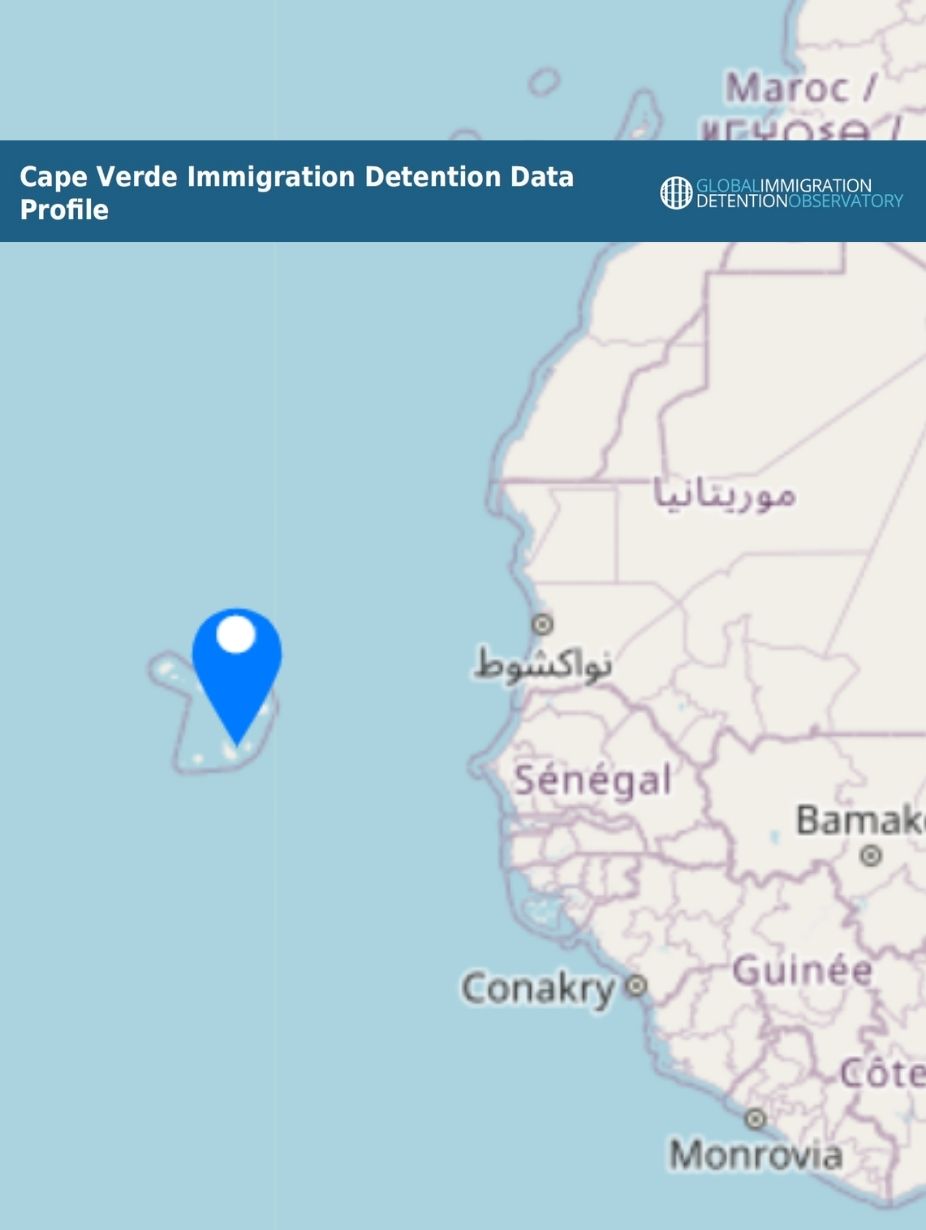
The Republic of Cabo Verde is an island country in the central Atlantic Ocean with a population of approximately 550,000 people. Following the confirmation of the first COVID-19 case in the country on 20 March 2020, a state of emergency was declared and a series of measures were implemented including the suspension of all incoming […]

Last updated:
DETENTION STATISTICS
Administrative Migration Detainee Entries
Not Available
2019
DETENTION CAPACITY
ALTERNATIVES TO DETENTION
ADDITIONAL ENFORCEMENT DATA
PRISON DATA
POPULATION DATA
LEGAL & REGULATORY FRAMEWORK
Does the Country Have Specific Laws that Provide for Migration-Related Detention?
GROUNDS FOR DETENTION
LENGTH OF DETENTION
DETENTION INSTITUTIONS
PROCEDURAL STANDARDS & SAFEGUARDS
COSTS & OUTSOURCING
COVID-19 DATA
TRANSPARENCY
MONITORING
NATIONAL HUMAN RIGHTS MONITORING BODIES
NATIONAL PREVENTIVE MECHANISMS (OPTIONAL PROTOCOL TO UN CONVENTION AGAINST TORTURE)
NON-GOVERNMENTAL ORGANISATIONS (NGOS)
GOVERNMENTAL MONITORING BODIES
INTERNATIONAL DETENTION MONITORING
INTERNATIONAL TREATIES & TREATY BODIES
International Treaties Ratified
Ratification Year
Observation Date
OP ICESCR, Optional Protocol to the International Covenant on Economic, Social and Cultural Rights
2014
2018
CAT, Convention against Torture and Other Cruel, Inhuman or Degrading Treatment or Punishment
1992
2017
ICRMW, International Convention on the Protection of the Rights of All Migrant Workers and Members of Their Families
1997
2017
CTOCTP, Protocol to Prevent, Suppress and Punish Trafficking in Persons, Especially Women and Children
2004
2017
CTOCSP, Protocol against the Smuggling of Migrants by Land, Sea and Air, supplementing the United Nations Convention against Transnational Organized Crime
2004
2017
OPCAT, Optional Protocol to the Convention against Torture and Other Cruel, Inhuman or Degrading Treatment or Punishment
2016
2016
Ratio of relevant international treaties ratified
Ratio: 14/19
Individual Complaints Procedures
Acceptance Year
ICESCR, Optional Protocol to the International Covenant on Economic, Social and Cultural Rights, 20082013
2013
CEDAW, Optional Protocol to the Convention on the Elimination of Discrimination against Women, 19992011
2011
Relevant Recommendations or Observations Issued by Treaty Bodies
Treaty Body
Committee on Migrant Workers
Recommendation Year
2022
Recommendation Excerpt
Recommendation (paragraph 40);
40. With reference to its previous recommendations, and in accordance with its general comment No. 5 (2021), the Committee recommends that the State party:
(a) Adopt measures to phase out, and ultimately put an end to, immigration detention; enact a presumption in law against detention and therefore in favour of freedom; and immediately cease migration detention of vulnerable groups of migrant workers and members of their families as well as asylum seekers, refugees and stateless persons;
(b) Ensure that:
(i) The detention of migrants is an exceptional measure of last resort, pursuing a legitimate end, and that it is necessary and proportionate, and applied for the shortest possible period of time in all other cases;
(ii) The grounds for detention are specified in each case, with specific reasons why alternative measures cannot be implemented;
(iii) The measure is reviewed within 24 hours by an independent and impartial judicial authority;
(iv) In line with its human rights obligations, alternative measures to detention are considered and made use of before imposing detention measures. The Committee recognizes as alternatives to detention all community-based care measures or non-custodial accommodation solutions – in law, policy or practice – that are less restrictive than detention and which must be considered in the context of lawful detention decision procedures to ensure that detention is necessary and proportionate in all cases, with the aim of respecting the human rights and avoiding the arbitrary detention of migrants, asylum seekers, refugees and stateless persons;
(c) Ensure that alternative measures to detention are applied to asylum seekers and refugees, and in all cases of voluntary return, and that migrant workers and members of their families are informed of their rights and about procedures in the detention context in a language they understand.
40. With reference to its previous recommendations, and in accordance with its general comment No. 5 (2021), the Committee recommends that the State party:
(a) Adopt measures to phase out, and ultimately put an end to, immigration detention; enact a presumption in law against detention and therefore in favour of freedom; and immediately cease migration detention of vulnerable groups of migrant workers and members of their families as well as asylum seekers, refugees and stateless persons;
(b) Ensure that:
(i) The detention of migrants is an exceptional measure of last resort, pursuing a legitimate end, and that it is necessary and proportionate, and applied for the shortest possible period of time in all other cases;
(ii) The grounds for detention are specified in each case, with specific reasons why alternative measures cannot be implemented;
(iii) The measure is reviewed within 24 hours by an independent and impartial judicial authority;
(iv) In line with its human rights obligations, alternative measures to detention are considered and made use of before imposing detention measures. The Committee recognizes as alternatives to detention all community-based care measures or non-custodial accommodation solutions – in law, policy or practice – that are less restrictive than detention and which must be considered in the context of lawful detention decision procedures to ensure that detention is necessary and proportionate in all cases, with the aim of respecting the human rights and avoiding the arbitrary detention of migrants, asylum seekers, refugees and stateless persons;
(c) Ensure that alternative measures to detention are applied to asylum seekers and refugees, and in all cases of voluntary return, and that migrant workers and members of their families are informed of their rights and about procedures in the detention context in a language they understand.
Sources
International Convention on the Protection of the Rights of All Migrant Workers and Members of Their Families, "Concluding observations on the combined initial to third periodic reports of Cabo Verde", 02 June 2022, United Nation, (paragraph 40), https://uhri.ohchr.org/Document/File/f71f2e34-3d43-4420-81cf-983436826d94/CD8F475C-4C8E-460F-9594-7BC4E6F494C7
Treaty Body
Human Rights Committee
Recommendation Year
2019
Recommendation Excerpt
§ 32. The State party should improve the collection of data on refugees and asylum seekers and ensure that relevant legal provisions are implemented effectively. It should undertake a thorough review of border management processes to ensure that an assessment of refugee and asylum status takes place without exception, in line with the principle of non- refoulement. In all cases where asylum and refugee status is refused, individuals should be allowed recourse to judicial review.
Sources
Human Rights Committee," Concluding observations on the initial report of Cabo Verde," CCPR/C/CPV/CO/1/Add.1,
3 December 2019, https://uhri.ohchr.org/Document/File/6fc41c26-b395-47ba-b6a9-eaac95c2c356/BCD08019-3652-4EA7-9666-5E26DFD311BD
Treaty Body
Committee against Torture
Recommendation Year
2017
Recommendation Excerpt
35. The State party should:
(a) Revise and develop mandatory and continuous training programmes, with the support of the National Commission for Human Rights and Citizenship, to ensure that all public officials, in particular law enforcement and military personnel, prison staff and medical and other personnel involved with detainees and asylum seekers, are well acquainted with the provisions of the Convention and the Optional Protocol thereto;
[...]
(a) Revise and develop mandatory and continuous training programmes, with the support of the National Commission for Human Rights and Citizenship, to ensure that all public officials, in particular law enforcement and military personnel, prison staff and medical and other personnel involved with detainees and asylum seekers, are well acquainted with the provisions of the Convention and the Optional Protocol thereto;
[...]
Sources
UNCAT, "Concluding observations on Cabo Verde in the absence of a
report," January 26, 2017, http://uhri.ohchr.org/document/index/522D1AAD-FA37-400F-9FC5-42A3CFE425D9
Treaty Body
Committee on Migrant Workers
Recommendation Year
2015
Recommendation Excerpt
"31.the committee recommends that the state party ensure that migrant workers and members of their families have access to legal aid and consular services and that the minimum guarantees enshrined in the convention are assured with regard to criminal or administrative procedures, in full compliance with articles 16 and 17 of the convention. the committee also recommends that the state party promote alternatives to detention for migrant workers and members of their families. the committee further recommends that the state party provide detailed information on the number of migrants arrested, detained and expelled for immigration-related infractions, as well as the reasons for the detention and expulsion of these migrant workers."
Sources
Concluding observations on Cabo Verde in the absence of a report*, CMW/C/CPV/CO/1, 8 October 2015
> UN Special Procedures
> UN Universal Periodic Review
Relevant Recommendations or Observations from the UN Universal Periodic Review
Recommendation Issued
No
Year Issued
2023
UPR Cycle
4th
Sources
Human Rights Council, "Report of the Working Group on the Universal Periodic Review* Cabo Verde", 10 November 2023, United Nations General Assembly, https://documents.un.org/doc/undoc/gen/g23/259/39/pdf/g2325939.pdf
Recommendation Issued
No
Year Issued
2013
Sources
Report of the Working Group on the Universal Periodic Review* Cape Verde, A/HRC/24/5, 3 July 2013, https://www.upr-info.org/sites/default/files/document/cape_verde/session_16_-_april_2013/ahrc245e.pdf
Recommendation Issued
No
Year Issued
2009
Sources
UNIVERSAL PERIODIC REVIEW Report of the Working Group on the Universal Periodic Review * Cape Verde, A/HRC/10/81, 12 January 2009, https://www.upr-info.org/sites/default/files/document/cape_verde/session_3_-_december_2008/ahrc1081capeverdee.pdf
REGIONAL HUMAN RIGHTS MECHANISMS
Regional Legal Instruments
Year of Ratification (Treaty) / Transposed (Directive) / Adoption (Regulation)
Observation Date
APRW, Protocol to the African Charter on Human and Peoples Rights on the Rights of Women in Africa (Maputo Protocol)2005
2005
2017
HEALTH CARE PROVISION
HEALTH IMPACTS
COVID-19
Country Updates
The Republic of Cabo Verde is an island country in the central Atlantic Ocean with a population of approximately 550,000 people. Following the confirmation of the first COVID-19 case in the country on 20 March 2020, a state of emergency was declared and a series of measures were implemented including the suspension of all incoming flights. Certain measures had been eased by early 2021, although people arriving in Cabo Verde must provide proof of a negative COVID-19 test taken no more than 72 hours before travel. As of 27 April 2021, the country had recorded 22,586 cases of COVID-19 and 208 related deaths.
The GDP has been unable to establish the extent to which detention facilities are used in Cabo Verde as part of immigration enforcement procedures or to obtain details on COVID-19 related measures that may have been taken to safeguard people in immigration or criminal custody, or those in international protection situations. According to UNHCR, during 2020, the country reported no refugees or asylum cases, although there were 115 stateless persons.
The UN Committee against Torture, in its concluding observations from its 2017 review of Cabo Verde, noted with concern that “neither the Constitution nor Law No. 99/V/99 on the legal regime of asylum and refugee status include the risk of being subjected to torture in the country of destination as a reason for granting protection. Furthermore, the Committee expresses concern at the absence of an institutional framework for an asylum determination procedure.… While noting that asylum seekers would have a right to judicial review in accordance with Legislative Decree No. 6/97, the Committee regrets that they would not be protected against refoulement during the judicial review process, since the review would not have suspensive effect on an expulsion order.” In consequence, the Committee recommended that the State party “(a) Adopt the necessary legislative measures to explicitly incorporate into its legislation regulating and expulsion of undocumented migrants the principle of non-refoulement set out in Article 3 of the Convention; (b) Promptly establish a national asylum determination procedure that carries out a thorough assessment of the merits of each individual case and a medical and psychological examination when indications of torture or traumatization have been detected among applicants; (c) Set up an asylum registration and screening process at the borders to identify as early as possible victims of torture and trafficking and provide them with immediate rehabilitation and priority access to the asylum determination procedure;” and “(d) Provide for an effective judicial remedy with automatic suspensive effect on the deportation orders of asylum seekers and other undocumented immigrants.”
In 2015, the UN Committee on Migrant Workers recommended that “the State party promote alternatives to detention for migrant workers and members of their families” and “that the State party provide detailed information in the number of migrants arrested, detained and expelled for immigration-related infractions, as well as the reasons for the detention and expulsion of these migrant workers.” Moreover, it recommended that Cabo Verde “repeal all provisions of Decree Law No. 6/97 of May 1997 which are in violation of the Convention.”
In its 2018 state report to the Committee on Migrant Workers, the country stated it had repealed the Legislative Decree No. 6/97 and replaced it with the Law on the entry, stay, exit and removal of foreign nationals from the Cabo Verde (RJE). The country indicated that following the entry into force of the RJE, a process of “extraordinary regularization of irregular citizens in the national territory was conducted in 2015, during which 1,058 citizens were regularized (888 males and 170 females).” Furthermore, according to the state report, “there are no records of migrant children detained in the country and there are no practices of detention of children due to irregular immigration.” In addition, the country reported that “although Law No. 106/V/99, of August 2, foresees the establishment of Temporary Installation Centres for foreign nationals, the establishment of such facilities has not been necessary considering that Cabo Verde does not implement institutional practices towards the detention of persons in irregular migration: alternative measures to detention have been preferred, such as the notification for regularization or voluntary abandonment of the national territory within 10 to 20 days, period which may be extended in cases of children attending school, the presence of other family members and social ties (Article 79 of the RJE).” Cabo Verde also stated that in cases where the return of a person to their country of origin due to prohibited entry of that person, they may be held in a hotel unit or other “decent” facility.
The country received numerous relevant recommendations during its review for the third cycle of the UN Universal Periodic Review (UPR) in 2018, including: “ratify the Convention relating to the Status of Refugees (Democratic Republic of the Congo) (para. 112.7)” and “consider enhancing coordination between institutions and services that deal with migration-related issues to aid in the effective implementation of rights under the International Convention on the Protection of the Rights of All Migrant Workers and Members of Their Families (Ghana) (para. 112.156).”
In May 2020, the country’s National Human Rights Commission recommended the early release of prisoners in order to decongest prisons and avoid a spread of COVID-19. On 20 August 2020, the Ministry of Health revealed that they had identified 25 COVID-19 cases in the Praia jail.
Government Agencies
Minister of Foreign Affairs, Cooperation, and Regional Integration - https://mne.gov.cv/en/o-ministro
Foreigners and Borders Directorate - https://e-portaldef.gov.cv/en/web/guest/inicio
International Organisations
UNHCR Cape Verde - https://www.unhcr.org/where-we-work/countries/cape-verde
IOM Cape Verde - https://www.iom.int/countries/cabo-verde
ILO Cape Verde - https://www.ilo.org/regions-and-countries/africa/cabo-verde
NGO & Research Institutions
Ombudsman - https://www.provedor-jus.pt/quem-somos/a-provedoria-2/
Caritas Cape Verde - https://www.caritas.org/where-caritas-work/africa/cape-verde/
Amnesty International - https://www.amnesty.org
Human Rights Watch - https://www.hrw.org/africa/cape-verde