On 7 August, Belarusian authorities expelled a young Guinean mother while her young baby remained in Belarus. Reportedly, the mother was removed without due process–including the ability to challenge her separation from her child. UN experts have condemned the incident, which reflects a broader pattern in Belarus of using parental separation from children for both immigration and political reasons. […]
Belarus: Covid-19 and Detention
The humanitarian crisis that unfolded–and continues to unfold–on Belarus’s borders with the European Union (EU) in late 2021 sparked widespread scrutiny of that country’s treatment of migrants and asylum seekers (see the 12 November 2021 update on Belarus on this platform). However, the EU has long seen Belarus as an important partner in its efforts […]

Belarus: Covid-19 and Detention
The escalating crisis on the Belarus-Polish border has spurred a growing number of countries to accuse Belarus of weaponizing migrant and refugee movements, using them as pawns to destabilise the European Union. At the same time, there is growing international outrage over Poland’s response to the situation–as well as that of other countries that border […]

Belarus: Covid-19 and Detention
In response to an information request submitted by the Global Detention Project and the NGO Human Constanta, Belarus Deputy Minister of the Interior Ministry Aleksandr Barsukov confirmed that during the pandemic non-nationals who violate the country’s legislation may continue to face detention and deportation. He wrote, “For foreigners violating the legislation of the Republic of […]

Last updated:
DETENTION STATISTICS
DETAINEE DATA
DETENTION CAPACITY
ADDITIONAL ENFORCEMENT DATA
PRISON DATA
POPULATION DATA
SOCIO-ECONOMIC DATA & POLLS
LEGAL & REGULATORY FRAMEWORK
Does the Country Have Specific Laws that Provide for Migration-Related Detention?
Do Migration Detainees Have Constitutional Guarantees?
Yes/No
Constitution and articles
Adopted in
Last amended
Yes
Art.11 Foreign nationals and stateless persons on the territory of Belarus shall enjoy
rights and liberties and execute duties on equal terms with the citizens of the Republic of
Belarus, unless otherwise specified in the Constitution, the laws and international treaties. Art 25. The State shall safeguard personal liberty, inviolability and dignity. The
restriction or denial of personal liberty is possible in the instances and under the procedure
specified in law.
A person who has been taken into custody shall be entitled to a judicial investigation into
the legality of his detention or arrest.
No one shall be subjected to torture or cruel, inhuman or undignified treatment or
punishment, or be subjected to medical or other experiments without one's consent.
1994
2004
Additional Legislation
Name
Year Adopted
Last Amended
Resolution No. 115 of the Ministry of Internal Affairs on 22 April 2024. The Program outlines a set of actions to regulate migration processes but focuses predominantly on security and oversight at the border, including information systems for monitoring foreign nationals, mandatory fingerprint registration for certain categories of migrants, and cooperation with foreign states, including through readmission agreements.
2024
Law of the Republic of Belarus N 354-З “On Granting Refugee Status, Additional Protection, Asylum and Temporary Protection in the Republic of Belarus to Foreign Citizens and Stateless Persons”
2008
2016
Regulations, Standards, Guidelines
Name
Year Published
Presidential Decree No. 202 of 21 May 2025, which entered into force on 23 August 2025 and which strengthens administrative supervision over migrant workers.
2025
Resolution of the Council of Ministers of the Republic of Belarus N 333 "On approval of the Regulations on the procedure for deportation of foreign citizens and stateless persons"
2007
Resolution of the Council of Ministers of the Republic of Belarus of 03.02.2006 N 146 "On approval of the Regulation on the procedure for the expulsion of foreign citizens and stateless persons from the Republic of Belarus and recognition as not valid of certain decisions of the Council of Ministers of the Republic of Belarus on the deportation of such persons"
2006
Centralised or Decentralised Immigration Authority
Centralized immigration authority
2018
GROUNDS FOR DETENTION
Immigration-Status-Related Grounds
Non-Immigration-Status-Related Grounds in Immigration Legislation
Criminal Penalties for Immigration-Related Violations
LENGTH OF DETENTION
DETENTION INSTITUTIONS
Custodial Authorities
Agency
Ministry
Typology
Year
The Department of Citizenship and Migration
Ministry of Internal Affairs of the Republic of Belarus
Interior or Home Affairs
Apprehending Authorities
Name
Agency
Ministry
Year
Departments of the Committee of State Security
Law enforcement, border control and national security
PROCEDURAL STANDARDS & SAFEGUARDS
Procedural Standards
Name
In Law
In Practice
Year
Impact of Legal ATDs on Overall Detention Rates
Impact
Nature
Year
Not applicable
2018
COSTS & OUTSOURCING
Description of Foreign Assistance
IOM Launches New Project to Improve Border Governance and Migrant Protection in Belarus. IOM launched a project to strengthen Belarus’s border management and better protect migrants. It focuses on improving the State Border Committee’s capacity, cooperation, and procedures, with special attention to vulnerable groups and human‑rights standards. The project is funded by the IOM Development Fund and implemented jointly with Belarusian authorities.
The project " Assistance to Belarus to handle increased irregular migration" was registered in August 2018. The project is funded by the European Union and is implemented by the International Organization for Migration Office in Belarus in cooperation with the Ministry of Internal Affairs and the State Border Committee. The budget of the project is €7 million. The project seeks to enable voluntary return of migrants to their homeland without deportation. The border guard service will also receive vehicles to transport migrants. The project provides for the construction of new centers and also renovation of the existing ones.
COVID-19 DATA
TRANSPARENCY
NATIONAL HUMAN RIGHTS MONITORING BODIES
NATIONAL PREVENTIVE MECHANISMS (OPTIONAL PROTOCOL TO UN CONVENTION AGAINST TORTURE)
NON-GOVERNMENTAL ORGANISATIONS (NGOS)
GOVERNMENTAL MONITORING BODIES
INTERNATIONAL DETENTION MONITORING
INTERNATIONAL TREATIES & TREATY BODIES
International Treaties Ratified
Ratification Year
Observation Date
CAT, Convention against Torture and Other Cruel, Inhuman or Degrading Treatment or Punishment
1987
2017
CTOCTP, Protocol to Prevent, Suppress and Punish Trafficking in Persons, Especially Women and Children
2003
2017
CTOCSP, Protocol against the Smuggling of Migrants by Land, Sea and Air, supplementing the United Nations Convention against Transnational Organized Crime
2003
2017
Ratio of relevant international treaties ratified
Ratio: 12/19
Relevant Recommendations or Observations Issued by Treaty Bodies
Treaty Body
Committee on the Elimination of Racial Discrimination
Recommendation Year
2024
Recommendation Excerpt
32. The Committee urges the State party to take measures to protect the life and safety of migrants, asylum-seekers and refugees, to prevent the excessive use of force, to provide human rights training to border guards and other law enforcement officials, to continue to cooperate closely with international organizations, including the United Nations, and other stakeholders to enhance the protection of the human rights of migrants, asylum-seekers and refugees and to guarantee the availability of the asylum
procedure in accordance with international standards. The Committee recommends that the State party ensure that its measures do not inadvertently constitute a risk of statelessness for certain categories of Belarusian citizens, including for members of national and other minority communities living abroad. In line with its previous recommendation,8 the Committee encourages the State party to accelerate the process of acceding to the Convention relating to the Status of Stateless Persons and the Convention on the Reduction of Statelessness.
procedure in accordance with international standards. The Committee recommends that the State party ensure that its measures do not inadvertently constitute a risk of statelessness for certain categories of Belarusian citizens, including for members of national and other minority communities living abroad. In line with its previous recommendation,8 the Committee encourages the State party to accelerate the process of acceding to the Convention relating to the Status of Stateless Persons and the Convention on the Reduction of Statelessness.
Sources
Committee on the Elimination of Racial Discrimination, "Concluding observations on the combined twenty-fourth to
twenty-fifth periodic reports of Belarus", 21 August 2024, United Nations General Assembly, (paragraph 39), https://uhri.ohchr.org/en/document/99967924-019b-4226-b1ef-d78e87edd7cf
Treaty Body
Committee on the Rights of the Child
Recommendation Year
2020
Recommendation Excerpt
§ 39. "Recalling joint general comments No. 3 and No. 4 (2017) of the Committee on the Protection of the Rights of All Migrant Workers and Members of Their Families / No. 22 and No. 23 (2017) of the Committee on the Rights of the Child on the human rights of children in the context of international migration, the Committee urges the State party to:
(a) Develop a legislative framework on undocumented children;
(b) Establish status determination procedures to ensure the identification and protection of children in situations of migration, including unaccompanied children and separated children;
(c) Develop a standard protocol on age-determination methods that is multidisciplinary, scientifically based, respectful of children ’ s rights and used only in cases of serious doubt about the claimed age, consider documentary or other forms of evidence available and ensure access to effective appeal mechanisms;
(d) Integrate the principle of the best interests of the child in legislation and regulations concerning migration, ensure that this principle is given primary consideration in asylum and migration-related procedures, including age and status determination and deportation, and that children ’ s views are duly taken into account therein, and provide support to families with migration backgrounds to prevent family separation;
(e) Build the capacity of the authorities to determine and apply the best interests of the child in asylum and migration-related procedures;
(f) Ensure that all children in situations of migration, including undocumented and separated children, receive appropriate protection, are informed about their rights in a language they understand, have access to education and health care, including psychosocial support, and are provided with interpretation and free legal aid; and develop comprehensive referral, case management and guardianship frameworks for unaccompanied and separated children;
(g) Prohibit immigration detention of children and ensure non-custodial solutions, including foster care and accommodation in specialized open reception centres serviced by trained professionals and providing access to education and psychosocial support, ensure the periodic and independent review of the care and ensure access to complaint procedures."
(a) Develop a legislative framework on undocumented children;
(b) Establish status determination procedures to ensure the identification and protection of children in situations of migration, including unaccompanied children and separated children;
(c) Develop a standard protocol on age-determination methods that is multidisciplinary, scientifically based, respectful of children ’ s rights and used only in cases of serious doubt about the claimed age, consider documentary or other forms of evidence available and ensure access to effective appeal mechanisms;
(d) Integrate the principle of the best interests of the child in legislation and regulations concerning migration, ensure that this principle is given primary consideration in asylum and migration-related procedures, including age and status determination and deportation, and that children ’ s views are duly taken into account therein, and provide support to families with migration backgrounds to prevent family separation;
(e) Build the capacity of the authorities to determine and apply the best interests of the child in asylum and migration-related procedures;
(f) Ensure that all children in situations of migration, including undocumented and separated children, receive appropriate protection, are informed about their rights in a language they understand, have access to education and health care, including psychosocial support, and are provided with interpretation and free legal aid; and develop comprehensive referral, case management and guardianship frameworks for unaccompanied and separated children;
(g) Prohibit immigration detention of children and ensure non-custodial solutions, including foster care and accommodation in specialized open reception centres serviced by trained professionals and providing access to education and psychosocial support, ensure the periodic and independent review of the care and ensure access to complaint procedures."
Sources
Committee on the Rights of the Child, "Concluding Observations on the Combined Fifth and Sixth Periodic Reports of Belarus," CRC/C/BLR/CO/5-6, 28 February 2020, https://tbinternet.ohchr.org/_layouts/15/treatybodyexternal/Download.aspx?symbolno=CRC%2fC%2fBLR%2fCO%2f5-6&Lang=en
Treaty Body
Committee against Torture
Recommendation Year
2018
Recommendation Excerpt
§53. The Committee recommends that the State party: [...]
(c) Establish a procedure to identify persons in situations of vulnerability and monitor the detention of undocumented migrants on a regular basis;
Para 53b Refrain from detaining migrants, including minors who may be detained with their relatives, in regular pretrial or temporary detention facilities and provide them with access to a lawyer and other fundamental legal safeguards;
[...]
(e) Compile and provide the Committee with detailed statistical data, disaggregated by country of origin, on the number of persons who have requested asylum or refugee status, and the outcomes of those applications, as well as the number of expulsions, deportations or extraditions that have taken place and the countries to which individuals were returned.
(c) Establish a procedure to identify persons in situations of vulnerability and monitor the detention of undocumented migrants on a regular basis;
Para 53b Refrain from detaining migrants, including minors who may be detained with their relatives, in regular pretrial or temporary detention facilities and provide them with access to a lawyer and other fundamental legal safeguards;
[...]
(e) Compile and provide the Committee with detailed statistical data, disaggregated by country of origin, on the number of persons who have requested asylum or refugee status, and the outcomes of those applications, as well as the number of expulsions, deportations or extraditions that have taken place and the countries to which individuals were returned.
Sources
Concluding observations on the fifth periodic report of Belarus. CAT, 8 June 2018, http://docstore.ohchr.org/SelfServices/FilesHandler.ashx?enc=6QkG1d%2fPPRiCAqhKb7yhsuYIhPYYu%2b7c2v1wUXnRL6yVIZQnE7ZgAhTdFsOuhXGqMIgFRSvtkaS7hCe7rD5wN8Wm5jTLu1TIYBN70SsoJqye630ilo0zgdnFHFxoQIVN
Treaty Body
Committee on the Rights of the Child
Recommendation Year
2011
Recommendation Excerpt
§68. The Committee recommends that the State party:
(a) Expressly identify the best interests of the child as a primary considerationwhen examining asylum applications of undocumented, unaccompanied orseparated children, and refrain fromplacing these children in detention centres;
(b) Train asylumandmigration officials in the application of the legislation governing asylumand complementary protection, including training in taking into consideration child-specificforms of persecution;
(c) Ensure, including through the signing of bilateral agreements containing appropriate safeguards, that decisions forreturn and reintegration of unaccompaniedBelarusian children are carried out with the primary consideration of the best interests of the child; and
(d) Take into account the Committee’s views contained in its generalcomment No. 6 (2005) on the treatment of unaccompanied and separated children outside theircountry of origin.
(a) Expressly identify the best interests of the child as a primary considerationwhen examining asylum applications of undocumented, unaccompanied orseparated children, and refrain fromplacing these children in detention centres;
(b) Train asylumandmigration officials in the application of the legislation governing asylumand complementary protection, including training in taking into consideration child-specificforms of persecution;
(c) Ensure, including through the signing of bilateral agreements containing appropriate safeguards, that decisions forreturn and reintegration of unaccompaniedBelarusian children are carried out with the primary consideration of the best interests of the child; and
(d) Take into account the Committee’s views contained in its generalcomment No. 6 (2005) on the treatment of unaccompanied and separated children outside theircountry of origin.
Sources
Committee on the Rights of the Child, "Consideration of reports submitted by States parties under article 44
of the Convention: Concluding observations: Belarus," CRC/C/BLR/CO/3-4, 25 January 2011, https://uhri.ohchr.org/en/document/2964d6fc-5615-416f-8636-b3e447b5babd
> UN Special Procedures
Relevant Recommendations or Observations by UN Special Procedures
Treaty Body
Special Rapporteur on the human rights of migrants
Decision Date
2023
Case Details
Recommendation by Special Rapporteur, (paragraph 40, 41, 42, 44, 46 )
40.The situation of migrants at the Belarusian-Polish border reflects the ongoing geopolitical crisis in the region. The Special Rapporteur firmly condemns the use of migrants as a political tool in violation of their human rights. Migrants should not be used or sacrificed.
41.Pushback practices at the border have cost migrants’ lives. Continued reports of migrants stranded at the Belarusian-Polish border, especially new arrivals, confirm that harsh border governance measures and the construction of the physical fence have not deterred irregular border crossing attempts, but have heightened the risks to migrants and increased their suffering. Serious concern remains about the physical and mental integrity of all migrants stranded at the Belarusian-Polish border, particularly in view of incoming arrivals and the increasingly harsh circumstances after the installation of the fence, and during winter. These conditions may also amount to cruel, inhuman or degrading treatment and may result in violations of the rights to life and security of person.
42.To find solutions for these migrants, the Special Rapporteur calls upon Belarus, Poland and the European Union to conduct constructive dialogue, most importantly to prevent further loss of life and ensure that protection of the human rights of migrants is placed at the centre of any solution adopted to address this situation, and recommends that:
(a)Belarus and Poland take all reasonable precautionary steps to protect life and to prevent excessive use of force and conditions amounting to cruel, inhuman and degrading treatment, and cooperate to save lives and prevent migrant deaths and injuries, in accordance with international law.
(b)Since each death requires a prompt, independent, transparent and thorough investigation, the authorities of Belarus and Poland must cooperate with such processes and conduct prompt, thorough and transparent investigations into each migrant death and each allegation of violence committed by border guards on both sides at the Belarusian-Polish border, and take proactive steps to remove suspected perpetrators from duty and to prosecute them where appropriate.
44.Belarus and Poland should ensure access to justice and remedies for migrants who have suffered human rights violations or abuses as a result of border governance measures, including by establishing accessible and adequate complaint and reparation procedures, and refraining from raising territorial or other restrictions that effectively prevent applicants from accessing justice.
46.To address this ongoing situation and provide safe pathways for migrants, it is essential for Belarus to grant unhindered access to relevant United Nations agencies, to strengthen cooperation, to rebuild partnerships and to regain trust and interest from donors. More specifically, Belarus should work closely with international organizations including the United Nations to enhance the protection of the human rights of migrants and asylum-seekers. Cooperation with relevant United Nations entities and agencies could include human rights training for law enforcement and immigration enforcement personnel, and technical cooperation in establishing independent monitoring mechanisms at international borders.
40.The situation of migrants at the Belarusian-Polish border reflects the ongoing geopolitical crisis in the region. The Special Rapporteur firmly condemns the use of migrants as a political tool in violation of their human rights. Migrants should not be used or sacrificed.
41.Pushback practices at the border have cost migrants’ lives. Continued reports of migrants stranded at the Belarusian-Polish border, especially new arrivals, confirm that harsh border governance measures and the construction of the physical fence have not deterred irregular border crossing attempts, but have heightened the risks to migrants and increased their suffering. Serious concern remains about the physical and mental integrity of all migrants stranded at the Belarusian-Polish border, particularly in view of incoming arrivals and the increasingly harsh circumstances after the installation of the fence, and during winter. These conditions may also amount to cruel, inhuman or degrading treatment and may result in violations of the rights to life and security of person.
42.To find solutions for these migrants, the Special Rapporteur calls upon Belarus, Poland and the European Union to conduct constructive dialogue, most importantly to prevent further loss of life and ensure that protection of the human rights of migrants is placed at the centre of any solution adopted to address this situation, and recommends that:
(a)Belarus and Poland take all reasonable precautionary steps to protect life and to prevent excessive use of force and conditions amounting to cruel, inhuman and degrading treatment, and cooperate to save lives and prevent migrant deaths and injuries, in accordance with international law.
(b)Since each death requires a prompt, independent, transparent and thorough investigation, the authorities of Belarus and Poland must cooperate with such processes and conduct prompt, thorough and transparent investigations into each migrant death and each allegation of violence committed by border guards on both sides at the Belarusian-Polish border, and take proactive steps to remove suspected perpetrators from duty and to prosecute them where appropriate.
44.Belarus and Poland should ensure access to justice and remedies for migrants who have suffered human rights violations or abuses as a result of border governance measures, including by establishing accessible and adequate complaint and reparation procedures, and refraining from raising territorial or other restrictions that effectively prevent applicants from accessing justice.
46.To address this ongoing situation and provide safe pathways for migrants, it is essential for Belarus to grant unhindered access to relevant United Nations agencies, to strengthen cooperation, to rebuild partnerships and to regain trust and interest from donors. More specifically, Belarus should work closely with international organizations including the United Nations to enhance the protection of the human rights of migrants and asylum-seekers. Cooperation with relevant United Nations entities and agencies could include human rights training for law enforcement and immigration enforcement personnel, and technical cooperation in establishing independent monitoring mechanisms at international borders.
Sources
Special Rapporteur on the human rights of migrants, Felipe González Morales, " Visit to Belarus: Report of the Special Rapporteur on the human rights of migrants, Felipe González Morales", 18 May 2023, United Nation, (paragraph 40, 41, 42, 44, 46), https://uhri.ohchr.org/Document/File/cf2d1608-c086-4d3e-bde6-157e217a5db8/FD688619-F086-4330-859C-D3A6377FF938
> UN Universal Periodic Review
Relevant Recommendations or Observations from the UN Universal Periodic Review
Recommendation Issued
Yes
Year Issued
2020
UPR Cycle
3rd
Recommendation Excerpt
Migrants, refugees and asylum seekers.
112. The Committee against Torture remained concerned at reports that the State continued
to engage in forced expulsion, deportation, returns and extradition to third countries in which
there were substantial grounds to believe that an individual would be in danger of being
subjected to torture.
113. The Committee was also concerned at reports indicating prolonged detention of
people who were in violation of migration legislation, at poor conditions in those detention
facilities and at the lack of fundamental legal safeguards provided to those detained.130
114. The United Nations country team recommended that the Government consider
introducing alternatives to detention for asylum seekers, and use detention only as a measure
of last resort in accordance with the law, for the shortest possible period.
115. The Committee on the Rights of the Child urged the State to establish status
determination procedures to ensure the identification and protection of children in situations
of migration, including unaccompanied children and separated children. It urged the State to
ensure that all children in situations of migration, including undocumented and separated
children, received appropriate protection.......
112. The Committee against Torture remained concerned at reports that the State continued
to engage in forced expulsion, deportation, returns and extradition to third countries in which
there were substantial grounds to believe that an individual would be in danger of being
subjected to torture.
113. The Committee was also concerned at reports indicating prolonged detention of
people who were in violation of migration legislation, at poor conditions in those detention
facilities and at the lack of fundamental legal safeguards provided to those detained.130
114. The United Nations country team recommended that the Government consider
introducing alternatives to detention for asylum seekers, and use detention only as a measure
of last resort in accordance with the law, for the shortest possible period.
115. The Committee on the Rights of the Child urged the State to establish status
determination procedures to ensure the identification and protection of children in situations
of migration, including unaccompanied children and separated children. It urged the State to
ensure that all children in situations of migration, including undocumented and separated
children, received appropriate protection.......
Sources
Working Group on the Universal Periodic Review, "Working Group on the Universal Periodic Review Belarus", 15 May 2020, United Nation General, session 36th, Third Cycle, https://documents.un.org/doc/undoc/gen/g20/052/76/pdf/g2005276.pdf
Recommendation Issued
No
Year Issued
2010
Sources
Report of the Working Group on the Universal Periodic Review Belarus, A/HRC/15/16, 21 June 2010, https://www.upr-info.org/sites/default/files/document/belarus/session_8_-_may_2010/ahrc1516e.pdf
Recommendation Issued
No
Year Issued
2015
Sources
Report of the Working Group on the Universal Periodic Review Belarus, A/HRC/30/3, 13 July 2015, https://www.upr-info.org/sites/default/files/document/belarus/session_22_-_may_2015/ahrc303en.pdf
Recommendation Issued
Yes
Year Issued
2021
Sources
Human Rights Council, "Report of the Working Group on the Universal Periodic Review: Belarus," A/HRC/46/5, 4 January 2021, https://uhri.ohchr.org/Document/File/31681a84-73f8-4ee3-a01b-ae19a6270779/237DBDA1-66E8-4AA0-97D1-06415516545C
REGIONAL HUMAN RIGHTS MECHANISMS
HEALTH CARE PROVISION
HEALTH IMPACTS
COVID-19
Country Updates
The humanitarian crisis that unfolded--and continues to unfold--on Belarus’s borders with the European Union (EU) in late 2021 sparked widespread scrutiny of that country’s treatment of migrants and asylum seekers (see the 12 November 2021 update on Belarus on this platform). However, the EU has long seen Belarus as an important partner in its efforts to halt the movements of migrants before they reach the EU.
As noted in a recent report by The Transnational Institute (TNI), the European Commission announced in 2016 that it would provide “€7 million from the European Neighbourhood Instrument for ‘the construction and/or renovation of several temporary migrants’ accommodation centres’ for ‘between 30 and 50 irregular migrants per centre at a time,’ where ‘all centres will have closed and open-type facilities.’ The Action Programme includes training on the management of these centres.” The International Organization for Migration (IOM) was reportedly tasked with helping implement the project.
Importantly, aside from some holding cells in border facilities, Belarus has to date only used prisons and police stations for migration-related detention purposes, having never established the types of specialized migrant facilities used in nearly all other European countries, particularly those that are members of the Council of Europe (of which Belarus is not).
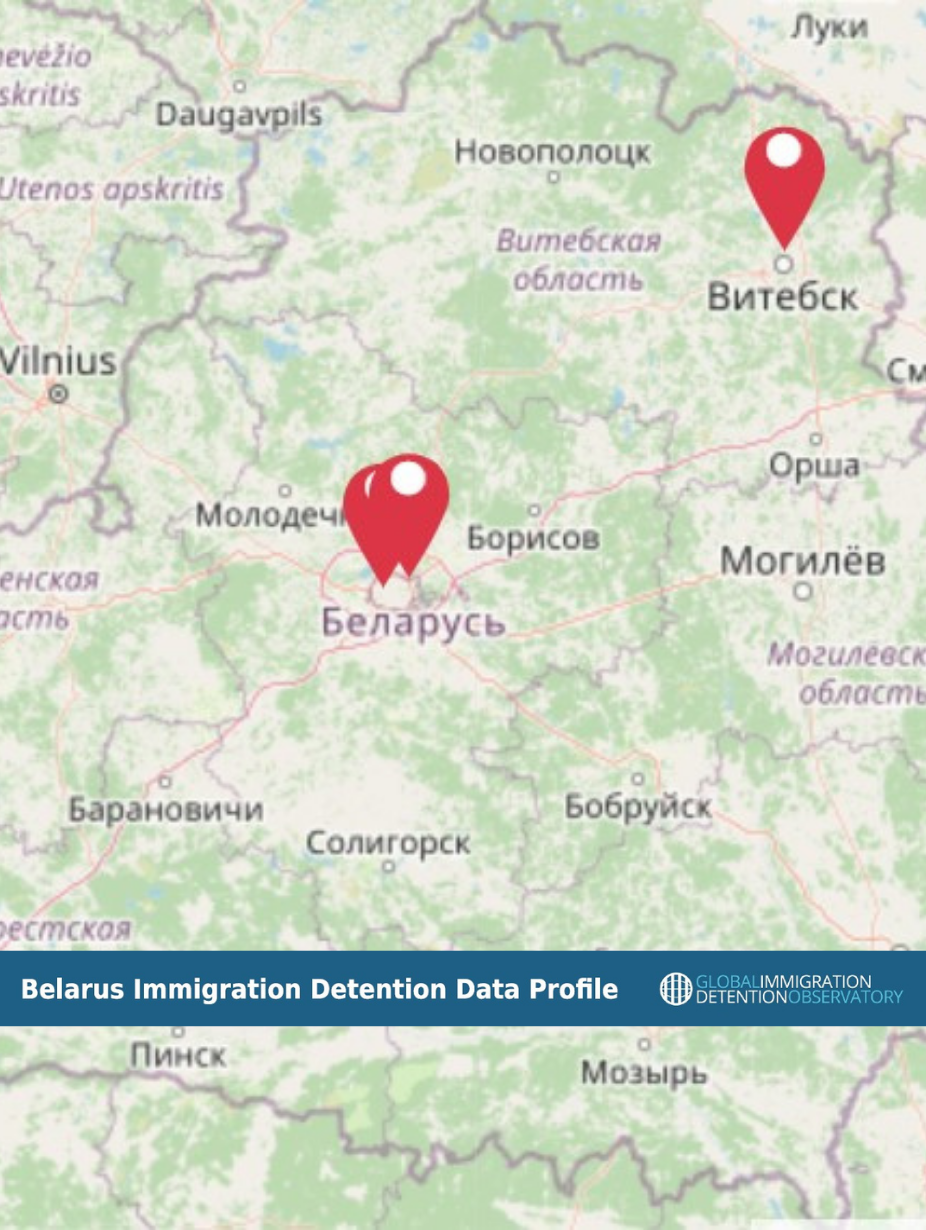
A non-governmental source in Belarus informed the Global Detention Project (GDP) that in 2018, Belarus began building two migrant centres with EU support, which are reportedly intended to hold up to 200 people each and be located in Lida and Navapolatsk. However, according to the GDP source, progress on these facilities was halted shortly after the onset of the COVID-19 pandemic, in mid-2020.
According to TNI, the EU has also supported numerous other detention-related projects. One such project, called “Helping Belarus Address the Phenomenon of Increasing Numbers of Irregular Migrants,” reportedly includes financing renovations of prisons in Belarus and includes the involvement of UNHCR and the Belarus Red Cross. Also, “As part of an earlier EU-funded project ‘Strengthening surveillance capacity on the green and blue border between Belarus and Ukraine’ (SURCAP, 2012–2014), also implemented by the IOM, border guards from Belarus and Ukraine went on study visits to detention centres in Italy and Portugal. In February 2018, the IOM also organised a study visit to detention centres in Albania and Macedonia for Belarusian border guards, once again funded by the EU.”
The GDP source in Belarus reported that there is no available information indicating that migrants are currently being detained in the country, adding that many are receiving accommodation in a non-secure “logistical” centre in Bruzgi. However, the source added that this situation could change as many people may now have expired visas.
Images filmed by Ruptly, a video news agency owned by the Moscow-backed RT television network (formerly Russia Today), appear to show migrants, refugees, and asylum seekers in a warehouse-like facility. Children and families are seen sleeping on the floor of the facility in between scaffolding. On 16 November 2021, a Belarusian presidential aide was quoted as saying that “all migrants will be able to stay at the centre until the issue is resolved.”
On 9 December 2021, Polish soldiers found the body of a migrant in the border region with Belarus. Around a dozen people have now been found dead along the border as aid groups warn that the toll could be even higher. Polish border guards said that on 8 December 2021, a group of 35 migrants had forced their way across the Polish border overnight and that the Belarusian military had helped them cross. The group was caught by Polish authorities and sent back to Belarus. According to the Polish government, it is estimated that the Lukashenko regime has sent back around 3,000 migrants to Iraq and Syria but there remain around 7,000 on the Belarusian territory.
While observers have been critical of the treatment of migrants and asylum seekers by Polish and Lithuanian security services during the border crisis with Belarus, which Belarus and Russia have also loudly denounced, there are long-standing concerns about how Belarus treats migrants crossing into its territory from Russia. According to TNI, a report by the group Danwatch “exposed the inhumane treatment of migrants by the Belarusian border authorities, including pushbacks of Chechen refugees to Russia and extremely violent treatment of perceived irregular migrants by armed border guards.”
UNHCR data shows that in 2020, there were 2,900 refugees, 136 asylum seekers, and 6,297 stateless persons in Belarus. In addition, data shows that around 600 asylum applications were submitted in Belarus in 2020.
The escalating crisis on the Belarus-Polish border has spurred a growing number of countries to accuse Belarus of weaponizing migrant and refugee movements, using them as pawns to destabilise the European Union. At the same time, there is growing international outrage over Poland’s response to the situation--as well as that of other countries that border Belarus like Lithuania (see the 9 October 2021 Lithuania update)--which has included leaving people (including families and children) stranded at the border in freezing conditions, bolstering troop movements, and mobilising anti-immigrant public sentiment.
In late May, Belarusian President Alexandr Lukashenko, angered by EU sanctions, declared that he would no longer prevent migrants and refugees from entering Europe. There are reports that State-controlled travel bureaux in Belarus have been luring migrants from the Middle East to Belarus, promising an onward passage to the EU for the price of Euro 15,000 - 20,000. On arrival, migrants are accommodated in State-managed hotels and then bussed to the Polish and Lithuania borders. There are videos of Belarusian security guards in full-combat gear pushing migrants towards the borders. Thousands of desperate men, women, and children--many from Iraq and Afghanistan--have been transported to Belarus's borders with Poland, Latvia, and Lithuania.
According to testimony from migrants, Belarusian soldiers have physically abused migrants. One person from Morocco told reporters: “They beat me in Belarus. There are gangs that stand behind the army and attack us. They beat you, take your money, split it 50-50, part for the gangs, part for soldiers.” Other testimonies indicate that Belarusian police have helped migrants cross the border to Poland. A 40 year-old Iraqi man said that he had travelled for three days by car to Istanbul, took a flight to Minsk from Turkey, and upon arrival at the Polish border, “the Belarusian police cut the barbed wire and let us through.”
Large numbers of migrants are now trapped between opposing security forces and forced to sleep in improvised camps in the middle of the forest along the border in freezing temperatures. By 22 October 2021, Polish authorities had announced the ninth recorded death in the forest region. According to the Polish border guard, so far this year, there were 24,500 attempts to cross the eastern border with Poland, 12,800 in October alone. On 9 November, the Polish government announced that there were around 3,000 to 4,000 people settled in an improvised camp on the border close to the village of Kuźnica.
The majority of migrants crossing into Poland are pushed back into Belarus by the Polish security forces. They describe a Kafkaesque situation of being repeatedly pushed backwards and forwards by the security forces of both countries--pawns in a political conflict. Doctors Without Borders have reported that they have seen “first-hand the injuries people experienced when assaulted by border guards from both Poland and Lithuania. People have described being beaten with the butt of a gun, kicked in the ribs, electrocuted in the neck, and have had all their belongings taken or destroyed by European border guards. This is unacceptable and must end now.”
The Polish government and the European Union argue that Belarus is deliberately encouraging migrants to enter the European Union through its borders. Lithuania’s foreign minister, Gabrielius Landsbergis, said that Lukashenko’s regime was negotiating visa liberalisation with several countries and adding flights to create new routes. Infomigrants reported that the number of countries whose citizens can enter Belarus without a visa has been expanded to 76 as of 20 October 2021.
In response to this situation, Lithuania has passed legislation tightening the rules on migration and asylum, approving the construction of a wall to prevent irregular crossings on the border with Belarus. On 9 November 2021, Lithuania declared a state of emergency on its border with Belarus, providing the police with additional powers to expel asylum seekers and restrict gatherings near the border.
For its part, Poland approved a plan to build a €353 million wall on its border with Belarus and adopted legislation providing that any non-nationals who are stopped after crossing the Polish border irregularly would be expelled from the country. Those expelled would be banned from entering the country for a period between six months to three years and Polish officials would be allowed to “leave unexamined” asylum applications filed by a non-national who is stopped immediately after entering the country irregularly. Poland has sent some 11,000 soldiers to the border area, created a militarised zone, and set up razor-wire fencing. Poland is also one of twelve EU member states requesting that the EU fund the construction of barriers at their borders. The EU has refused to fund the walls, adopting the same stance as in 2015-2016, when the European Commission refused to reimburse Hungary for fencing off its border with Serbia.
A group of doctors operating on the border have said they are prevented from accessing the zone where migrants are stranded. A Polish Red Cross worker from the border area said, “we have no access to the off-limits zone… we can’t hand over aid packages ourselves.” ECRE also reported that a group of 17 people located in the borderland forest between Poland and Belarus was left for 32 hours without food and water.
The president of the European Commission, Ursula von der Leyen, called upon EU member states to approve new sanctions against Belarusian authorities responsible for the influx of migrants at the Polish border, statingt: “The instrumentalisation of migrants for political purposes is unacceptable.” She added that the EU would “examine how to sanction airlines from third countries” that bring migrants to Belarus. Subsequently, on Tuesday 9 November, the 27 EU member states agreed to suspend an EU-Belarus visa facilitation agreement. Belarus has denied having any involvement in directing the flow of people and the Belarusian border guard said that: “the indifference and inhumane attitude of the Polish authorities has prompted the refugees to take such a step of despair.”
In response to an information request submitted by the Global Detention Project and the NGO Human Constanta, Belarus Deputy Minister of the Interior Ministry Aleksandr Barsukov confirmed that during the pandemic non-nationals who violate the country’s legislation may continue to face detention and deportation. He wrote, “For foreigners violating the legislation of the Republic of Belarus on the plight of foreign citizens and persons who have taken citizenship, measures are applied in accordance with the requirements of the Code of Administrative Offenses, including deportation.” However, he specified that foreigners stuck in the country for reasons outside their control will be granted stay extensions: “Foreigners who cannot leave the Republic of Belarus for reasons beyond their control, the length of stay is extended.”
Belarus has attracted significant criticism for its slow and limited response to the pandemic, and few official containment measures have been adopted. With President Lukashenko publicly downplaying the pandemic--which he has dismissed as a “psychosis”-- authorities have refused to cancel large public events such as football matches or the country’s Victory Day military parade. Several small measures were, however, adopted with regards to prisons, with authorities suspending visits on 16 March and issuing new guidance on supplies to be delivered to inmates. Reportedly, every 30 days prisoners may receive food packages weighing up to 10kg, but they may only contain items authorities deem necessary for the prevention of respiratory illnesses (specifically: citrus fruits, garlic, onions, and apples).
To date, however, no steps have been taken to release prisoners - or foreign detainees - prompting the United Civic Party to launch a petition in April calling for prisoners to be released. It warned that if measures were not taken, prisons will “turn into mass graves.” Family members of inmates sent an open letter to the president requesting an amnesty bill which will permit the release or reduced sentencing of vulnerable people and those sentenced for non-violent crimes.
On 7 May, the UN Special Rapporteur on the Situation of Human Rights in Belarus and the UN Working Group on Arbitrary Detention urged the government to release all children and young people imprisoned for drug-related offences. They called on authorities “to avoid by all means the detention of children, to release those who do not pose a threat to society … which is especially necessary in light of the COVID-19 pandemic.”
Government Agencies
Ministry of Interior - https://mvd.gov.by/ru
Department of Citizenship and Migration DCM Belarus - https://mvd.gov.by/ru/page/departament-po-grazhdanstvu-i-migraci
International Organisations
UNHCR Office - https://www.unhcr.org/where-we-work/countries/belarus
IOM Office - https://belarus.iom.int/
NGO & Research Institutions
Ombudsman office - https://humanrights-online.org/institute-of-the-ombudsman-in-the-republic-of-belarus-position-of-the-belarusian-section-of-the-ishr/
Amnesty Office Belarus - https://www.amnesty.org/en/location/europe-and-central-asia/eastern-europe-and-central-asia/belarus/report-belarus/
Human Rights Watch Belarus - https://www.hrw.org/europe/central-asia/belarus