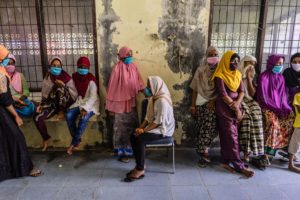
For years, India has served as an important destination for asylum seekers and refugees from neighbouring countries like Pakistan, Bangladesh, and Myanmar. However, under the Hindu nationalist Bharatiya Janata Party (BJP) there has been a marked increase in xenophobic attitudes and policies; a securitised approach to immigration enforcement; and intensified detention and deportation operations targeting specific groups like Rohingya refugees and persons perceived to be Bangladeshi, especially Bengali-speaking Muslims.
Together with the Asia Pacific Refugee Rights Network, the GDP submitted information to the UN Committee on the Elimination of Racial Discrimination outlining shared concerns regarding the country’s discriminatory migration enforcement policies. The submission was prepared ahead of CERD’s review of India’s twentieth and twenty-first periodic reports at its upcoming 118th session.
Intensified Immigration Enforcement
Despite a July 2025 appeal from CERD to India calling for an end the arbitrary mass detention and forced deportation of Rohingya to Myanmar, the discriminatory targeting of this population–as well as persons perceived to be Bangladeshi–has escalated.
In May 2025, the Ministry of Home Affairs published revised guidelines “regarding deportation of illegally staying Bangladeshis / Rohingyas (Myanmar nationals).” Since then, there have been widespread verification drives, detentions, and pushbacks disproportionately affecting Bengali-speaking Muslims, Rohingya refugees, and others perceived to be Bangladeshi.
These efforts have taken place alongside broader developments concerning India’s migration governance framework, including recent legislative changes that have expanded state powers over non-nationals while providing insufficient safeguards against arbitrary detention, discrimination, and forced removal. In 2025, for example, India replaced the 1946 Foreigners Act with a new Immigration and Foreigners Act which is even more restrictive, providing broad powers to immigration officers to detain and deport summarily with little judicial oversight.
Counter to international guidance, including CERD’s 2025 Joint General Recommendation No.39, the Act also criminalises irregular entry, with Section 21 providing for imprisonment for up to five years and/or fines of up to five lakh rupees (approximately 5,300 USD). Additionally, it fails to place a statutory limit on the duration of immigration detention, leaving detainees subject to indefinite detention.
The National Register of Citizens: A Gateway to Detention
Published in 2019, the NRC is a register of people who can prove they came to Assam before 24 March 1971, and which excludes nearly two million residents. Those who are excluded are vulnerable to being labelled “illegal” by quasi-judicial “Foreigners’ Tribunals.” The consequences of being labelled “illegal” are severe, with non-nationals facing detention under the Immigration and Foreigners Act.
While the State party failed to provide statistics regarding the numbers detained as a result of this process and authorities do not publish an official dataset, according to Assam’s Governor as of January 2026 170,000 people had been declared “illegal foreigners,” and large numbers of detainees have been documented. According to information received by the National Law School of India University and Queen Mary University London, in January 2025 255 people were in detention. In February 2019, 938 persons were detained in six Assam detention centres.
Targeting Specific Groups for Arrest, Detention, and Deportation: Rohingyas and Persons Perceived to be Bangladeshi
India’s immigration enforcement policies have disproportionately targeted specific groups, notably refugees and asylum seekers from Myanmar (notably Rohingya and Chin), as well as Bangladeshi nationals and Bengali-speaking populations. Central government authorities have urged state authorities to identify, detain, and remove these specific populations.
Most recently, in May 2025 the MHA issued revised guidelines on the “deportation of illegally staying Bangladeshis / Rohingyas (Myanmar nationals).” Amongst various instructions included in these guidelines were requirements for all State Governments/UT Administrations to: set up Special Task Forces in each District “to detect, identify and deport / send-back illegal immigrants”; set up Holding Centres in each District to detain non-nationals; to assess claims of Indian citizenship within 30 days–and to ensure their deportation if documents are not verified; and to take detainees “in groups as far as possible” to Border Guarding Forces / Coast Guards to “facilitate their exit from India to Bangladesh or Myanmar.”
In the wake of the publication of these revised guidelines, there has been a sharp increase in the detention and forced removal of persons suspected of being Bangladeshi nationals or Rohingya. Following arrest, non-nationals have been detained in a network of facilities, including “holding centres,” as well as informal, ad-hoc sites.
Extensive documentation by rights observers reveals that removals have not been conducted on a voluntary basis, or in conditions that meet international standards. Authorities often employ violent tactics during these removals, such as forcing people across borders at gun point. Particularly grave allegations include that of an Indian naval vessel casting Rohingya refugees into the Andaman Sea in May 2025–described by the UN Special Rapporteur on the situation of human rights in Myanmar as “an affront to human decency” and “a serious violation of the principle of non-refoulement.”
India is not party to the 1951 Refugee Convention or its 1967 Protocol, and has maintained that it is therefore not bound by the principle of non-refoulement. However, the country played an important role in the development of regional refugee protection standards through the Asian-African Legal Consultative Organization (AALCO), for which India was a founding member in 1956. Through its longstanding participation in AALCO, India has demonstrated its support for the principle of non-refoulement and other key refugee protection standards reflected in the organisation’s adoption of several relevant instruments, including:
- 1961 Principles Concerning Admission and Treatment of Aliens, Article 3 of which provides that “A State shall not refuse to an alien entry into its territory on the ground only of his race, religion, sex or colour.”
- 1966 Bangkok Principles on the Status and Treatment of Refugees (revised in 2001 at AALCO’s 40th Session in New Delhi), which include a specific article on the issue of non-refoulement. Article III(1) states that “No-one seeking asylum in accordance with these Principles shall be subjected to measures such as rejection at the frontier, return or expulsion which would result in his life or freedom being threatened on account of his race, religion, nationality, ethnic origin, membership of a particular social group or political opinion.”
Detention Conditions
Observers have continued to document poor conditions within the country’s detention facilities. Concerns include overcrowding, poor hygiene/cleanliness levels, non-functioning toilets, lack of basic provisions like clothes and food prepared in a safe and healthy manner, lack of means to communicate with families and counsel, and lack of medical facilities (in particular mental health care services). Women have complained of poor sanitation leading to reproductive and menstrual health issues, and older detainees with mobility difficulties are reported to have no assistance in accessing toilets. The use of violence against detainees has also been documented.
Delays in completing administrative processes for deportation often cause detention to become indefinite. This, combined with detention in such poor conditions, has led to large numbers of detainees reporting poor health, and illnesses such as tuberculosis, urinary issues, and skin diseases are reported to be “rampant.” Deaths are not uncommon. Research by Refugees International and the Azadi Project found that between 2021 and 2024, seven detainees died in Jammu alone. In March 2024, a 12-year-old girl died in Sewa Sadan Detention Centre in Delhi, after authorities denied her urgent medical assistance.
Recommendations
Amongst numerous recommendations, the GDP and APRRN urged CERD to call on India to:
- Amend the Immigration and Foreigners Act to ensure that deprivation of liberty is only used as a measure of last resort, where it is necessary and proportionate; is used for the shortest possible time; and is based on an individual assessment which demonstrates a realistic prospect for removal.
- Ensure that that the implementation and consequences of the NRC process do not result in arbitrary deprivation of nationality, discrimination, and exposure to immigration detention.
- Ensure the eradication of racial profiling and other discriminatory practices in migration control activities, and ensure that immigration enforcement is based on an individualised assessment rather than group-based categorisation.
- Immediately cease collective expulsions, summary deportations, and informal pushbacks at both land and maritime borders, and investigate allegations of such removals.
- Incorporate the principle of non-refoulement into domestic legislation, consistent with principles in the Bangkok Principles on the Status and Treatment of Refugees, and taking into account the country’s commitment to refugee protection reflected in its role as a founding member of AALCO.
- Ensure that detention conditions comply with international standards–including by guaranteeing adequate living conditions with access to healthcare–to safeguard the dignity and wellbeing of foreign detainees.