Mayotte, the Indian Ocean French territory comprising an archipelago situated between Mozambique and Madagascar, has experienced record numbers of arrivals from Africa. This has spurred plans to boost detention and deportation efforts, including backing off a proposed prohibition of the detention of children.
Approximately 50 percent of Mayotte’s population are foreign nationals, and according to the French Senate half of these foreigners are undocumented. Traditionally, the nearby Comoros islands have been the main source of irregular migrants to Mayotte. More recently, however, there have been increasing numbers of arrivals from East Africa and the Great Lakes regions: in 2025, Congolese nationals comprised 50 percent, and Somalians 24 percent, of all asylum applicants on the island.
These developments have led France to call for increased immigration detention capacity on the territory. According to an April 2026 report by the French Senate, “since deportations are unpredictable or even impossible for foreigners from continental African countries, the average length of detention tends to increase. … These new circumstances may increase the need for detention capacity, which remains structurally insufficient.” Mayotte’s existing immigration detention centre (CRA) in Pamandzi has an official capacity of 136 places.
Calls to increase Mayotte’s immigration detention capacity are long-standing. In November 2023, the French Minister of the Interior and Overseas Territories announced plans to create a second detention centre in Mayotte as part of a larger push to grow France’s overall immigration detention capacity. However, as of November 2026, the opening of this new facility, in Koungou, remained pending.
France is also pursuing a hardline diplomatic effort to control irregular migration to Mayotte. During a two-day visit to Mayotte this past August, French Prime Minister Sébastien Lecornu announced that official development assistance will become conditional for seven African countries based on their participation “in the fight against people smugglers” and on their “capacity to take back foreign nationals in an irregular situation” in Mayotte.
The conditional development assistance is targeted at the Comoros, Burundi, Tanzania, the Democratic Republic of Congo, Rwanda, Somalia, and Kenya, with the aim of discouraging departures from these countries and encouraging their governments to facilitate the return of their nationals from the French overseas territory.
“The Mother of All Battles”
French officials have characterised efforts to restrict irregular migration to Mayotte employing dramatic terminology. The French Senate said in 2026 that “the fight against illegal immigration … is the mother of all battles for the archipelago.”
This discourse has been accompanied by increasingly hardline enforcement actions designed to identify, detain, and deport foreign nationals. These have included ‘Operation Wuambushu’ in April-June 2023–a “large-scale military-police operation” targeting “informal housing, illegal foreigners and crime”–in which thousands of non-nationals were removed following interception. Similar successive operations have been conducted since.
Removals are often conducted extremely swiftly: frequently, people are deported within 24 hours of being detained. As La Cimade noted in its 2023 annual report, “the speed of these removals prevents those in detention from taking steps to assert their rights…. It is difficult to consult a lawyer before being removed.” (In 2023, Solidarité Mayotte–an association approved to provide legal aid–was able to meet just 2,913 out of 28,810 people detained.)
Even as Mayotte faced the enormous task of rebuilding following the December 2024 Cyclone Chido, against a backdrop of deepening poverty and deteriorating public services, the 2025 reconstruction bill adopted by the French National Assembly placed considerable emphasis on combating irregular migration, reflecting the authorities’ continued determination to make migration control a central priority for the island.
Amongst its provisions, the 2025 reconstruction bill provides for 52 million EUR for tackling irregular migration by “Strengthening capabilities for detection, recognition, and interception via maritime and aerial routes” (Article 2). Further, it notes plans the establishment of a “holding zone…with the aim of preventing the entry into national territory of foreign nationals intercepted at sea or arriving via unauthorised landings,” as well as a “new 48-place administrative detention facility” (Rapport Annexé).
Applying Exceptionality in Mayotte
In its efforts to combat migration to Mayotte, officials have employed numerous exceptional measures that undermine its adherence to fundamental rights. For instance, authorities have persistently arbitrarily attached children to unrelated adults in order to remove them: in 2025, 22 children were subjected to this practice, despite repeated condemnation by international rights bodies. La Cimade notes one particular case, where a child enrolled at school in Mayotte was apprehended and subsequently linked to an unrelated adult who had been arrested the same day at sea aboard a boat, “despite there being no established connection between the two.” (Article L.611-3 of the CESEDA provides that children under 18 cannot be subject to a decision requiring them to leave French territory–an order known as an obligation de quitter le territoire français (OQTF). However, if parents are subject to such a measure, a child can be removed with them.)
They have also made use of exceptional derogation powers provided in French law that enable authorities to sidestep application of legal protections in Mayotte. These derogations leave foreign nationals and asylum seekers in Mayotte without the ability to enjoy the same rights as those in metropolitan France. France has justified such decisions on the grounds of “important migratory pressure”; however it leaves migrants vulnerable to abusive detention conditions, as well as swift deportations with fewer safeguards.
Detention standards in Mayotte, for example, differ to mainland France. While Article R. 744-11 of France’s Code on the Entry and Residence of Foreigners and the Right of Asylum (CESEDA) requires administrative detention facilities to provide, among other things, “single-sex communal rooms accommodating a maximum of six people,” these standards do not apply in Mayotte, where there are no equivalent requirements regarding gender-separated accommodation or maximum room occupancy (Article R.761-5(9)).
In 2024, meanwhile, amendments to CESEDA prohibited the detention of all children (both accompanied and unaccompanied) (Article L741-5). In Mayotte, however, the application of this amendment has been postponed until 1 July 2028 (LOI n° 2025-797 du 11 août 2025 de programmation pour la refondation de Mayotte (1)). Moreover, Article 14 of this law provides for the establishment of new detention facilities for the detention of families with children for up to 48 hours.
The continued detention of children in Mayotte is reflected in data published by La Cimade, Forum Réfugiés, France terre d’asile, Groupe SOS Solidarités, and Solidarité Mayotte: of 26,520 people detained in Mayotte in 2025, 3,074 were children.
Mayotte’s “system of derogations” has been the subject of significant criticism by international observers for years, including the Human Rights Committee (2015) Committee against Torture (2025), the Committee on the Rights of the Child (2023), Committee on the Elimination of Racial Discrimination (2022). However, authorities continue to entrench Mayotte’s exceptional legal regime rather than addressing the concerns raised by international human rights bodies.
Conditions in Detention
“Living conditions in administrative detention centers (CRA) and administrative detention premises (LRA) severely infringe upon the fundamental rights and basic needs of those detained—all the more so in the case of the youngest individuals and those held for up to 90 days.”- Contrôleur général des lieux de privation de liberté (CGLPL), 2024.
Children, alongside men and women, are detained in the Mayotte Centre de Rétention Administrative (CRA) (also known as the Pamandzi Administrative Detention Center). This 136-bed facility is comprised of 26 rooms (10 rooms with 4 beds for families, and 16 rooms with 6 beds).
Serious concerns have been raised regarding conditions in the facility. In 2023, the Contrôleur général des lieux de privation de liberté (CGLPL) visited the centre, and noted a “sharp deterioration in the conditions of detention and care of detainees since the 2016 visit” when findings had already been “alarming.” Amongst concerns were detainees’ lack of privacy; broken emergency call buttons in cells; lack of clean clothes and bedding; broken or missing shower doors; insufficient provision of hygiene products including soap, toothbrushes, and toilet paper; broken water fountains; cockroaches in the kitchen; and lack of access to recreational activities such as television and books.
Non-nationals can also be held in LRAs (locaux de rétention administrative). LRAs can be established by local authorities when non-citizens cannot immediately be placed in a CRA (Article R744-8 CESEDA), and are intended for short-term detention (up to 48 hours, except for when they are accompanied by minors, when detention cannot exceed 24 hours [Article R761-5, CESEDA]).
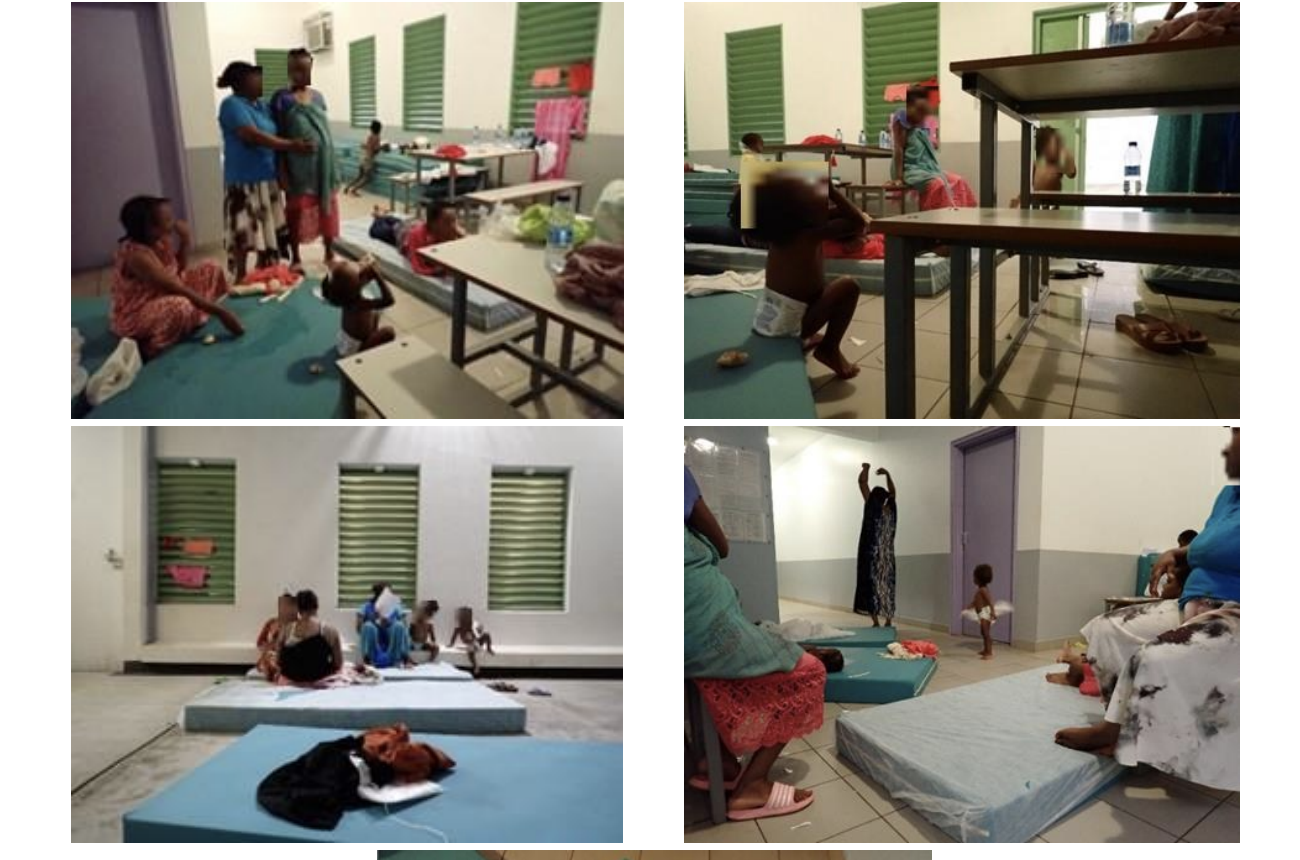
- During its October 2023 visit, the CGLPL visited three LRAs which were in use at the time–the STAPF LRA and the “Zone 7” LRA in Pamandzi, and an LRA adjoining a health-screening facility for new arrivals (Centre d’évaluation de la situation administrative (CESI)). Conditions concerns were noted, such as lack of access to the outdoors; and dirty mattresses placed on the ground.
- Conditions that resemble detention have also been observed at the CESI health-screening facility itself, with persons intercepted at sea forced to spend hours confined in spaces akin to cages.