News broke this week that the Trump administration was planning to “immediately” deport migrants to Libya, a country long condemned by the U.S and the wider international community for its horrific treatment of migrants and asylum seekers. Recent investigations have revealed the existence of mass graves in the southeast of the country containing the bodies of dozens of migrants, some bearing evidence of gunshot wounds. Although the U.S. scheme has yet to be fully confirmed and is already facing strong pushback in U.S. courts and from officials in Libya, the move is in line with a broader Trump administration effort to deport as many people as possible regardless of judicial oversight to countries across the globe, including Panama, El Salvador, Costa Rica, and Rwanda.
According to a 7 May Reuters report, several unnamed U.S officials confirmed to the press agency that authorities plan to deport migrants to the north African nation as soon as wednesday using U.S military aircraft. While Reuters could not confirm how many were slated for deportation, or their nationalities, several media outlets have referred to court filings which note nationalities including Filipinos, Laotians, and Vietnamese. According to lawyers, migrant clients had been told that they would be deported to Libya in coming days.
Libya’s rival governments have both denied the reports that the country will soon be receiving third country nationals from the U.S. In a statement on 7 May, Libya’s National Unity Government said, “The Government of National Unity categorically denies any agreement or coordination with US authorities regarding the deportation of migrants to Libya.” Meanwhile, Khalifa Hiftar’s “Libyan National Army,” which controls the east of the country, said migrants “will not be received through airports and ports secured by the Armed Forces, and that this is completely false and we cannot accept it at all.”
On Wednesday, a federal judge said that the deportation of migrants to Libya would violate a previous court order which he had issued earlier this year. In March, Judge Brian E. Murphy of Massachusetts prohibited the Department of Homeland Security (DHS) from deporting people to third countries without giving them the opportunity to challenge their removal should they have concerns about their safety in said third country. While the Trump administration has argued that Murphy’s order only applies to DHS and not the Department of Defense, which it has since used to conduct deportations such as those to El Salvador, Reuters reports Judge Murphy as arguing that DHS cannot “evade” his order by transferring responsibility to other agencies.
“Crimes Against Humanity”
The U.S., along with much of the international community, has consistently condemned the harsh treatment that migrants and asylum seekers face in Libya, acknowledging systematic abuses and lack of basic safeguards for non-nationals in the country. As the State Department’s most recent Country Report on Human Rights Practices (2023) notes, “migrants routinely experienced unlawful killings, arbitrary detention, torture, sexual exploitation, and other abuses. Perpetrators included state officials, armed groups, smugglers, traffickers, and criminal gangs.”
The UN, meanwhile, has accused actors in the country of committing crimes against humanity. In 2023, the UN Fact Finding Mission to Libya concluded that: “the Mission has found reasonable grounds to believe that since 2016 crimes against humanity have been committed against Libyans and migrants throughout Libya in the context of deprivation of liberty. Notably, the Mission documented and made findings on numerous cases of, inter alia, arbitrary detention, murder, torture, rape, enslavement and enforced disappearance, confirming their widespread practice in Libya. In its assessment of evidence on the treatment of migrants, the Mission concluded that there were reasonable grounds to believe that sexual slavery, as an additional underlying act of crime against humanity, was committed against migrants.”
For years, the GDP has documented reports of widespread abuse in both state and non-state -run detention centres, as well as the involvement of EU countries in supporting Libyan migrant detention and interdiction efforts. Many face indefinite detention in abysmal conditions. Detention sites, often makeshift, are endemically overcrowded; detainees can experience physical mistreatment and torture; forced labour, slavery, and exhortion are rife; and there is a stark absence of oversight. In February this year, footage shared on social media showed a Pakistani migrant–whose detention was being used to exhort a ransom from his family–being tortured by three officials.
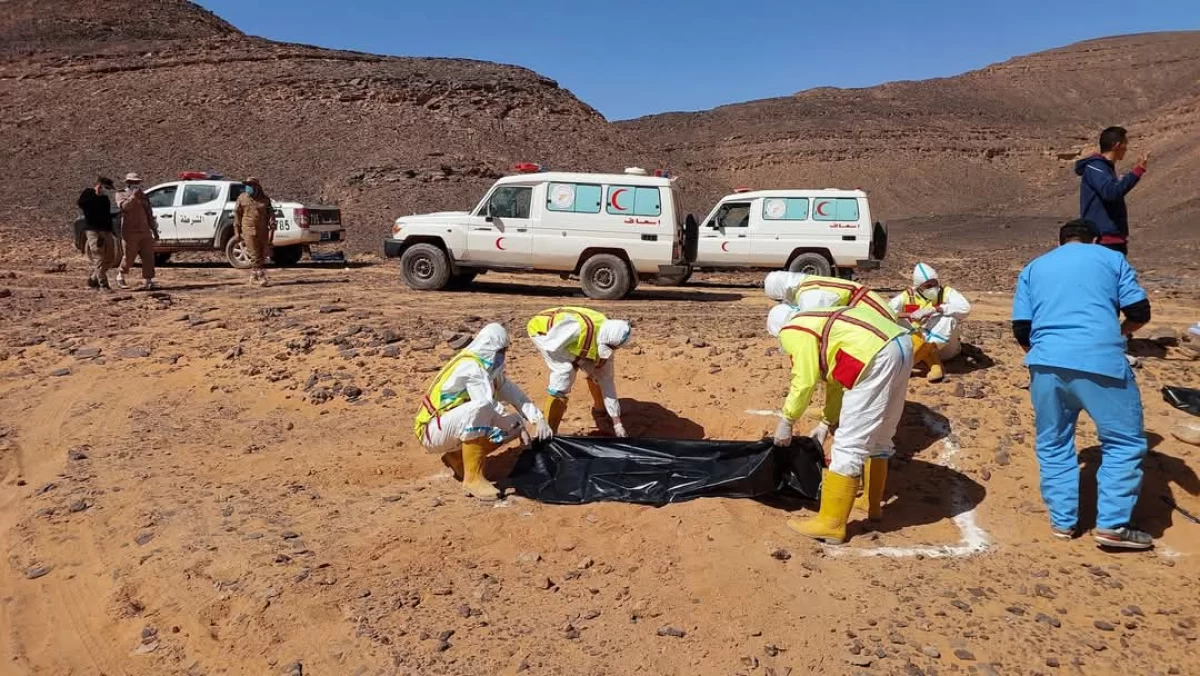
Deaths are frequent. In February this year, authorities in the country found two mass graves in the southeastern desert, containing the bodies of nearly 50 migrants–one of which was found after authorities raided a detention centre. According to the IOM, some of the bodies had gunshot wounds. Last year, 65 bodies were found in a mass grave in southwest Libya–with the IOM stating that it believed they “died in the process of being smuggled through the desert.”
Although the GDP has documented more than 30 detention centres in operation since 2020, the wide variety of actors involved in detaining migrants in Libya–including the government-run Department for Combatting Illegal Migration (DCIM) as well as a host of militias and armed groups–makes it extremely difficult to determine exact numbers of detainees in the country, or even definitive lists of the names and locations of detention facilities currently in operation.
According to UNHCR, as of 28 April 2025 2,663 migrants and asylum seekers (including women and children) were being detained in eight detention centres across the country. The refugee agency also noted that it had documented 15 operational detention centres run by the DCIM. A recent investigation by Forensis meanwhile noted 29 DCIM detention centres (although their operational status was not confirmed). True numbers of detainees and centres will be significantly higher, as there are many other facilities run by non-state actors–often ad-hoc in nature, in areas where government control is weak and which provide no access to humanitarian agencies, lawyers, or civil society organisations.
Outsourcing Detention
While there has been no official public confirmation of the administration’s plans to deport migrants to Libya, such a policy is in-keeping with the White House’s recent efforts to deport migrants and asylum seekers to third countries–with no zero consideration of the risks they may face. In a televised Cabinet meeting last week, U.S Secretary of State Marco Rubio summed up the administration’s disturbing hopes: “We are working with other countries to say, ‘We want to send you some of the most despicable human beings to your countries. Will you do that as a favour to us?’ And the farther away from America, the better, so they can’t come back across the border.”
As the GDP has recently reported, President Trump has overseen a slate of deportation schemes since coming into office, including offshoring detention to the notorious Guantanamo whereby migrants and asylum seekers have been sent to third countries where they have been detained upon arrival. These have included the removal of hundreds to Panama where they have been detained in the notoriously treacherous Darién region, and the deportation of Venezuelans to El Salvador, where they have been imprisoned in the human rights black hole that is the “supermax” CECOT prison.
Costa Rica, too, has received hundreds of non-Costa Rican deportees from the US (including 80 children)–placing them in a detention centre near the border with Panama (the Centro de Atención Temporal para Migrantes (CATEM)) pending repatriation. While the head of the country’s migration authority has claimed that the deportees have not been detained, rights groups disagree. In a recent lawsuit filed against Costa Rica, lawyers claim that the country has violated the rights of child migrants by detaining them for two months and holding them in conditions that “could cause irreparable harm.” In a separate report, the Ombudsman’s Office also cited concerns including the seizure of passports and a lack of translators.
Most recently, Rwanda has confirmed that it is in discussion with the U.S to receive deportees. Less than a year ago, the U.K abandoned a similar plan with the country.