Since early 2025, Crete and the nearby island of Gavdos have seen a sharp increase in the number of refugees, asylum seekers, and migrants arriving from Libya. The islands have quickly become the newest frontline to Greece’s increasingly hardline approach to migration: in July, the government suspended all asylum claims for anyone arriving irregularly from North Africa for a three-month period. At the same time, a new legislative proposal is being considered which would tighten migration rules in line with the new, but not yet adopted, EU Return Regulation. This would introduce a slate of amendments, including the introduction of broader grounds for detention and an extension of the maximum length of detention.
Libya to Crete-Gavdos: The Emergence of a New Refugee Route
Since 2024, growing numbers of refugees, asylum seekers, and migrants have attempted to reach Greece’s southernmost islands (Crete and Gavdos) by sea from Libya. According to Refugee Support Aegean, 7,336 arrivals were documented in the first half of the year–64.4 percent of whom were recorded arriving on the small island of Gavdos. Others arrived at Kaloi Limines, Agia Galini, and Diskos Gortynas in southern Crete. The most common countries of origin were Egypt, Sudan, Bangladesh, and Pakistan. Amongst them have been significant numbers of children–in one small vessel which arrived in Kaloi Limines on 1 March, 22 of the 66 passengers were children. Greece’s Minister of Immigration and Asylum Thanos Plevris, who has publicly praised Trump’s migration policies, stated on TV on 10 July that “Greece is not going to tolerate uncontrolled immigration flows that take on the character of an “invasion” from North Africa.”
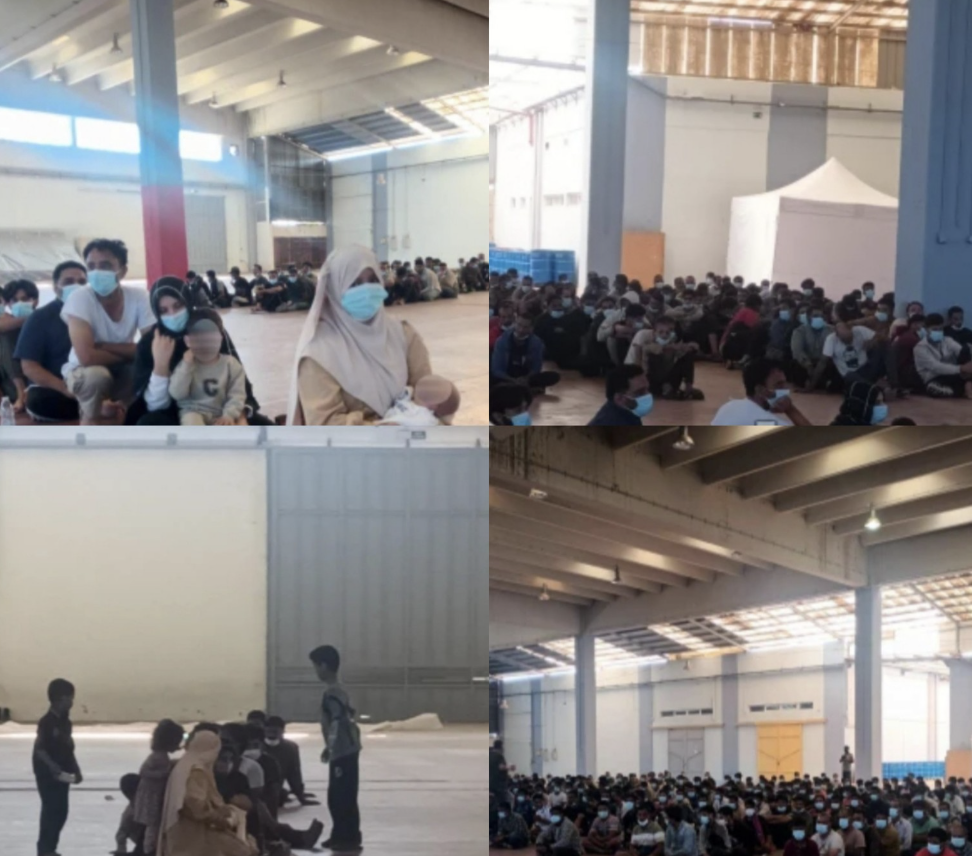
With a lack of first reception areas (despite discussions since 2024 regarding the need to establish short-term accommodation facilities), arrivals were initially temporarily held in makeshift accommodation structures wholly unsuitable for their needs, prior to their transfer to facilities in mainland Greece. These have included an “exhibition structure” outside Chania where media reports have highlighted refugees forced to sleep on thin mattresses or blankets on the floor, and the Cesme football stadium in Rethymno where arrivals slept in tents and were exposed to far-right activists hurling flares. On 6 July, amidst an extreme heatwave, hundreds were even stranded overnight outdoors in Rethymno’s commercial port, amongst them 15 children.
Responding to the situation, Greece announced plans in early July to establish a detention facility in Crete. Reports suggest that the new detention centre plans have evolved into plans to open three new temporary registration centres.
On 11 July, Greece’s parliament voted to approve a three-month suspension of asylum claims for maritime arrivals from North Africa. Under this new framework, all arrivals are to be immediately placed in detention (one of the “PROKEKAs” pre-removal detention centres) under return procedures. Unlike earlier arrivals, those arriving in the wake of the asylum suspension have therefore been taken by boat directly to mainland Greece–reportedly disembarking in Lavrio before being transferred to detention centres. Plevris stated on TV: “The message is clear: safe ‘refuge’ is no longer offered though a formal asylum application. … Those who are not entitled to asylum will be detained.” Authorities now say that the suspension may be extended beyond the initial three months.
The controversial policy, however, has been denounced by the European Court of Human Rights, which recently blocked Greece from deporting eight Sudanese men who had been detained in the Amygdaleza Pre-Removal Detention Centre following their arrival in Crete, where they were denied the opportunity to apply for asylum. Commenting on the case, Refugee Support Aegean stated: “This order also signals a recognition of the serious risks they face upon removal, which constitute valid grounds for their asylum applications.”
Negotiating with Libya
Greece has also been intensifying efforts to collaborate with Libya to block the route–both with Libya’s eastern-based Haftar-led administration and the official government based in Tripoli. This has included hosting and delivering training to Libyan coast guard officials in Crete to bolster their efforts in intercepting and returning irregular vessels, which media outlets report has been provided to officers from both eastern and western Libya. The Greek Navy has also deployed two naval frigates to patrol the international waters around Libya to thwart irregular crossings. According to the Washington Post, Plevris and his European counterparts have also discussed the option of establishing centres in Libya.
Greek cooperation with Libya mirrors a broader pattern across the European Union in which Member States have actively supported Libyan migrant detention and interdiction efforts. But as the Global Detention Project has documented, non-nationals face widespread abuse in both state and non-state detention centres–with many facing indefinite detention in abysmal conditions. In July, ahead of a visit by the EU’s Migration Commissioner and EU ministers (amongst them Plevris) to Libya to conduct discussions on enhanced migration management cooperation, Amnesty called such policies “morally bankrupt” and warned that “Instead of addressing the catastrophic human cost of its migration deals in Libya and beyond, the EU and its member states are doubling down – trapping more and more people in abhorrent cycles of abuse.”
Changes to the Law on the Return of Third Country Nationals
In another move reflecting the country’s increasingly hardline approach to migration, on 17 July Greece’s Minister of Migration and Asylum submitted a legislative proposal for public consultation, titled “Reform of the framework and procedures for the return of third-country nationals.” The proposal is heavily inspired by the European Commission’s proposal for a New Common European System for Returns (Return Regulation), published in March 2025 – despite the fact that it has not yet been adopted by the European Parliament and Council.
Amongst the proposed changes:
- Extending the maximum length of immigration detention from 18 to 24 months.
- Introduction of new scenarios where detention can be used, including automatic detention if obligations imposed on a returnee to avoid the risk of absconding are breached, or if an individual fails to comply with a voluntary return period–omitting the obligation to consider less coercive alternatives, and irrespective of international standards requiring individual assessments of necessity and proportionality.
- Criminalisation of irregular entry/stay/exit, and expansion of penalties. Currently, non-nationals who enter or exit irregularly face penalties of 3 months’ imprisonment and a 1,500 EUR fine. The new proposal, however, expands these to a minimum of two years’ imprisonment and a fine of at least 5,000 EUR. In May, former Minister of Immigration and Asylum Makis Voridis stated that “the illegal immigrant is forced to reveal his real identity and return to his homeland to avoid prison.”·
- Reduction to the period of voluntary departure from a maximum of 25 days to a maximum of 14 days, and introduction of electronic monitoring for individuals during the voluntary departure period.
* * * *
Edit: On 3 September, the Greek Parliament approved the legislative proposal. Read more.