In recent years, Algeria has ramped up its detention and deportation operations in response to mounting pressure from Europe. Working increasingly with both neighbouring and European countries, Algerian authorities have conducted targeted raids, used an extensive network of formal and informal detention sites, and carried out (often violent) crossborder pushbacks to Niger and elsewhere. Moroccan migrants have been among the recent targets, sparking outrage in Morocco and prompting detainees’ relatives to campaign for their release and repatriation.
The Detention of Moroccans
As Morocco has intensified its crackdown on irregular migrants–the result of growing pressure from the EU and Spain–increasing numbers of migrants (Moroccans and non-Moroccans alike) have entered Algeria in order to attempt the journey to Spain or Italy from the Algerian coastline. Many, however, have been apprehended by Algerian authorities and detained for irregular entry and exit.
In Morocco, a country that has a long history of strained and bitter relations with Algiers, organisations such as the Moroccan Association for Aid to Migrants in Vulnerable Situations (AMSV), as well as detainees’ friends and relatives, have campaigned for the release and repatriation of detained Moroccans. Many have also called for the provision of legal, social, and psychological support for those detained, and greater transparency surrounding migrants’ detention.
Some have been released as a result of this sustained campaign: on 29 May, 39 Moroccans were returned via the Jouj Bghal border–amongst them mothers with children. Others, however, have not been so fortunate. On 5 June, the bodies of two Moroccan migrants who disappeared in Algeria were repatriated.
Border Enforcer
While Algeria once boasted a reputation as a champion of anti-colonial and pan-African solidarity, welcoming refugees and asylum seekers (including tens of thousands of Sahrawi refugees from Western Sahara) and eschewing cooperation with the EU in “migration management” schemes, authorities have sharply changed course and significantly stepped up anti-migration policies and discourses–particularly since 2023.
A recent report published by the Forum Tunisien pour les Droits Economiques et Sociaux (FTDES) highlights a number of aggressive enforcement tactics, including: stepped up beach patrols around key departure points like Oran and Annaba; the construction of walls along coast roads to prevent people from carrying boats to the beach; imposition of movement restrictions by instructing transport companies to carry out residency and ID checks; coordinated raids targeting neighbourhoods known to be housing migrants; the detention of thousands of foreigners in a broad array of detention sites; and the expulsion of untold numbers of migrants into Niger and Libya. Organisations that previously supported people on the move in the country have been shut down or criminalised, mirroring the shuttering of organisations in Libya and Tunisia.
As the Global Detention Project has previously reported, for much of its recent history Algeria had rejected cooperation with the EU on migration control schemes, in sharp contrast to other North African countries like Libya, Morocco, Tunisia, and Mauritania, all of whom have signed bilateral agreements with Brussels. This was notably apparent when the country rejected proposals in 2018 to establish EU-funded “disembarkation centres” to process asylum seekers and migrants. However, the FTDES report notes that more recently Algeria has “extensively engaged with the border regime industry, adopted narratives and policies similar to those promoted by the EU and its affiliates, and used migration as a bargaining chip vis-a-vis the Global North and in relations with some of its African neighbours.”
Under President Abdelmajid Tebboune and army Chief Saïd Chengriha, Algeria has broadened cooperation with European countries like Italy, as well as international organisations such as the IOM, Frontex, ICMPD, the EU Agency for Law Enforcement Training (CEPOL), and Interpol, among others. In January 2025 for example, Algeria and Italy signed a bilateral protocol on police training, which included a focus on “combat against illegal migration, drug trafficking and organised crime networks.”
While the EU does not directly channel funds to the Algerian government, FTDES reports that money is still transferred through international partners. It notes: “The Algerian government is nevertheless participating in EU-funded fora that facilitate informal exchanges on (anti-)migration policies and provide for the training of law enforcement and civilian officials.”
“Desert Dumps” and “Chain Deportations”
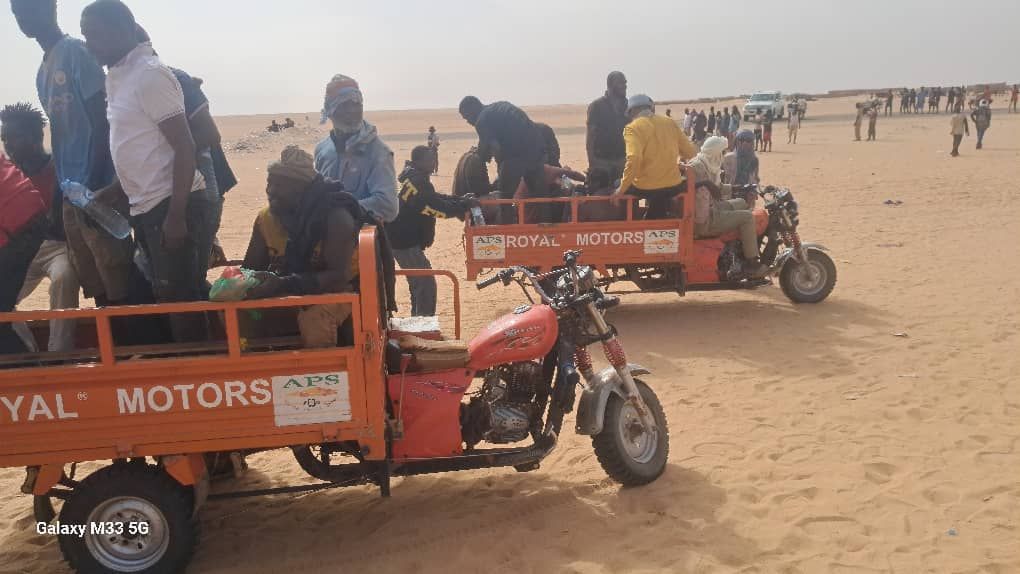
In addition to the arrest and detention of irregular migrants, Algerian authorities have increasingly implemented a policy that humanitarian organisations refer to as “desert dumps.” This practice entails the detention of large numbers of migrants, often in Tamanrasset, transporting them by truck to the so-called “zero point”on the Algerian-Nigerien border, and abandoning them without food, water, or shelter. Children, women, and men must then walk about 15km through desert terrain to Assamaka. According to FTDES, the frequency and volume of expulsions has become so large that the IOM and local authorities in Niger have installed signposts to Assamaka along the 15km route. Authorities have also pursued this practice at the Libyan border.
While Algerian authorities acknowledge official deportations, conducted in cooperation with Nigerien authorities, they have often denied the existence of “unofficial convoys” and do not provide any statistics related to the practice. However, according to Alarm Phone Sahara (APS)–a network that documents expulsions to Niger–31,404 people were expelled to Niger in 2024. More recently, the group reports that as many as 2,222 people (including 146 Nigeriens) were deported in unofficial convoys between just 1-21 April this year.
APS has also documented numerous deaths “caused by the conditions of expulsion”–including five in March and April this year alone. They state: “Given the difficult conditions in Algerian detention centres and during transport in the back of trucks, as well as the ill-treatment inflicted, many people arrive sick, injured or with fractures.” Previously, in April 2024, Algeria’s ambassador to Niger was summoned to a meeting by the government given the “violent nature” of the expulsions.
For many, however, their ordeal did not start in Algeria. According to FTDES, an informal corridor of expulsion exists whereby migrants are apprehended in Tunisia, pushed across the border into Algeria, re-detained in Algeria, and transported south for expulsion into NIger. This pattern has been referred to by observers as “chain deportations,” and has been extensively documented by organisations including APS and the World Organisation Against Torture.
As well as this ad-hoc “cooperation,” the Rosa Luxemburg Foundation highlights the fact that Tunisia, Libya, and Algeria have co-ordinated their crackdowns against people on the move since early 2024. “At a high-level summit in Tunis in April 2024, Algeria’s President Abdelmadjid Tebboune, Tunisia’s head of state Kais Saied, and Mohamed al-Menfi, who governs western Libya, agreed that they would henceforth align their (anti-)migration policies. Just weeks later, the interior ministers of the three states met with their Italian counterpart in Rome, also with the aim of further expanding migration control coordination.” FTDES describes this as “regional integration that is increasingly prioritising the coordination of reprisals against undocumented people and the fortification of borders.”
Wider Detention Context
⭕ Algeria employs a range of detention facilities–including prisons, gendarmerie bases, and detention centres, as well ad-hoc sites like apartments. Although the country provides little transparency surrounding detention, with observers and civil society groups generally denied access to facilities, what little is known about detention sites suggests that conditions are generally very poor. In 2018, OHCHR stated that detention conditions are “reported to be inhuman and degrading,” and the Committee on Migrant Workers has also noted the “inadequate conditions of detention.” More recently, the New York Times reported that testimonies revealed “horrendous” conditions, with the newspaper speaking to one migrant who described detainees being so thirsty “that they stole each other’s bottles of urine.”
⭕ Key legislation governing immigration detention in Algeria:
- Law No. 08-11 Relating to the Conditions of Entry, Stay and Movement of Foreigners in Algeria (2008) – established conditions for legal entry, stay, and exit, as well as grounds for criminal incarceration if these conditions are not met.
- Article 37 of Law No. 08-11 allows for the establishment of “waiting centres” to detain people prior to expulsion. Individuals have 5 days to appeal an expulsion order.
- Law 09-01 (March 2009) (a reform to Algeria’s penal code) makes irregular entries and departures outside regular border points a criminal offense, punishable by prison terms of two to six months, and fines. Repeat offenders are liable to prison terms of 10 to 20 years.
⭕ Algeria is in the process of drafting an asylum law. According to FTDES, like Egypt (which introduced a controversial asylum law in December 2024 that moved refugee status determination from UNHCR to the Egyptian state), Algeria’s new law “aims at regulating the UN refugee agency UNHCR more closely, and at gradually transforming the organisation’s Algiers branch into a mere service provider.” However, as Algeria’s law is still in the early stages, UNHCR’s precise future role remains unclear.