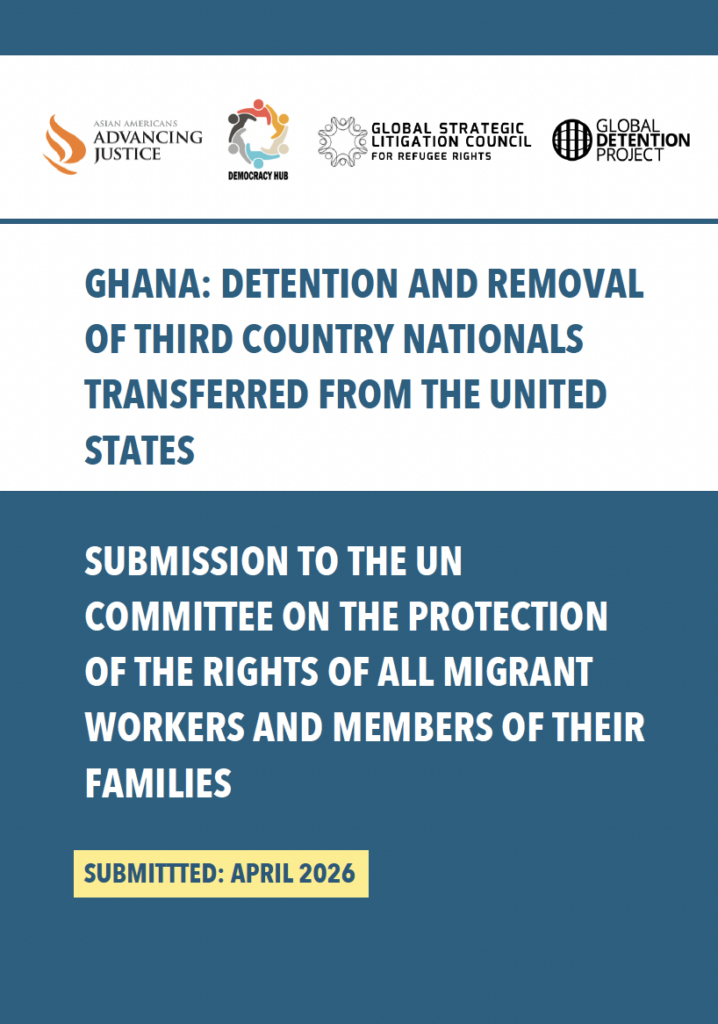
Together with Asian Americans Advancing Justice, the Ghana-based Democracy Hub, and the Global Strategic Litigation Council, the Global Detention Project has urged the UN Committee on Migrant Workers to assess the country’s recent agreement with the United States to accept deported third-country nationals, as well as its subsequent detention and removal of these individuals.
In September 2025, Ghana confirmed that it had reached an understanding with the United States to receive deported West African nationals from US immigration detention facilities. However, public information on Ghana’s arrangement with the United States remains limited. The Government has acknowledged an arrangement under which Ghana received West Africa nationals deported from the United States. However the actual MOU, agreement, operational protocol, or exchange of correspondence has not been publicly disclosed. The US Supreme Court has ordered that the MOU be disclosed by giving litigants access to view it. As of April 2026, however, access had not yet been provided.
Because the Ghanaian government has not been transparent about the operation of the arrangement, the exact number of persons deported into Ghana is currently unknown. As of early 2026, Asian Americans Advancing Justice, Democracy Hub, and the Global Strategic Litigation Council have been working directly with 34 deportees (23 men and 11 women aged between 21 – 65), but based on available information, anticipate that the total number of persons brought into Ghana under the arrangement may be between 70 and 100.
Upon arrival in Ghana, the third country nationals were detained under armed guard in military camps including Dema Camp/Bundase Training Camp, a hotel, and holding cells at Kotoka Airport for days and weeks until they were refouled or deported.
Victims described the military camp as an indoor-outdoor compound surrounded by wilderness “in the middle of nowhere.” They described the sleeping quarters as one large room filled with mosquitos. Victims were given beds, but no bedding. The bathroom was squalid and had an overpowering smell of urine and faeces. The food and water were of poor quality, causing several people to fall ill. Individuals reported having symptoms of malaria while detained in the camp. Access to phones and WiFi was intermittent, limiting victims’ contact with lawyers and loved ones. At times, guards confiscated victims’ phones or disabled the WiFi as punishment. (According to a declaration by the wife of one of the detainees, on 15 September camp officials informed the detainees that they would no longer permit them access to the internet.)
Most were then refouled to their home countries, including to Nigeria, Senegal, Sierra Leone, Togo, and Mali where they feared persecution. This raises serious concerns that Ghana’s reception, detention, and onward transfer of these individuals may have exposed them to indirect or chain refoulement, contrary to Ghanaian constitutional law, refugee law, and international human rights obligations.