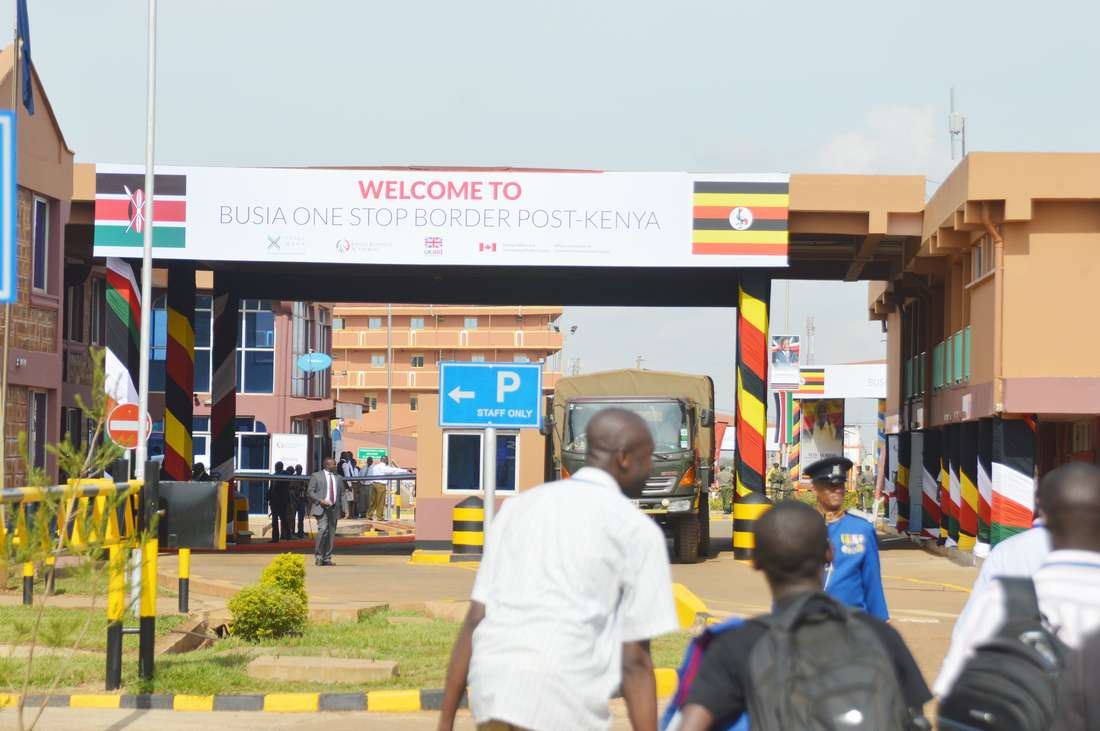
In February, the UK and Kenya signed a Memorandum of Understanding on “collaborative border security,” reinforcing a bilateral partnership on migration that reflects Kenya’s securitised approach to migration and refugee issues, which includes the use of dozens of police stations and prisons across the country for immigration detention purposes. In contrast, Kenya’s National Commission on Human Rights joined counterparts from Ethiopia, Mozambique, and Zambia in a recent public demand for stronger protections for migrants travelling along the so-called “Southern Route,” warning of escalating rights abuses linked to increasingly enforcement-driven approaches.
“Collaborative Border Security”
According to a press release from Kenya’s Ministry of Interior, the Memorandum of Understanding (MOU) signed between the UK and Kenya aims to “strengthen border security cooperation and stability in the borderlands”–with aims for “coordinated interventions to protect citizens and communities from irregular migration” amongst its stated goals. During its initial phase, cooperation “is expected to enhance evidence-based understanding of mixed migration, organized crime, and protection risks to inform policy and operational responses.”
The news of this latest MOU comes at a time of increased concern regarding the safety of migrants on the so-called “Southern Route” (the migration corridor in eastern and southern Africa). In December 2025, Kenya’s National Commission on Human Rights joined the human rights commissions of Ethiopia, Mozambique, and Zambia in calling for improved safety for migrants on the route, noting rising securitisation of migration and its effects in reconfiguring migration routes, with migrants making increasingly dangerous journeys. In particular, they voiced concern for the “grave protection risks migrants face in cross border irregular migration including exploitation, human trafficking, sexual and gender-based violence, arbitrary detention, violence and discrimination.” Calling on national governments to “adopt human rights-based approach in migration governance,” they called on countries to ratify and implement the Migrant Workers Convention, and to “faithfully implement” the Global Compact for Migration.
According to the Mixed Migration Centre, the Southern Route has become increasingly popular during the past two decades. It notes, however, that “the vulnerability of those attempting the route is exacerbated by the fact that authorities are increasingly focusing their efforts on enforcement, with at least 6,000 migrants from the Horn of Africa currently in detention in various transit countries, some for extended periods.”
Commenting on the MOU, Shadrack Kuyoh of the Refugee Consortium of Kenya (RCK), a Global Detention Project partner in Kenya, stressed that any bilateral MOU needed to be carefully “grounded in and harmonised with existing human rights protection frameworks.” He highlighted the importance of balancing any security agreements with the adoption of strategies that de-emphasise detention and focus instead on “the employment of case management and community placement” of refugees and other vulnerable non-citizens.
Blanket Detentions Amidst Increased Securitisation
In recent years Kenya has increasingly viewed irregular migration as a matter of security, often portraying migrants as security threats rather than individuals in need of protection or assistance. As the country’s 2025 Annual Report on the State of National Security explicitly states:
“Kenya serves both as a destination and a transit hub for both regular and illegal immigrants from East and Central Africa, the Great Lakes and the Horn of Africa regions. Many of these aliens, fleeing conflict, violence, and persecution enter the country without proper documentation, creating significant security challenges.”
This is reflected in the country’s legislation, which treats irregular entry and stay as criminal offences. Article 53 of the 2011 Kenya Citizenship and Immigration Law provides fines for up to 500,000 KES (approximately 3,300 EUR) and/or imprisonment for up to three years.
Article 43 of Kenya’s 2011 Citizenship and Immigration Law also provides that all persons ordered to be deported from the country may “be kept and remain in police custody, prison or immigration holding facility,” and the country’s 2021 Refugee Law similarly permits the use of prisons, police stations, and immigration detention facilities as “transit centres” for asylum seekers while their protection applications are processed. (Of additional concern, Article 19(2) of the Refugee Law also includes provisions allowing exceptions to the principle of non-refoulement on the basis of public morality.)
According to the Kenyan National Commission for Human Rights (KCNHR), irregular arrivals tend to be apprehended in border areas and detained in “immigration holding areas” in prisons and police stations for brief periods before a decision is made on their cases. Based on various reports from the RCK, since 2024, Kenya has used approximately 50 prisons and police stations for holding migrants for criminal prosecution or for administrative reasons.
The criminalisation of all irregular entry coupled with limited identification mechanisms leaves vulnerable arrivals, such as asylum seekers and trafficking victims, facing automatic detention. Indeed, even when persons present themselves at the border seeking protection, they can be branded trafficking victims, apprehended, and transported to police stations where they are placed in custody without any Refugee Status Determination interviews being conducted. Thus, As the KCNHR notes:
“[T]his blanket approach results in the detention of victims of trafficking and smuggling as they often commit infractions or offences such as irregular entry, use of false documents and other violations of immigration laws and regulations. These offences are often punished as criminal offences and victims of trafficking are thus often detained and deported without regard for their assistance, re-victimization and consideration of the risks they may be exposed to if returned to their country of origin.”
According to the Annual Report on the State of National Security, between September 2024 and August 2025, 953 irregular migrants were apprehended –with Ethiopians accounting for 650 of these arrests, followed by Somalis, Burundians, and Eritreans. The same period in 2023-2024 saw 1,498 arrests. Media outlets commonly report on the apprehension of suspected victims of trafficking, and their placement in police stations. In July 2025, for example, 105 Eritreans were found near the Ugandan border and held at Alale Police Station “under tight security.”
Commenting on the detention of vulnerable individuals, Shadrack Kuyoh (RCK) said: “Kenya must shift from mass arrests and detention to individualised screenings. The RCK has been supporting this, in close collaboration with the government, with efforts to strengthen the capacity and training of frontline officials such as the police and immigration officers in order to sustainably improve vulnerability assessments–particularly so that children, asylum seekers, and victims of trafficking can be identified and protected from automatic detention.”
The detention of non-nationals in criminal facilities, however, raises a multitude of concerns–particularly regarding the placement of vulnerable individuals alongside convicted criminals, and the lack of personnel specifically trained and equipped to support non-nationals. As the UN Committee on the Elimination of Racial Discrimination stated in its recent joint General Recommendation no.39 (no.8 with the UN Committee on Migrant Workers):
“States Parties should ensure that measures and practices on migration-related detention are different from those used in policies for addressing criminal issues. They should take adequate measures to guarantee that the facilities and all conditions of migration-related detention are entirely different from those of the criminal system.”
Targeting Refugees and Asylum Seekers
Kenya is one of Africa’s largest refugee-hosting countries. As of February 2026, there were 836,466 refugees and asylum seekers in Kenya. Forty four percent of them live in Dadaab Refugee Camp, forty percent in Kakuma, and sixteen percent in urban areas. However, refugee communities have often been framed as security risks by authorities. In 2014 for example, the Somali community was targeted in a security crackdown following several terrorist attacks, with thousands arrested and detained–as detailed by Amnesty. More recently, authorities have repeatedly attempted to close Dadaab and Kakuma refugee camps, citing security concerns and the “threat of terrorism.”
In a July 2025 directive, the country’s Commissioner for Refugee Affairs suspended the registration of asylum seekers from Ethiopia and Eritrea, as well as the processing of exemptions allowing refugees to live outside camps. A consortium of NGOs challenged the directive in court, arguing that by suspending registration, persons seeking protection would be denied lawful recognition, exposing them to arbitrary arrest, detention, and deportation–as well as refoulement.
The Commissioner for Refugee Affairs, meanwhile, held that the principle of non-refoulement is not absolute, and claimed that “asylum seekers of Ethiopian and Eritrean nationalities misuse the asylum process while being trafficked and smuggled through the country to final destinations in South Africa and beyond.” In November 2025, a Kenyan high court ruled that the blanket suspension was unlawful, and ordered the government to resume registration of Ethiopian and Eritrean asylum seekers.