Amidst growing numbers of irregular departures from eastern Libya towards the Greek islands of Gavdos and Crete, internal EU documents reveal plans to collaborate with the country’s de facto leader Gen. Khalifa Haftar to intercept irregularly departing migrants. The plans could significantly expand Libya’s migrant “pullbacks,” leading to more people being stranded in the country’s network of detention facilities, which have been repeatedly denounced for their inhuman conditions.
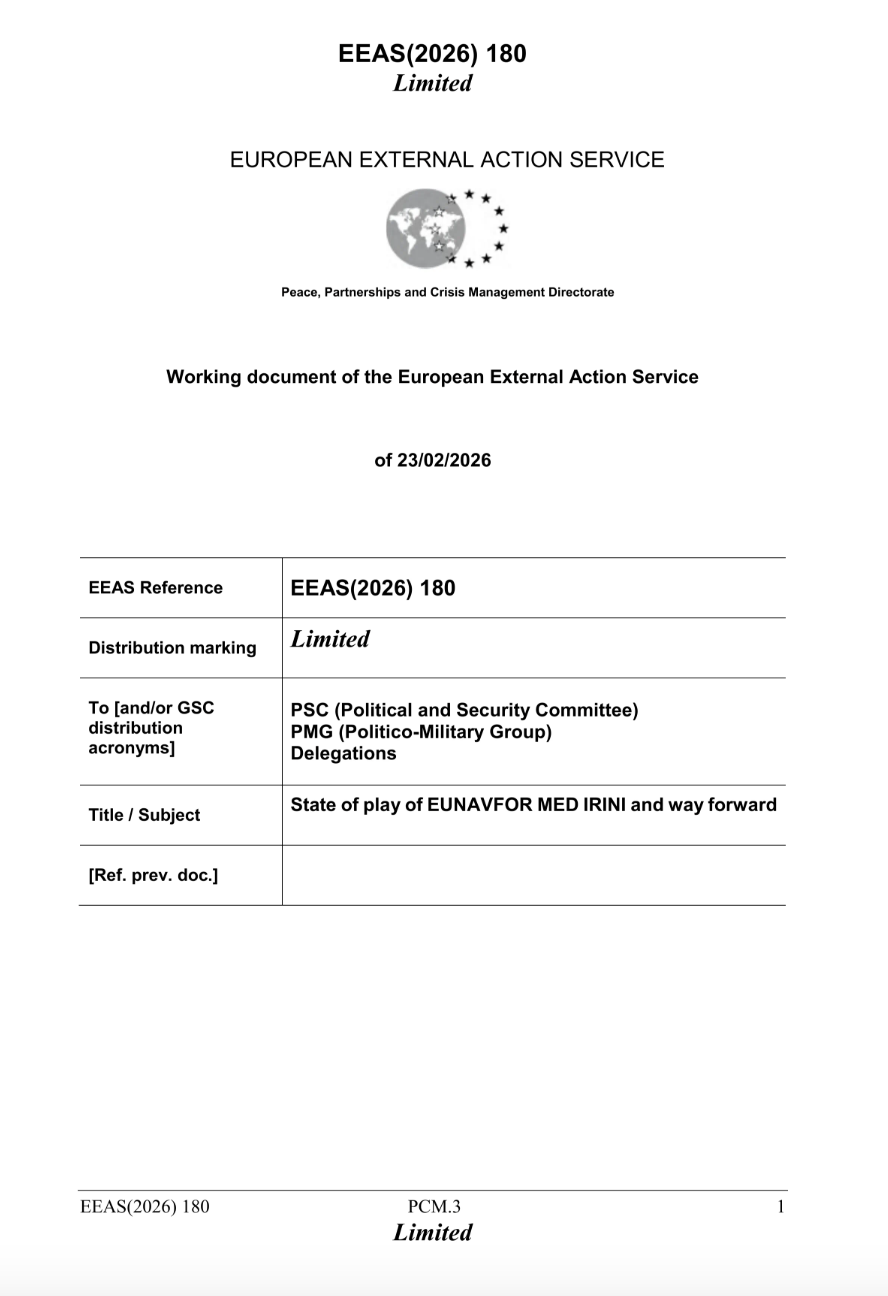
Internal EU documents published by FragDenStaat, a German freedom of information platform, indicate EU plans to collaborate with General Haftar’s authorities in intercepting boats irregularly departing from eastern Libya. In particular, the documents reveal plans to implement a “Maritime Rescue Coordination Centre (MRCC)” project in Benghazi, to coordinate the interception of migrant boats in the area–replicating the MRCC established in Tripoli. According to an article published by a German news outlet (nd) in January, the project–an Italian initiative– is still in its initial phases, with start-up funding worth three million EUR via the EU’s “European Peace Facility.”
These plans are seen as a response to the growing numbers of migrant boats departing from eastern Libya. Despite a decrease in the overall numbers of irregular migrants entering Europe in 2025, data shared by the Greek Coastguard reveals that the number of migrants arriving in Crete and Gavdos from Libya significantly increased last year. More than 19,000 arrivals were documented–a 400 percent increase on 2024’s arrival numbers. According to Frontex, by August 2025 it appeared that a “new migratory corridor between Eastern Libya and Crete” had developed.
In explaining the growing arrivals from eastern Libya, analysts point to increased interceptions from western Libya: Between January and October, some 22,509 were intercepted and returned to the country, compared to 21,762 through all of 2024. As the GDP has frequently documented: as one route becomes more securitised, another tends to emerge.
The EU has only minimally collaborated with Haftar and his armed faction in eastern Libya. However, Brussels has cooperated extensively with the UN-recognised Government of National Unity (GNU) in Tripoli in trying to prevent irregular crossings. This support has included financial and technical support to the Libyan Coast Guard (LCG) –a group of inter-linked militias and semi-state entities linked to the GNU.
As well as direct funding, the EU has supplied the LCG with vessels, equipment, and training, strengthening its ability to conduct “pullbacks” of irregularly departing migrant vessels. Frontex, too, has shared aerial surveillance data with the LCG, enabling interception: since January 2021, it has reportedly transmitted more than 2,200 communications containing geolocation data of migrant vessels. According to IOM data, an estimated 145,437 people were intercepted and returned to Libya between January 2018 and September 2025. Although there are countless reports of violence and abuses committed by the LCG–with the UN Independent Fact-Finding Mission on Libya stating in 2023 that there were reasonable grounds to believe that the LCG was involved in crimes against humanity–and calls from NGOs, MEPs, and activists to sever support, the EU financing has continued to bolster them.
More Pullbacks, More Detentions
The abuses faced by migrants and asylum seekers following their interception at sea have long been documented by civil society organisations and rights monitors. Following interception, they are typically forcibly returned to disembarkation points along the Libyan coastline (of which there are at least 11), upon which migrants are transferred to either “official” detention centres or unofficial and illegal facilities operated by militias and traffickers. This is enabled by Libya’s Law No. 19 of 2010 on Combating Illegal Migration, which criminalises irregular entry, stay, and exit.
According to the latest report from OHCHR and the UN Support Mission in Libya (UNSMIL), as of January 2026 there were at least 40 official, unofficial, and illegal detention facilities operating in the country (17 of which are in Tripoli). Monitoring by UNSMIL and OHCHR documented ongoing rights abuses in these facilities, including the trafficking of detainees, violence (including sexual violence), torture, exploitation, forced labour, extortion, and inhumane detention conditions. A former detainee, who had been held in Ain Zara for over a year and a half, is cited by the agencies stating: “If you fail to pay the ransom or refuse to work, you are deprived of food and beaten by the prison guards. This is the routine.”
Describing a “brutal and normalized reality,” the agencies present evidence depicting a country-wide system of torture and abuse. Among the documented cases they recorded, they highlight evidence of detainees being shot in al-Assa unofficial detention facility; beatings and whipping of detainees (including children) in Ajdabiya detention facility; the deaths of dozens of migrants since December 2024 in Sabha and Brak al-Shati detention centres from tuberculosis and starvation; and the detention of 900 persons in Tobruk detention centre, a centre built for 150 people.
The persistence of these abuses raises serious questions about the role of external actors whose financial, technical, and operational support enables interception operations that ultimately return migrants to Libya’s detention system. As UNSMIL and OHCHR conclude: “Countries and regional organizations cooperating with Libyan authorities in border and migration management bear a specific responsibility to ensure that any technical, financial or operational support is grounded in human rights due diligence and the ‘do no harm’ principle. Such cooperation must be grounded in a rights-based and victim-centred approach, supported by robust risk assessments, safeguards, and monitoring – and suspended where the risk of violations and abuses cannot be effectively mitigated.”