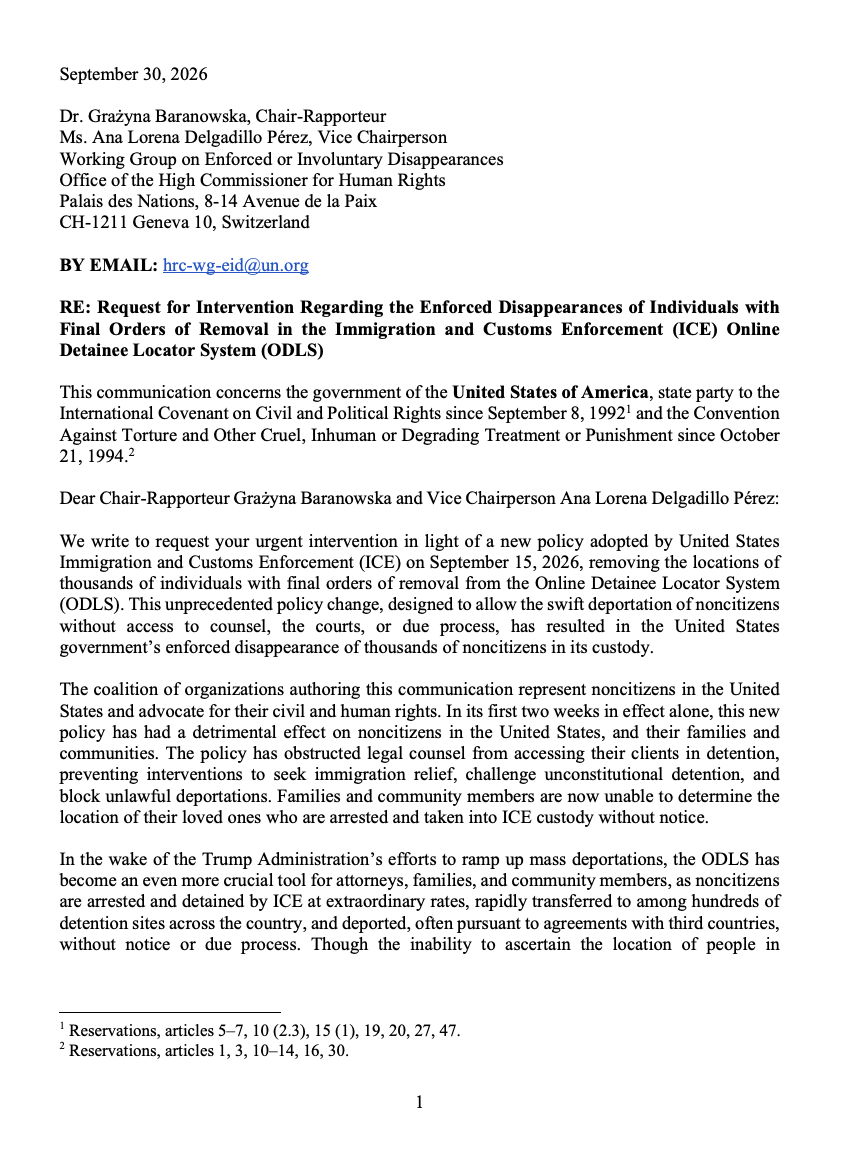
On 15 September, U.S Immigration and Customs Enforcement (ICE) removed the locations of individuals with final orders of removal from its Online Detainee Locator System. Responding to this development, a coalition of NGOs has called on the UN Working Group on enforced or involuntary disappearances to intervene.
Established in 2010, ICE’s Online Detainee Locator System (ODLS) provides users with information on a detainee’s whereabouts. This system has been a crucial tool for detainees’ friends and relatives, attorneys, and NGOs, who are operating in a context in which immigration detainees are frequently transferred between detention facilities, and deported without notice or due process. In some cases, these deportations are to third countries where they have no prior connections, have been locked up indefinitely, or chained refouled back to situations of harm.
On 15 September 2026, with no warning, ICE removed thousands of individuals with final orders of removal from the ODLS, critically handicapping the ability of advocates and family members to remain informed. In an urgent letter to the UN Working Group on enforced or involuntary disappearances, a coalition of organisations–including Amnesty International, Human Rights First, Refugees International, and the Robert & Ethel Kennedy Human Rights Center–have called on the Working Group to demand that the U.S. government “end ICE’s new ODLS policy, immediately restoring the access of noncitizens’ locations on the ODLS.”
The NGOs have also called on the UN expert body to characterise ICE’s policy as a form of enforced disappearance. The letter notes:
“Under the new ODLS policy, the U.S. government has deprived noncitizens of their liberty, placed them outside the protection of the law, and deprived them of fundamental rights, while denying families, community members, and attorneys access to information about their fate and whereabouts. The new ODLS policy is aimed at forcibly disappearing and secretly detaining noncitizens with final orders of removal. By subjecting noncitizens to this policy, the United States has placed these individuals beyond the reach of legal protections, and rendered them particularly vulnerable to unlawful detention and deportation.”