“These actions … appear to be part of a pattern and widespread effort to evade the [U.S] government’s legal obligations by doing indirectly what it cannot do directly.” U.S Federal Judge Chutkan, September 2025.
___
In September, Reuters reported that Ghana had agreed to accept West African nationals deported from the United States under a new agreement between the two countries–marking yet another expansion of the Trump Administration’s unprecedented efforts to summarily deport irregular migrants to third countries. Shortly after their arrival in Ghana, some of the deportees were reportedly expelled to Togo. Ghana was previously accused, in 2023, of unlawfully expelling refugees from Burkina Faso, undermining the country’s commitment to international legal standards.
In early September, the United States began to deport West African migrants to Ghana–with an initial group of 14 West African immigrants (from Nigeria, Liberia, Togo, Gambia, and Mali ) sent to the country. According to sworn declarations submitted to the U.S District Court for the District of Columbia by some of those deported, the group were taken from the Alexandria Staging Facility in Louisiana in the middle of the night on 5 September, many of them shackled at the waist, hands, and feet, and put on a military cargo plane. They were not informed where they were going until the plane had departed, and some were placed in straight jackets.
One described this experience: “I remained straitjacketed for several hours until I pleaded with the officers to remove it so that I could use the restroom. I begged the officers over and over again to take off the straitjacket so that I could use the restroom, otherwise I would urinate on myself. They finally removed the restraints on my legs after pleading with them for a long time, but left the restraints on my upper body. Because the straitjacket was so tight on my legs, I now have difficulty walking. My legs are extremely swollen to the point that I can only limp to move around.”
Since then, more people have been deported to the country: as of 15 October, 42 deportees have arrived in Ghana.
Humanitarianism?
Ghana has framed the acceptance of these deportees as a humanitarian gesture. On X, the country’s ‘Information Services Department’ stated: “The Government of Ghana took the principled and humanitarian decision to accept the limited number of West African nationals deported from the United States under exceptional circumstances in line with Ghana’s longstanding Pan-African ideals and unwavering commitment to regional solidarity. Many of these individuals were being held in detention which was both psychologically and physically distressing. … As a nation that upholds the dignity and rights of all people, particularly those of African descent, Ghana’s action was guided solely by our moral responsibility, our legal obligations under the 1992 Constitution and ECOWAS protocol, our distinguished Pan-African track record and historic and legendary leadership in championing the rights of all Africans.”
In reality, however, deportees have faced a host of abuses in Ghana. Upon arrival, one of the deportees describes being detained at the airport for five days “with no access to phones, no showers, and no change of clothes.” Two others were quickly returned to their countries of origin. Meanwhile, although Ghanaian authorities said that all of the deportees had “since been assisted to return to their home countries,” lawyers for the deportees contested this. In a complaint, they said that 11 of them were being detained in a military camp outside Accra, an “open-air detention facility surrounded by armed military guards.”
According to their lawsuit, the group had not violated any Ghanaian law and therefore their detention in the camp was illegal. Further, it notes that they should be immediately released and protected against deportation to their home countries (eight of the detainees report that they had legal protections against deportation to their countries of origin due to the risk of torture, persecution, or inhumane treatment.) As one of the detainees stated in a sworn declaration on 13 September: “We are all afraid for our lives. We are not safe here, and now they are planning to hand us over to our country’s government for further persecution and torture. We don’t know what our futures hold.”
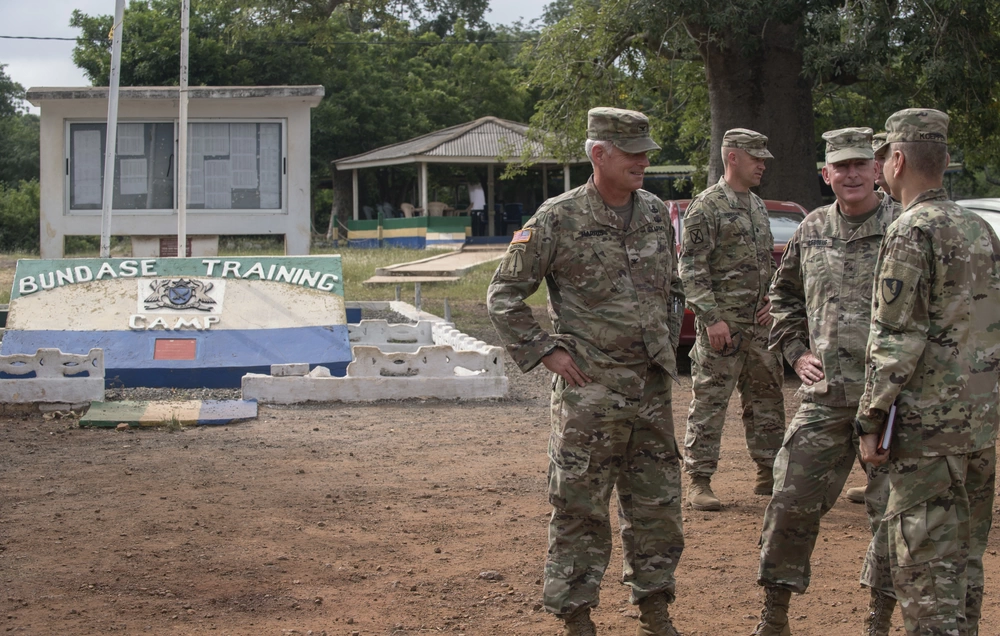
This camp–the Bundase Training Camp (also referred to as Dema Camp)–is a Ghanaian military training facility that has been used to host multilateral peacekeeping training exercises, and which has benefited from direct U.S support as part of the U.S State Department’s Global Peace Operations Initiative. The detainees reportedly spoke to the Associated Press by phone from the camp, and described “terrible” conditions–including the fact that at least one had contracted Malaria “due to bad water and bad food.” Other reports also mention exposure to heat, mosquitoes, and unsanitary water, and a detainee stated on 13 September that: “Conditions are horrible at Dema Camp. Since the morning of September 12, there has been no reliable power, Internet, or running water.” According to a declaration by the wife of one of the detainees, on 15 September camp officials informed the detainees that they would no longer permit them to access the internet.
Lawyers in the U.S representing five of the deportees (Nigerians and Gambians), all of whom had been granted withholding or deferral of removal by courts in the U.S, also filed a complaint calling for them to be protected from removal to their home countries. But in her 16-page opinion, U.S District Judge Tanya Chutkan noted that as they were now in Ghana, her “hands are tied.” She further wrote:
“The court does not reach this conclusion lightly. It is aware of the dire consequences Plaintiffs face if they are repatriated. And it is alarmed and dismayed by the circumstances under which these removals are being carried out, especially in light of the government’s cavalier acceptance of Plaintiffs’ ultimate transfer to countries where they face torture and persecution. But its hands are tied.”
Within Ghana, a lawsuit has also been filed against the Ghanaian government by an NGO–Democracy Hub–claiming that the country’s acceptance of the deportees is unconstitutional given that it had not been approved by the Ghanaian parliament, and because it could violate the principle of non-refoulement.
Secretly Removed
More recently, one of the Nigerian deportees spoke to the BBC and reported that he and five others had been illegally expelled into Togo. The man, who remained anonymous for security reasons, informed the broadcaster that Ghanaian immigration officers took them “through the back door” into Togo after they demanded better conditions in Ghana. Despite initially telling the group that they were being taken to a hotel, they were instead taken to the border: “They did not take us through the main border,” he said. “ They paid the police there and dropped us in Togo.” According to the Guardian, the group were abandoned without any documents and left to fend for themselves. Reportedly, several were living in a hotel room with one bed.
Allegations of unlawful removals from Ghana are not new. The country has previously been criticised for its practice of unlawfully detaining and deporting Fulani refugees from Burkina Faso. As the GDP noted in a June 2024 blog (“Ghana: Expelling People Fleeing Conflict in Burkina Faso”), while UNHCR called on Ghana to cease deportations of Burkinabè nationals in need of protection–which was described as a “violation of the non-refoulement principle,”–the Government of Ghana defended the practice as a “repatriation process.”
The removal of migrants to Ghana is part of the Trump Administration’s wider efforts to deport “illegal” migrants from the United States. Hundreds have been deported to third countries under largely secretive agreements, including El Salvador, Panama, Eswatini, Rwanda, and South Sudan (via Djibouti).