Despite increasing international scrutiny of India’s immigration detention practices, recent reports reveal the dire conditions faced by detained migrants, refugees, and victims of trafficking in the country.
UN Committee on the Elimination of Racial Discrimination Calls for Reforms
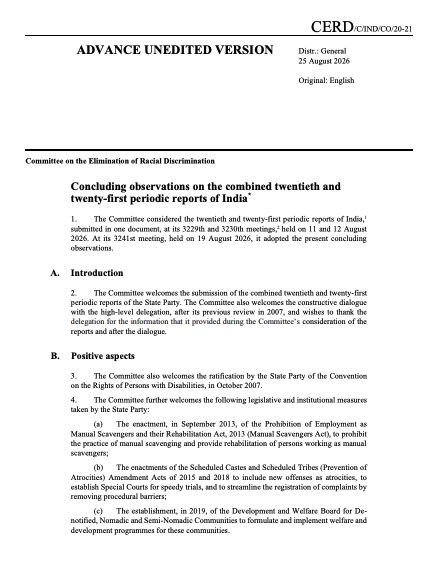
The UN Committee on the Elimination of Racial Discrimination (CERD) has raised serious concerns about India’s immigration detention laws and practices, echoing many of the concerns that the Global Detention Project (GDP) and the the Asia Pacific Refugee Rights Network (APRRN) raised in a submission to the committee.
Amongst the recommendations, CERD called on India to amend its Immigration and Foreigners Act, enacted in 2025, which empowers authorities to “arbitrarily arrest and detain migrants and asylum seekers without documentation with limited judicial oversight for an indefinite duration, and requires reporting by personnel working in health care and educational facilities.” Noting also the act’s criminalisation of irregular entry–which runs counter to international guidance, including the CERD’s 2025 Joint General Recommendation No.39–the committee called on India to:
“(a) Review its legislative framework, namely the Immigration and Foreigners Act, to align it with the Convention and ensure that migrants, asylum-seekers and refugees exercise their human rights without racial discrimination; (b) Decriminalize irregular entry and ensure that immigration detention is applied only as a measure of last resort and for the shortest possible period, after an assessment of its legality, necessity and proportionality on a case-by-case basis.”
The committee also noted the abusive raids targeting Rohingya and Bengali-speaking Muslims, following central government orders to state authorities to identify, detain, and remove specific populations. These concerns closely reflected evidence documented by the GDP and APRRN in the joint submission, which highlights numerous incidents, including the detention of more than 1,000 people suspected of being “illegal Bangladeshi immigrants” in Ahmedabad and Surat between April and July 2025. The committee also raised concerns about reports of widespread detention in inhumane conditions and removals that violate the principle of non-refoulement.
Amongst numerous recommendations, the committee urged Indian authorities to:
“(a) Refrain from collective expulsion and provide access to its territory for migrants and asylum-seekers in need of international protection, in respect of the principle of non-refoulement; (b) Adopt measures to improve the living conditions in detention facilities for migrants and asylum-seekers in accordance with international standards, and ensure that all persons detained in those facilities have access to medical care, interpreters and adequate food and drinking water.”
Ongoing Evidence of Detention in Abusive Conditions
India has issued an official statement in response to the CERD’s review in which it rejects the recommendations and refuses to take responsibility for the alleged abuses. In the statement, issued by India’s Ministry of External Affairs, the government states that “India rejects any politically motivated highly malicious referenced in the report with all the contempt that it deserves.” The statement claims that CERD makes “sweeping generalizations” and “unsubstantiated allegations” that “exceed the Convention’s mandate.”
Importantly, CERD has recently issued an expert interpretation of the Convention as it relates to rising xenophobia around the globe in which it denounces the use of immigration detention. In particular, it states that “immigration detention is always harmful and disproportionate as an interim measure during administrative procedures” and that states parties should take appropriate measures to “abolish migration-related detention policies and practices.”
CERD’s review of India also comes as recent reports reveal the surging arrests of migrants, refugees, and asylum seekers, and acute concerns about the country’s detention and removal practices. Among those being targeted are trafficking victims from African countries, according to journalist Pari Saikia, who has published a series of articles in The Guardian and other outlets about the plight of these victims. Women from Uganda, Kenya, and Tanzania have been trafficked to India under false promises of education or employment only to find themselves detained indefinitely, often with their children, in India.
“Lily*, 27, a Ugandan survivor of sex-trafficking, has been held since she was arrested in a police raid in April 2025. At 3am, Lily and her sons, aged two and four, were woken by banging on the door. “My children woke up terrified. Before I could respond, nine policemen broke the lock and stormed in,” says Lily. The officers said her visa was invalid and put the family into a van. “Three hours later, they dropped us at a detention centre near Bengaluru,” says Lily, speaking from the centre, where she is still being held more than a year later.” (The Guardian, 2 July 2026).
Saikia raises particular concerns regarding conditions in Delhi’s detention facilities (specifically, Lumpur Male Detention Centre and Sewa Sadan Female Detention Centre) and Karnataka’s Tumkur Female Detention Centre and Home of Hope (Auto Raja Detention Centre)–and reports instances of detainees being beaten with sticks, denial of medical care (including refusing to provide antiretrovirals), and extortion.
In an email to the GDP, Saikia observed that “in Delhi’s detention centres, African women have been beaten for asking when they can go home, while African men with valid exit documents and tickets have reportedly been stopped from leaving for airports after refusing to pay bribes. This is not just cruelty, but rampant corruption and abuse of power. No person should have to pay for their freedom.”
Further, she noted that “the situation extends far beyond these cases–to refugees from Sudan, Somali, Afghanistan, Cameroon, and Congo, who are currently subjected to forcible detention in Delhi despite having UNHCR refugee cards. Deportation is not viable due to active conflict and instability in their countries of origin. Yet many remain in indefinite detention without any updates on their legal status. This requires urgent investigation.”