On 1 August, the European Court of Justice delivered a landmark ruling on Italy’s application of the “safe country of origin” concept, delivering a blow to the country’s offshore asylum processing scheme in Albania. The ruling was quickly criticised by authorities in Rome, with Meloni’s office claiming it “reduc(es) the already limited” capacity of the government to take decisions on migration. The ruling also has wider implications across Europe, where it is likely to impact new EU asylum regulations due to come into force in 2026, as well as EU Member States’ efforts to externalise migration management schemes.
The ECJ Ruling
On 1 August, the European Court of Justice (ECJ) issued a landmark ruling in joined cases C‑758/24 (Alace) and C‑759/24 (Canpelli) clarifying rules on how EU member states can designate “Safe countries of Origin” (SCoO).
The cases concerned two Bangladeshi nationals who had been intercepted at sea, on a boat from Libya, before being detained in the Italian-operated Gjadër detention centre in Albania. However, their fast-tracked asylum applications were rejected due to Bangladesh being designated a SCoO by Italy. Arguing that Bangladesh would not be safe for them, the cases held that rigidly labelling Bangladesh as “safe” without permitting applicants access to legal remedy breached EU law. In particular, they said that the “safe country” designation denied them a fair appeal, lacked transparent evidence, and failed to allow exceptions for people at real risk of persecution.
The August ECJ ruling held that under EU law, SCoO designations must remain subject to judicial review, and applicants must be allowed to challenge the presumption based on their own individual circumstances. Moreover, the ECJ ruled that member states can only designate a country as “safe” if “the entire population” is protected across all regions, that SCoO designation must be based on information sources that are accessible to both the asylum seeker and the court in charge of the review, and that
Impact on Italy’s Offshore Detention Scheme
Critically, the ECJ’s ruling impacts Italy’s efforts to process asylum applications offshore in Albania–as the scheme relies heavily on the SCoO concept to justify fast-tracked asylum decisions.
The EU Asylum Procedures Directive (2013/32/EU) provides that “all applications for international protection made in the territory, including at the border, in the territorial waters or in the transit zone of the Member States” are to be assessed in Member State’s territory. To bypass this, in 2023 Italy agreed with Albania that it could send migrants and asylum seekers intercepted at sea outside Italy’s territorial waters to processing centres in Albania. Although located on Albanian soil, these centres would be “subject exclusively to Italian jurisdiction.”
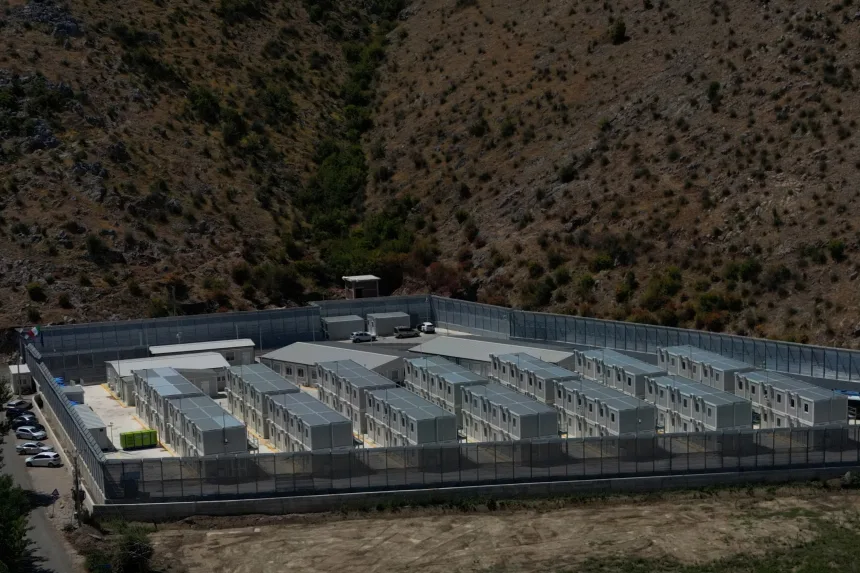
Under this arrangement, migrants and asylum seekers are to be taken to the Shëngjin Migrant Processing Center where they undergo medical examinations and identification procedures, asylum applications are registered, and vulnerable individuals should technically be identified. Those “fit for detention” are transferred to Gjadër Detention Centre, where asylum claims are to be decided within 28 days. Those whose applications are approved are to be returned to Italy, while those who are rejected are swiftly processed for deportation: anyone from a SCoO refused asylum is expected to be reported within a week.
Speed lies at the heart of the scheme: asylum applications are to be processed quickly, with the SCoO concept used to reject applications based purely on nationality and to limit the need for individual assessments as well as applicants’ right to appeal. By invalidating Italy’s use of the SCoO in its automatic form–and instead requiring authorities to redefine its list of “safe” countries, permit judicial review, and allow applicants to challenge “safe country” designation– the ECJ ruling has removed the key engine behind the Italy-Albania deal.
Italian authorities quickly condemned the ruling, with Meloni’s office claiming that it allows judges to dictate policy on migration, “reduc(ing) the already limited” capacity of parliament and government to take decisions on the matter. Observers argue that the ruling highlights “a widening legal gap between national migration enforcement policies and EU legal obligations.”
Given the ECJ’s ruling, it is unlikely that many–if any–asylum seekers will have their applications processed in Italy’s Albanian facilities any time soon. But empty cells will not be a new feature here: since the centres opened, beds have largely remained unoccupied–despite observers estimating that the scheme is costing some 800 million EUR over five years, and seven times more than an equivalent facility in Italy. Multiple court rulings in Italy have meant that the small numbers of migrants and asylum seekers sent to the centres have so far been returned to Italy. Between October 2024 and January 2025, three groups (totalling 73 persons) were transferred there, but were quickly ordered to be returned to Italy when Italian magistrates refused to validate their detention there.
In response to the centres lying largely unused, in March this year the Italian government passed a decree to expand the remit of the centres, allowing them to be used as repatriation hubs for asylum seekers whose applications have been assessed and rejected inside Italy. This latest development mirrors the EU’s broader proposal of placing “return hubs” in third countries (a concept the European Commission proposed in March 2025 as part of a new Return Regulation) –although the Italian-Albanian model retains Italian jurisdiction, while the European Commission’s proposal does not provide clear jurisdiction on the part of Member States.
As ActionAid commented: “Although formally different, the Albania model and European return hubs share the same logic: governing migrant bodies through detention, marginalisation and the use of grey legal spaces, where protections are minimal or absent. Both reduce access to asylum, increase detention, and empty fundamental rights of meaning.”
Wider European Impact
The ECJ ruling may also impact wider efforts by European states to develop their own offshore schemes. As well as the European Commission’s proposal, various European states have individually sought to develop their own offshore asylum processing schemes as well as “return hubs”–part of a wider shift amongst migrant-receiving states to externalise migration management. In 2024 for example, the German government announced that it was exploring offshore models. According to the Financial Times, Germany has also conducted talks with Rwanda to replicate the now-shelved UK-Rwanda scheme, and the Netherlands has reportedly explored the idea of sending rejected asylum applicants to Uganda. The ECJ ruling underscores that asylum and return procedures must occur within the EU legal framework, suggesting that transferring applicants offshore without full legal protections may violate EU law.
New EU asylum regulations, which are due to come into effect in June 2026, may also be impacted by the ruling. An integral component of the broader EU Pact on Migration and Asylum, the new asylum regulations will enable Member States to fast track asylum procedures for applicants from specific “safe countries,” including by permitting simplified examinations of such asylum claims, shortening timeframes, and limiting access for applicants to legal or other support. On 16 April, the EC included countries such as Bangladesh, Colombia, Egypt, Morocco, and Tunisia in its proposed list of “safe countries.”
This has attracted widespread criticism from rights groups. According to the European Public Service Union, “There is no public evidence that human rights organisations were consulted in developing the list, and the studies cited by the European Commission are not publicly available.” Amnesty also noted: “As an aspect of the right to seek asylum, anyone who applies for protection in the EU should have their claim assessed individually and on its own merits – regardless of where they are fleeing from. The application of the ’safe country of origin’ rule undermines the individual assessment of asylum claims and increases the risk of individual vulnerabilities and protection needs being missed.”
The ECJ ruling, which requires “safe country” designations to be based on transparent, evidence-backed assessments, and mandates individualised assessments and the right to appeal—even in fast-track procedures—is thus likely to have a significant impact at the EU level. As Amnesty International’s Migration Researcher commented: “The ECJ’s ruling is a welcome wake-up call for EU member states seeking to expand migration control to the detriment of migrants and refugees’ rights. It sets out key safeguards for people navigating asylum procedures, which should set the standard not only for Italy’s practice, but also the implementation of the EU’s Pact on Asylum and Migration.”
Broader Concerns Regarding Italy’s Offshore Detention
However, it is not just concerns regarding Italy’s expedited processing of asylum applications in Albania that have lead to observers challenging the scheme. The deal also entails de facto, arbitrary detention for an extended period of time. As Amnesty International noted in February 2024: “Individuals disembarked in Albania and brought to the centres there, including refugees and asylum seekers, would be automatically detained and unable to leave the centres for up to 18 months. Under international law, automatic detention is inherently arbitrary and therefore unlawful.” The GDP also reported in January that the European Committee for the Prevention of Torture has expressed concerns.
Having visited Italian detention centres (pre-removal centres – Centri di Permanenza per il Rimpatrio or CPRs), the CPT also noted its concerns that the poor detention conditions it had observed in Italy would be replicated in Albania. “The findings of the 2024 visit outlined in this report, notably in relation to the very poor material conditions, absence of regime of activities, disproportionate security approach, variable quality of healthcare provision, as well as the complexity of the management of CPRs by private contractors, call into question the very use of such a model in Albania.”
On 22nd November 2024, four Volt Europa MEPs visited the centres. Commenting afterwards, a Dutch MEP described “rain dripping from the ceiling. So a bucket was standing there because it was already leaking.” She also noted the fact that the medical unit was still being constructed in Gjadër Detention Centre, despite the facility already being open–raising concerns regarding safeguards in the centre.
During a separate monitoring visit, Tavolo Asilo e Immigrazione and the Parliamentary Contact Group on Immigration, noted the absence of the IOM in conducting screening and vulnerability assessments (the Italian government designated the IOM as the entity responsible for this)–and expressed concern that instead it was being conducted by military doctors.